
Libido vs Erectile Function: Desire vs Performance in Men—Understanding the Brain-Body Connection
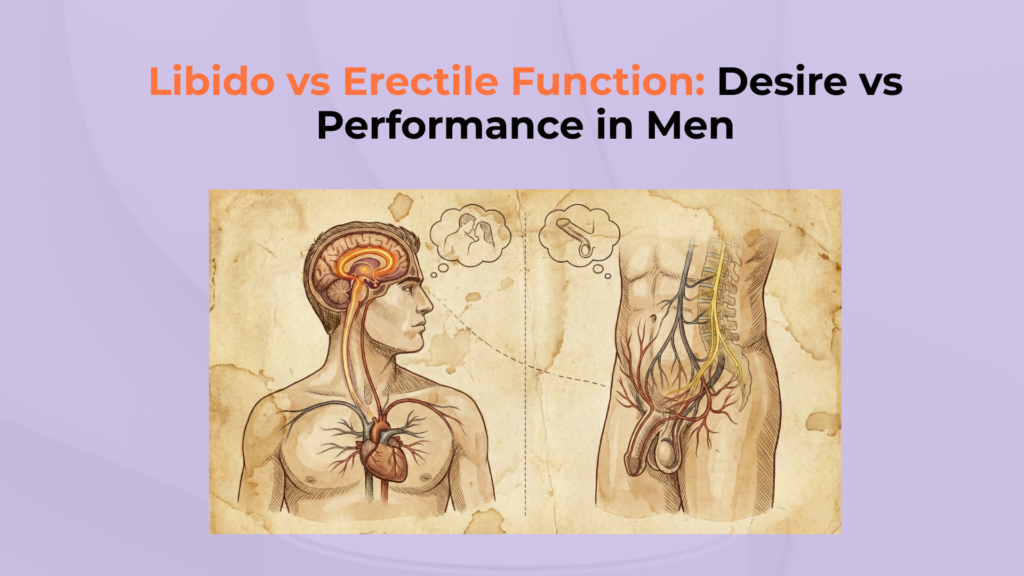
The distinction between Libido and Erectile Function lies in the separation of the psychological “mental appetite” for intimacy from the physical “mechanical ability” to perform [LE1]. Libido is the motivational engine; Erectile Function is the vascular execution.
Locating whether failure is motivational (brain) or mechanical (penile hemodynamics) determines the next best step for treatment.
If you want the clean clinical definition of “libido” (what it is and what it isn’t), start with Male Libido because most confusion comes from mixing desire (“wanting”) with performance (“mechanics”).
If you’re trying to classify your desire style (spontaneous vs responsive vs situational), use Male Sex Drive first—then you can interpret whether a “low libido” complaint is actually a normal shift in trigger-dependence.
Since this article focuses on the brain-vs-body split, the closest companion piece is Libido vs Erectile Function , which maps desire failure vs erection failure into distinct next-step pathways.
Erectile dysfunction can be an early marker of Cardiovascular Health risk, while low libido often points to Hormonal Balance or psychological factors.
This guide is for educational purposes only. Erectile dysfunction can be an early marker of cardiovascular risk, while low libido may reflect hormonal or psychological imbalance. Consult a clinician for diagnosis.
Desire vs. Performance: At a Glance
- Libido: The “Engine.” A motivational state; for the core definition and boundaries, see Male Libido .
- Erectile Function: The “Wheels.” A performance system; if desire and performance are mismatched, use Libido vs Erectile Function to route the cause correctly.
- Key Check: Desire without erection often means the problem is primarily performance-side; start with Erectile Dysfunction and Libido to see how ED can exist even when desire is intact.
- Key Check: Erection without desire often means the motivation system is muted; compare Spontaneous Libido vs Responsive Libido so you don’t mislabel a responsive-only pattern as “low libido.”
What Is the Fundamental Distinction Between Libido and Erectile Function?
The fundamental distinction is that Libido is a proactive motivational state, while Erectile Function is the physical execution of erection mechanics. To understand sexual health, one must differentiate between Incentive Salience (the desire to act) and Genital Tumescence (the physical readiness) [LE7], [LE2].
If your “wanting” feels offline (low incentive pull), your first job is to classify the libido phenotype and its drivers—use Low Libido in Men plus Libido Variability in Men to separate a true drop from normal fluctuation.
Defining Libido (The Mental Appetite)
Libido is the “desire” or “drive” for sexual activity, operating as a biopsychosocial state of wanting intimacy [LE1].
It is regulated primarily by the brain’s reward centers (Dopamine) and the hormonal baseline (Testosterone) [LE7].
For the two most common upstream “engine” levers—hormonal permissive readiness and motivation tone—see Testosterone and Libido and Dopamine and Libido in Men , because low fuel and low spark can look identical subjectively.
Levine notes that desire is a complex force integrating biology, psychology, and social context [LE1].
Male libido generates the psychological urge for sex, initiating the search for or response to sexual stimuli.
Defining Erectile Function (The Physical Execution)
Erectile function is the mechanical ability to achieve and maintain a firm erection, defined as a neuro-vascular event [LE2].
It is driven by blood flow (Nitric Oxide) into the corpora cavernosa and the subsequent trapping of that blood (Veno-occlusion).
If the concern is “performance” rather than desire, anchor the differential in how ED interacts with libido—start with Erectile Dysfunction and Libido and then use ED Treatment (Libido Context) to avoid treating the wrong system first.
Dean & Lue define this as a hemodynamic process dependent on arterial inflow exceeding venous outflow [LE2].
Erectile function converts mental or physical arousal into a rigid, functional erection.
How Does the Biological “Engine” Differ for Desire and Performance?
The biological “engine” differs in that Libido relies on slow-acting neuro-hormonal modulation, while Erectile Function activates quickly through neuro-vascular signaling [LE3]. Think of Libido as the fuel in the tank (potential energy) and Erectile Function as the transmission and wheels (kinetic delivery).
The Neuro-Hormonal Drivers of Libido
The primary drivers of Libido are Testosterone, which acts as a permissive fuel, and Dopamine, which acts as the motivational spark [LE4], [LE7].
Libido is a “slow” system influenced by mood, energy levels, and long-term hormonal balance.
If libido fell during overload, treat it like a “brakes engaged” pattern—see Cortisol and Libido , Chronic Stress and Libido , and Burnout and Libido because inhibition can suppress desire even when attraction and relationship quality are unchanged.
If sleep is disrupted, libido often becomes more variable and less spontaneous—use Sleep Deprivation and Libido and Insomnia and Libido to connect sleep physiology to desire patterns.
Pfaus demonstrates that dopamine pathways in the brain are essential for sexual incentive motivation [LE7].
Adequate testosterone levels support reward responsiveness, strengthening the subjective experience of sexual motivation.
The Vascular and Neural Drivers of Erectile Function
The primary drivers of Erectile Function are Nitric Oxide, cGMP, and the Cavernous Nerves (Autonomic system) [LE2].
Nitric Oxide initiates smooth muscle relaxation → raises cGMP → increases inflow → Veno-occlusion sustains rigidity [LE2].
The AUA Guidelines confirm this vascular cascade is the target of most ED medications (PDE5 inhibitors) [LE3].
This explains why you can want sex but fail physically if the vascular “wheels” are broken.
Can You Experience One Without the Other? (Scenarios)
You can experience one without the other because desire pathways and genital reflex arcs can operate semi-independently [LE8]. This is often referred to as “Sexual Discordance.”
Scenario A: High Libido, Low Erectile Function (The “Willing but Weak”)
In this scenario, desire is present, but rigidity fails—consistent with Erectile Dysfunction (ED) patterns [LE3].
Common causes include Cardiovascular Disease, diabetes, medication effects, or performance anxiety [LE5].
Jackson highlights that ED is often a “canary in the coal mine” for systemic vascular issues, occurring even when libido is intact [LE5].
Strong psychological desire signals for an erection, but is blocked by impaired vascular integrity.
High desire with weak erections is a classic discordance pattern—use ED + Low Libido in Men to separate “performance failure causing secondary desire drop” from “primary low libido.”
Scenario B: Low Libido, High Erectile Function (The “Able but Uninterested”)
In this scenario, erection mechanics can remain intact (often signaled by NPT), while libido feels low or absent [LE8].
Common causes include Low Testosterone, depression, chronic stress, or Reward Desensitization.
Corona et al. distinguish these risk factors, noting that hypogonadism (Low T) specifically targets desire often before it destroys function [LE8].
Functional vascular mechanics allow for reflexive arousal, but lack the mental incentive salience to pursue the act.
Low desire with preserved function is usually upstream—start with Low Libido in Men and then check the common levers: Low Testosterone and Libido , Depression and Libido , and Anxiety and Libido .
What Common Factors Impact Libido vs. Erectile Function Differently?
Common factors impact libido and arousal differently depending on whether they target the brain’s reward center (Desire) or the body’s vascular system (Performance).
Factors That Primarily Kill Libido (Desire)
Factors that primarily kill Libido target neurochemistry and hormones, with Chronic Stress and Mood Disorders acting as primary suppressors [LE6].
Stress physiology (Cortisol) can suppress testosterone and dopamine function.
Hamilton et al. demonstrate that high cortisol correlates directly with lower sexual arousal and affect [LE6].
Low Testosterone specifically targets this “wanting” phase [LE4].
If medications are involved, libido and erections can shift through different mechanisms—start with SSRIs and Libido in Men (and if needed, Antidepressants and Libido ) before assuming the cause is “purely hormonal” or “purely performance.”
Factors That Primarily Kill Erectile Function (Performance)
Factors that primarily kill Erectile Function target Biology, specifically the vascular system and nerve integrity required for blood trapping [LE3].
Smoking and heavy alcohol use cause vascular constriction or nerve damage that physically prevents erection.
Jackson confirms that ED is a vascular disorder in the majority of cases, serving as a marker for systemic disease [LE5].
Damage from pelvic surgery or spinal injury physically blocks the signal, regardless of desire.
[Checklist] Auditing Your Sexual Health: Desire vs. Performance
Use this functional audit to determine if your primary issue lies with mental “wanting” (Libido) or physical “performance” (Erectile Function).
Functional and Health Audit
- □ Mental Check: Do you experience spontaneous sexual thoughts? (If NO → route to Low Libido in Men and then classify whether you’re actually Responsive-Only or Situational —two patterns that can be mislabeled as “low.”)
- □ Stimulus Check: Does direct stimulation trigger erection? (If NO → check the interaction pathway in Erectile Dysfunction and Libido and then route to ED Treatment (Libido Context) .)
- □ Morning Check: Do you wake up with “morning wood” (NPT)? (If YES → Mechanics intact; issue is Mental/Libido) [LE3].
- □ Stress Check: Are you under extreme cognitive/emotional load? (Primarily kills Libido) [LE6].
- □ Discordance Check: Do you have desire in your mind, but performance fails in the moment? (If YES → this is often performance anxiety or learned inhibition; start with Performance Anxiety and Libido and then cross-check with Erectile Dysfunction and Libido .)
- □ Blood Work: Tested Total/Free Testosterone (for Libido) and Glucose/Lipids (for Erectile Function)? [LE4], [LE5].
- ⚠ Safety Rule: ED can be a marker of cardiovascular risk; Low Libido often signals endocrine/psychological context—both merit evaluation [LE5].
Choose the next page based on your pattern
- Desire is present, performance fails: start with Erectile Dysfunction and Libido then route to ED Treatment (Libido Context) .
- Performance is possible, desire feels muted: start with Low Libido in Men and the two most common levers: Testosterone and Libido and Chronic Stress and Libido .
- Libido is inconsistent day-to-day: classify normal variability vs a warning pattern with Libido Variability in Men and Fluctuating Libido in Men .
References & Citations
- [LE1] Levine SB. (2002) “Reexploring the concept of sexual desire.” PubMed
- [LE2] Dean RC, Lue TF. (2005) “Physiology of Penile Erection…” PMC
- [LE3] Burnett AL, et al. (2018) “Erectile Dysfunction: AUA Guideline.” J Urol
[LE4] Bhasin S, et al. (2018) “Testosterone Therapy… Endocrine Society Guideline” JCEM - [LE5] Jackson G, et al. (2010) “The second Princeton consensus on sexual dysfunction and cardiac risk” J Sex Med
- [LE6] Hamilton LD, et al. (2008) “Cortisol, sexual arousal, and affect…” PubMed
- [LE7] Pfaus JG. (2009) “Pathways of sexual desire.” J Sex Med
- [LE8] Corona G, et al. (2013) “Risk factors associated with primary and secondary reduced libido…” J Sex Med


One Response