Does Erectile Dysfunction Reduce Libido in Men?
Erectile dysfunction sometimes contributes to lower libido through distress, anxiety or relationship strain, but an erection problem does not automatically reduce sexual desire. ED and low libido also share some underlying causes. The order in which symptoms developed helps guide assessment. [1]
Erectile dysfunction and libido assessment examines whether erection difficulties preceded reduced desire. The ED with low libido guide assesses both symptoms together without assuming that one caused the other.
How does erectile dysfunction differ from low libido?
Erectile dysfunction concerns getting or keeping an erection firm enough for sex; libido concerns sexual desire. A man with ED still sometimes wants sex. A man with low desire sometimes retains the physical capacity for an erection. These patterns require different questions. [2]
| Reported pattern | What it describes | What it does not prove |
|---|---|---|
| Wants sex but loses firmness | An erection problem with retained desire | That libido is low or testosterone is deficient |
| Avoids sex because he fears erection difficulty | Avoidance associated with an anticipated problem | That attraction or desire has disappeared |
| Reports both reduced desire and erection difficulty | Two sexual symptoms needing assessment | That one symptom caused the other |
Use the words that describe your experience. “I want sex but worry about my erection” communicates a different concern from “I rarely feel interested in sex.” Neither statement determines the diagnosis on its own.
How does erection-related anxiety affect male libido?
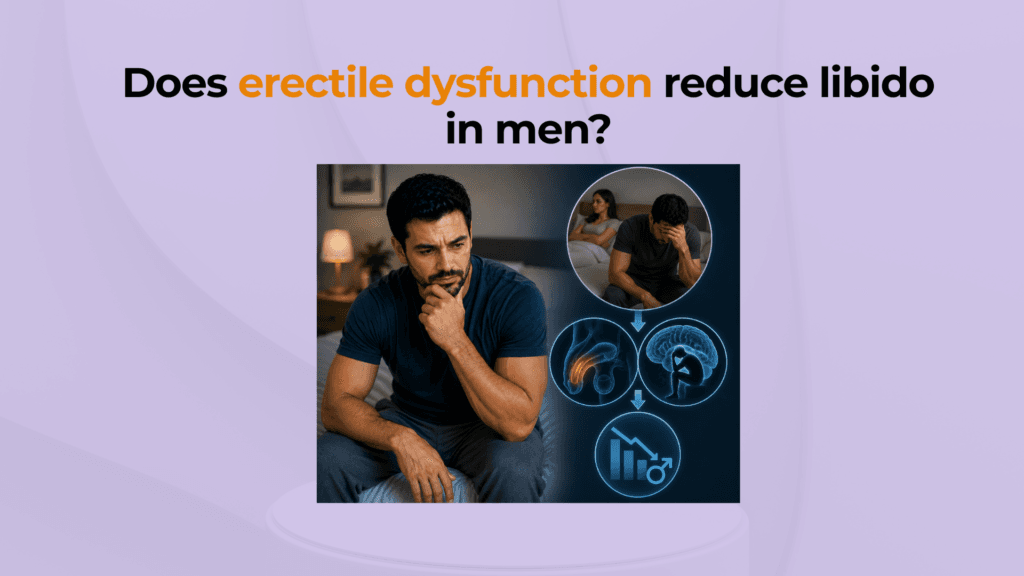
Erection-related anxiety sometimes affects male libido by making sexual activity stressful. ED also creates relationship strain or reduced confidence. These reactions deserve assessment alongside physical causes; they do not mean an erection problem is imagined. [1] [3]
Describe whether you still have sexual thoughts, whether you avoid situations you previously enjoyed, and whether concern centres on erection reliability. This history distinguishes reduced interest from avoidance. A rigid sequence of “ED causes anxiety, then low libido” should not be assumed for every man.
Which shared causes explain ED and low libido?
Shared causes of erectile dysfunction and low male libido include testosterone deficiency, depression and medication effects. Diabetes, vascular disease or nerve injury also cause erection problems, but their presence does not prove that sexual desire is reduced. [1] [3]
Testosterone is one possible contributor rather than a conclusion drawn from ED. The Endocrine Society requires compatible symptoms and consistently low testosterone concentrations, confirmed with repeat morning fasting testing. A single random low value is insufficient for that diagnostic process. [4]
For the assessment of both symptoms together, read ED and low libido in men. For the meaning of desire itself, read what male libido means.
Can ED medicines restore male libido?
ED medicines support erections rather than directly creating male libido. Tadalafil increases penile blood flow during sexual stimulation; MedlinePlus states that it does not increase sexual desire. Persistent low interest needs its own review even when erection treatment works. [5]
Assess the outcomes separately: erection firmness, sexual interest, distress and relationship satisfaction. Better firmness alone does not establish restored desire. Tell the prescriber which outcome remains troublesome instead of increasing the dose to treat an unaddressed libido problem.
Tadalafil requires medication safety review, particularly with nitrates or riociguat. An erection lasting more than four hours requires urgent medical care. Chest pain during sexual activity requires immediate medical advice or emergency treatment; tell clinicians when the medicine was last taken. [5]
What assessment helps when ED seems to reduce libido?
Assessment of ED with changing libido begins with the timing, context and severity of each symptom, followed by a medical and sexual history. Clinicians also review medicines and perform an examination or targeted tests. A chronology helps; it does not prove causation. [6]
- Record the sequence: Describe when erection difficulty started and when interest changed.
- Compare contexts: Describe partnered sex, masturbation and spontaneous or morning erections.
- List changes: Include new medicines, dose changes, mood symptoms and major stressors.
- State the goal: Explain whether you want better firmness, more interest, less worry or help with several concerns.
The EAU recommends assessment of cardiovascular risk and relevant metabolic or hormonal findings in men with ED. Testing includes glucose or HbA1c, lipids and early morning fasting total testosterone when not already appropriately assessed. Further tests depend on the clinical findings. [7]
What treatment helps when ED and low libido interact?
Treatment of interacting ED and low libido follows the identified contributors, with separate attention to erection function and sexual interest. EAU guidance supports ED treatment and psychological approaches when indicated. A combination is appropriate when physical and psychological factors coexist. [7]
Agree on measurable goals with the clinician: fewer troublesome erection failures, less distress, or improved interest in wanted sexual activity. A treatment for one symptom should not silently become a promise to resolve every sexual concern.
Review suspected medicine effects with the prescriber rather than stopping treatment yourself. Ask for help when ED persists or desire changes concern you. ED deserves medical assessment even when embarrassment seems to be its main consequence. [1]
References for erectile dysfunction and male libido
These ED and libido references support definitions, assessment and treatment boundaries. They do not establish a universal percentage of men whose erection difficulty causes low desire.
- MedlinePlus: Erection problems.
- NIDDK: Definition and facts for erectile dysfunction.
- NIDDK: Symptoms and causes of erectile dysfunction.
- Endocrine Society: Testosterone therapy for hypogonadism guideline.
- MedlinePlus: Tadalafil drug information.
- NIDDK: Diagnosis of erectile dysfunction.
- EAU: Management of erectile dysfunction.