Do Omega-3s Support Libido in Men?
Omega-3 supplements are not an established treatment for low male libido; vascular and testosterone findings do not demonstrate increased sexual desire. Libido means interest in sexual activity. The evidence below separates desire from blood-vessel function, hormone measurements and supplement safety.
What does omega-3 research show about male libido?
Omega-3 research cited here does not establish a direct male libido benefit because it measures vascular function or testosterone rather than sexual desire. A change in a related biological marker is not proof that men want sex more often or more strongly.
| Study | Population and duration | Measured result | Libido interpretation |
|---|---|---|---|
| Arabi et al., 2024 [1] | 32 studies; 2,385 participants; 4–48 weeks | Brachial artery flow-mediated dilation increased by 0.8 percentage points; 95% CI 0.3–1.3 | Measured an arm-artery response, not sexual desire or penile erections |
| Abbott et al., 2020 [2] | Secondary trial analysis; 61 participants, including 22 men; 12 weeks | DHA-rich fish oil increased total testosterone in the male subgroup after adjustment | Measured a hormone outcome in overweight or obese men, not libido improvement |
The vascular analysis reported substantial variation between studies (I² = 82.5%). Its pooled result does not predict an individual’s response. The hormone analysis included only 22 men and was secondary to an insulin-resistance trial. Neither result establishes an omega-3 libido dose. [1][2]
Do omega-3 effects on blood vessels prove better libido?
Omega-3 effects on blood vessels do not prove better male libido because vascular function and sexual desire are different outcomes. Flow-mediated dilation measures how an artery widens in response to increased blood flow. It is not a sexual desire questionnaire. [1]
Erectile function concerns obtaining and maintaining an erection; libido concerns wanting sexual activity. For example, a man who wants sex but loses erections has a different symptom from a man with reliable erections and little interest. Read libido versus erectile function.
Do omega-3s raise testosterone enough to treat low libido?
Omega-3s do not replace testosterone-deficiency assessment or treatment for low male libido. The small DHA trial found a testosterone change in a selected male subgroup. It did not demonstrate that fish oil treats symptomatic testosterone deficiency or increases desire in men with normal levels. [2]
Testosterone deficiency requires compatible symptoms and consistently low measurements. The Endocrine Society recommends confirmation with repeat morning, fasting total testosterone testing. Low desire alone does not establish this diagnosis. See low testosterone and libido. [3]
Which omega-3 sources are relevant to a man’s diet?
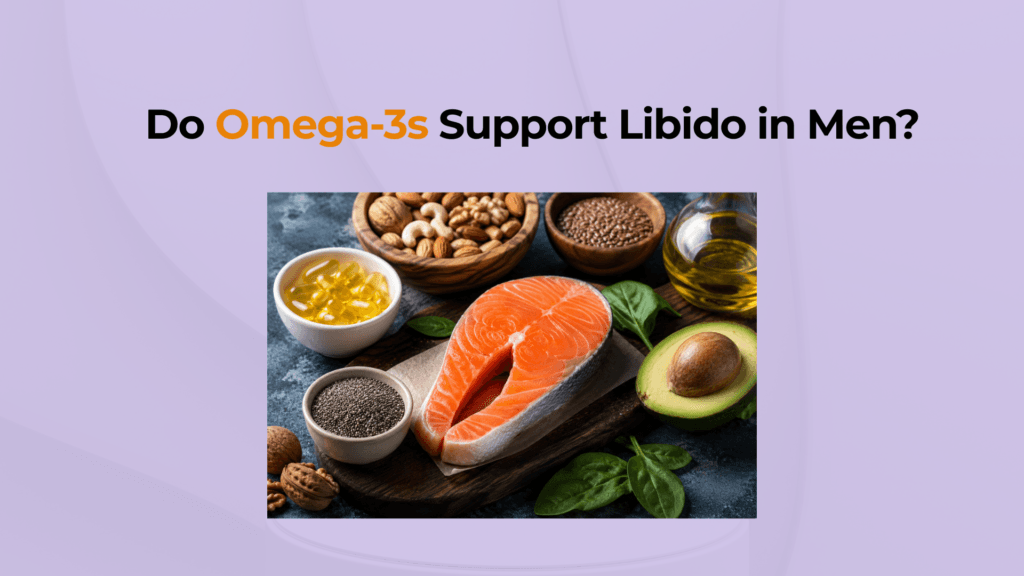
Omega-3 food sources support nutrition, but they carry no established male libido treatment claim. Fish supplies eicosapentaenoic acid (EPA) and docosahexaenoic acid (DHA). Flaxseed, walnuts and plant oils supply alpha-linolenic acid (ALA). The body converts only small amounts of ALA into EPA and DHA. [4]
- Choose fish sources: Include salmon, sardines, trout or mackerel within a suitable dietary pattern.
- Recognize plant sources: Use walnuts, flaxseed or canola oil for ALA.
- Read supplement labels: Identify EPA and DHA amounts per serving rather than assuming total fish-oil weight equals active omega-3 content.
What omega-3 dose increases male libido?
No established omega-3 dose increases male libido. The adequate intake for adult men is 1.6 g/day of ALA, a nutrition reference rather than a fish-oil or libido prescription. EPA, DHA and ALA are different fatty acids; their amounts are not interchangeable. [4]
A supplement decision should address a defined dietary or medical need. A clinician selects prescription omega-3 treatment for an appropriate indication; a dose used for blood lipids does not become a treatment for reduced sexual desire.
What risks matter when using omega-3s for libido?
Omega-3 use for libido carries supplement risks without an established desire benefit. Common adverse effects include unpleasant taste, heartburn, nausea and diarrhea. Trials using 4 g/day for several years found a small increase in atrial fibrillation among people with cardiovascular disease or high cardiovascular risk. [4]
A 2024 analysis of 11 randomized trials and 120,643 participants found no significant overall bleeding increase: rate ratio 1.09, 95% CI 0.91–1.31. This pooled finding does not remove the need to review the formulation, dose and anticoagulant use with a clinician. [5]
- Report medicines: Tell the clinician about anticoagulants and other regular prescriptions.
- Discuss heart rhythm: Mention a history of atrial fibrillation before considering high-dose supplements.
- Avoid dose escalation: Do not increase omega-3 intake to chase an unproven libido effect.
When should low male libido receive assessment?
Low male libido warrants assessment when a change persists, causes concern or affects a relationship. Omega-3 supplementation should not delay a review of medicines, mood, stress, sexual difficulties and relevant medical conditions. Treatment addresses the cause identified in that review. [6]
Record the timing of reduced desire and distinguish it from erection difficulties. Include new medicines, sleep changes and mood symptoms in the history. The low libido guide explains these assessment questions.
References for omega-3s and male libido
These omega-3 references report vascular, hormone and safety outcomes. Their results do not establish a direct treatment effect on male libido.
- Arabi et al. Omega-3 fatty acids and endothelial function: a GRADE-assessed systematic review and meta-analysis. European Journal of Clinical Investigation. 2024.
- Abbott et al. DHA-rich fish oil and testosterone in overweight and obese men. Prostaglandins, Leukotrienes and Essential Fatty Acids. 2020.
- Endocrine Society: Testosterone therapy for hypogonadism guideline.
- NIH Office of Dietary Supplements: Omega-3 fatty acids fact sheet.
- Javaid et al. Bleeding risk in patients receiving omega-3 polyunsaturated fatty acids. Journal of the American Heart Association. 2024.
- NHS: Low sex drive.