
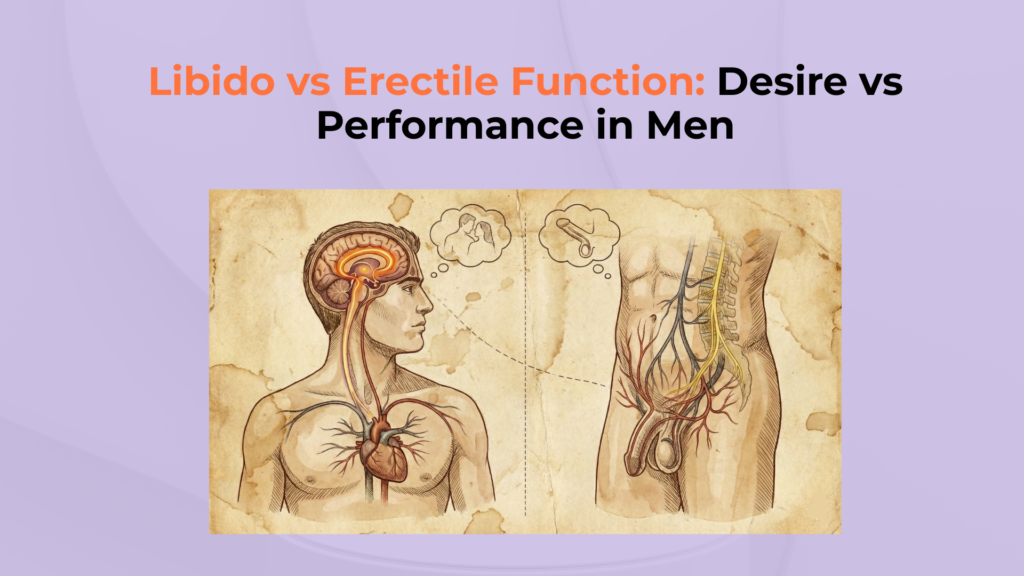
Libido vs erectile function: what is the difference?
Libido means sexual desire; erectile function means the ability to achieve and maintain an erection. Reduced desire and erection difficulty are different complaints. They also occur together, so an assessment should describe both. [1]
How do libido and erectile dysfunction differ?
Libido concerns wanting sexual activity; erectile dysfunction concerns recurrent difficulty getting or keeping an erection sufficient for sexual activity.
| Feature | Libido | Erectile function |
|---|---|---|
| Main question | Do I want sexual activity? | Can I achieve and maintain an erection? |
| Reported change | Less interest or fewer sexual thoughts. | Less reliable rigidity or maintenance. |
| Assessment detail | Compare interest across time and contexts. | Describe when erection difficulty occurs. |
| Limit | Does not measure hormone concentrations. | Does not establish desire or consent. |
Libido and erections should not be divided into a purely “mental” problem and a purely “physical” problem. NHS guidance lists psychological symptoms, hormone problems, medication effects and conditions such as diabetes among contributors to erection difficulties. The complaint identifies what changed; it does not identify its cause. [1]
Can men have libido without a reliable erection?
Men can want sexual activity while experiencing erection difficulty; interest does not guarantee a sufficiently firm or sustained erection.
For libido with erection concerns, describe wanting and the bodily response separately. “I felt interested, but the erection did not last” is more specific than “My libido failed.” This is an illustrative description, not a diagnosis of vascular disease or performance anxiety.
For recurrent erection difficulties, seek medical assessment. NHS guidance recommends discussing problems that keep happening, including relevant lifestyle and relationship circumstances and basic health checks. [1]
Can men have an erection without wanting sexual activity?
An erection does not establish sexual desire or agreement to sexual activity.
For libido assessment, describe the interest you felt rather than inferring it from rigidity. A physical response and a wish to continue are different observations. Read the libido and arousal comparison for the distinction between subjective experience and bodily response.
Libido also cannot be diagnosed from morning erections alone. NHS guidance notes that some men with erectile dysfunction still have erections on waking, depending on the cause. Preserved morning erections therefore do not exclude every erection problem. [1]
How do erection difficulties and libido concerns interact?
Erection difficulties and libido concerns interact in some men’s experiences, but the direction of that relationship requires an individual history.
For the experience of sexual difficulties, a Swedish qualitative study interviewed 18 men: ten with erectile dysfunction and eight with premature ejaculation or both. Participants described reduced desire and lower self-esteem among the consequences, and wanted medical treatment and counselling support. Interviews identify reported experiences; they do not establish how often every man develops low desire after erectile dysfunction. [2]
For libido and erections, report which change appeared first and whether both remain a concern. This helps describe the sequence without assuming that one symptom explains the other.
Do erection medicines directly treat low libido?
Erection medicines support erectile function; their mechanism does not establish that an underlying low-desire complaint has been treated.
For erection treatment, UCLH explains that sildenafil and tadalafil increase penile blood flow during sexual stimulation. These medicines require stimulation to help produce an erection. Their effect should not be treated as proof of improved desire. [3]
For libido alongside erectile dysfunction, discuss both treatment goals with the clinician. UCLH also lists psychosexual counselling and other specialist options for relevant erection concerns. The chosen approach depends on assessment. PDE5 inhibitors must not be combined with nitrate medicines because of dangerous blood-pressure reduction. [3]
What should a libido and erection assessment record?
A libido and erection assessment should record desire, erectile response, onset, context and the impact on the man.
- Describe sexual interest before and during an experience.
- Record difficulty achieving or maintaining an erection.
- Compare experiences alone and with a partner.
- Identify the order in which changes appeared.
- Review medicines, physical symptoms and relevant health history.
- Explain personal distress and relationship concerns.
For libido and erection concerns, these prompts organize a conversation; they do not form a home diagnostic test. Read the low-libido guide when reduced interest is the principal complaint.
Evidence sources for libido and erectile function
Libido and erection sources distinguish clinical guidance from men’s reported experiences.



One Response