What Is Spontaneous Libido in Men?
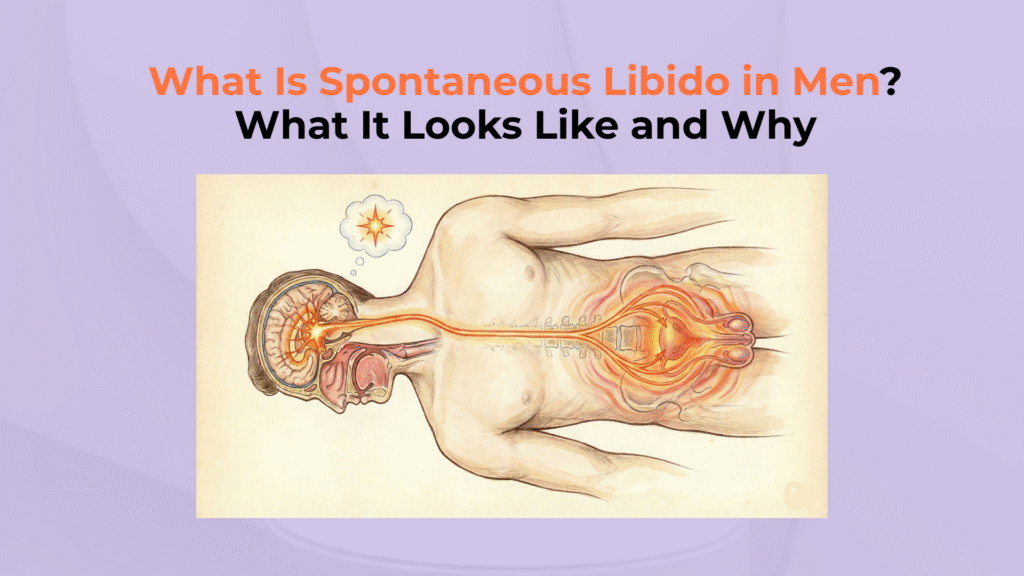
Spontaneous libido in men is sexual desire that appears before deliberate sexual stimulation or a partner’s initiation; it describes the timing of desire, rather than a hormone level or a measure of masculinity.
How does spontaneous libido differ from responsive desire?
Spontaneous libido starts with wanting sexual activity, whereas responsive desire develops during a welcome sexual or intimate interaction. Both patterns occur in men. A man’s interest also varies across situations, so one label does not explain every encounter.
A 2011 online survey of 2,215 men in Portugal and Norway identified spontaneous, responsive, and decreased desire patterns. The authors defined responsive desire through receptiveness to a partner’s initiation without initially wanting sex. Men with responsive and spontaneous patterns reported better sexual interest and satisfaction than men in the decreased-desire group. Štulhofer and colleagues, 2013.
Read the related explanation of responsive libido in men for the distinction between welcome stimulation and pressure to participate.
How common was spontaneous libido in the study?
Spontaneous libido accounted for 73.9% of this selected survey sample; that percentage is a study result, rather than a population estimate for all men.
- Included men aged 18–75 years, with an average age of 36.5 years.
- Classified 23.6% with decreased desire and 2.5% with the study’s responsive pattern.
- Excluded current antidepressant users, men previously diagnosed with erectile dysfunction, men without partnered sex in the previous year, and men reporting mainly or exclusively male partners.
These exclusions and online recruitment limit generalization. The 2.5% figure therefore does not establish how many men experience responsive desire in ordinary life. Study methods and findings.
What does spontaneous libido look like in daily life?
Spontaneous libido appears as an urge, fantasy, or interest in sexual activity before someone intentionally seeks stimulation. The following examples illustrate the definition; they are not diagnostic criteria.
- Notice a sexual fantasy while doing an unrelated task.
- Want to initiate consensual intimacy before a partner suggests it.
- Feel interest in solo sexual activity without first watching or reading sexual material.
Sexual thoughts do not establish a mandatory daily target. A seven-day study of 283 college students counted thoughts about sex, food, and sleep. Men reported more thoughts in all three categories, which challenges interpreting the difference as a uniquely sexual biological rule. The study did not establish a clinical minimum for sexual thoughts. Fisher and colleagues, 2012.
Does spontaneous libido mean an erection comes first?
Spontaneous libido means desire appears first in the person’s experience; an erection is a separate physical response and does not define that desire pattern.
Men’s experiences of sexual arousal include thoughts, feelings, and bodily changes. In six focus groups involving 50 men aged 18–70, participants described varied arousal cues and experiences. This qualitative evidence illustrates differences between men; it does not validate morning erections as a test of spontaneous desire. Janssen and colleagues, 2008.
Compare libido and arousal and desire and erectile function when describing a change.
Does spontaneous libido prove testosterone or dopamine is high?
Spontaneous libido does not measure testosterone or dopamine, and its absence does not establish a deficiency in either substance.
Desire is a broader motivational experience. Levine’s conceptual review describes forces that move a person toward or away from sexual behavior. It is a framework for understanding desire, rather than a blood-test threshold or a rule that men must feel an urge every 24–48 hours. Levine, 2002.
Read the separate guides to testosterone and libido and dopamine and libido for evidence and testing limits.
How should men describe a change in spontaneous libido?
Men should describe spontaneous libido by its timing, persistence, context, and effect on their lives, rather than comparing themselves with a fixed number of urges.
- Record when spontaneous interest changed and whether the change persists.
- Distinguish interest in partnered intimacy from interest in masturbation.
- Describe whether desire develops during welcome touch or intimacy.
- Note medication changes, sleep problems, mood symptoms, and erection difficulties.
- Discuss a persistent or distressing change with a clinician.
Use the low-libido guide to organize that discussion. A change from spontaneous to responsive desire describes an experience; it does not, by itself, diagnose a disorder.