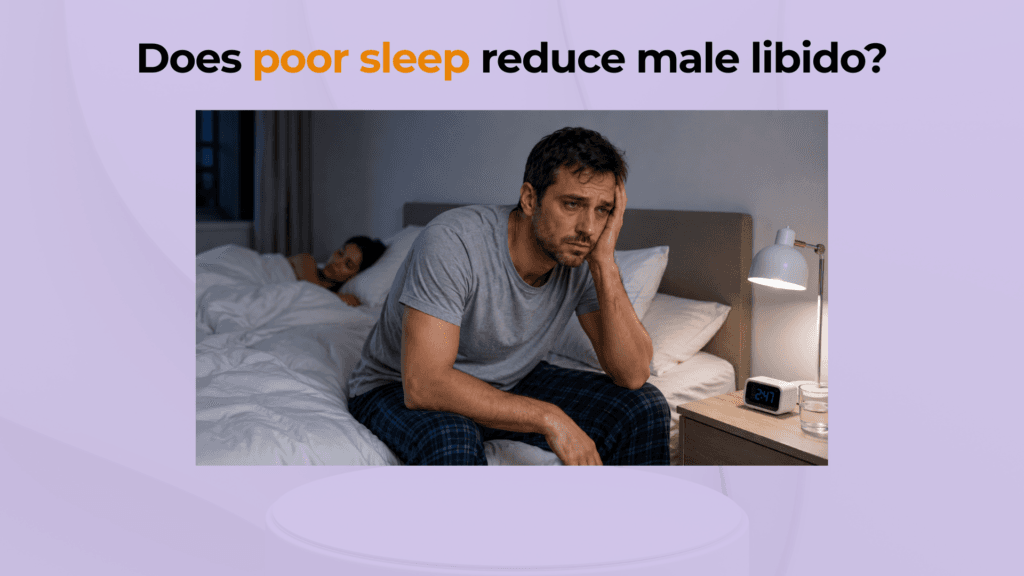
Does Poor Sleep Reduce Male Libido?
Poor sleep can reduce male libido, but the strongest wording is “can contribute to lower libido”, not “always directly causes it.” Sleep affects desire through energy, mood, stress-system activation, sleep apnea risk, and in some men, measurable changes in daytime testosterone.
Quick Answer
Yes. Poor sleep can reduce male libido by making the body and brain less ready for sexual desire. Short sleep may lower daytime testosterone in some men, fragmented sleep can increase fatigue and irritability, and sleep disorders such as obstructive sleep apnea can affect oxygenation, vascular function, mood, and sexual performance.
The key point is balance: low libido after several poor nights may improve with better rest, but persistent low desire should not be blamed on sleep alone without checking mental health, medication effects, relationship stress, testosterone status, and sleep-disordered breathing.
Medical Safety Notice
See a clinician if low libido persists for several weeks or appears with erectile dysfunction, depressed mood, severe fatigue, loud snoring, choking or gasping during sleep, morning headaches, infertility concerns, or symptoms of low testosterone. Hypogonadism should be diagnosed only when symptoms are present and testosterone is repeatedly low on appropriate testing.
Sexual desire in men depends on more than one hormone. Testosterone matters, but libido also needs enough sleep, emotional safety, adequate energy, healthy blood vessels, stable mood, and a brain that is not locked in a stress state. That is why poor sleep often shows up as low desire before a man notices a clear sexual “problem.”
For most men, one bad night causes temporary tiredness, not a permanent libido disorder. The concern rises when short sleep, insomnia, irregular sleep timing, or untreated sleep apnea becomes chronic. At that point, the body may spend more energy staying alert and less energy supporting sexual interest, arousal, and intimacy.
How Does Sleep Deprivation Lower Testosterone Levels?
Sleep deprivation may lower testosterone by disrupting sleep-dependent hormone timing, but the effect should be described carefully. A small JAMA study found that young healthy men restricted to 5 hours of sleep per night for one week had 10% to 15% lower daytime testosterone. Later research has not always found the same effect, so the safest conclusion is that short sleep can lower testosterone in some conditions, not that it always does.
Testosterone is not released in a flat line. Levels follow daily and sleep-related rhythms. During healthy sleep, the hypothalamus and pituitary help regulate pulsatile reproductive signaling, including luteinizing hormone, which stimulates Leydig cells in the testes. When sleep is shortened or fragmented, that timing can become less efficient.
Evidence-safe clinical data point
In the best-known acute sleep restriction study, 10 young healthy men slept 5 hours per night for one week, and their daytime testosterone fell by about 10% to 15%. This is strong enough to mention, but the article should also avoid adding unsupported claims such as “older men decline 15% to 20%” unless a specific source is provided.
For libido, the testosterone effect is only one layer. A man can have normal testosterone and still feel low desire if he is exhausted, anxious, depressed, overworked, or waking repeatedly through the night. A man can also have low testosterone from causes unrelated to sleep. That is why persistent low libido deserves a full evaluation rather than a single-cause assumption.
Because testosterone testing varies across the day, a clinician usually interprets symptoms together with properly timed repeat blood tests. Testosterone is part of the libido picture, but it should not be treated as the whole explanation for desire.
Stress Hormones, Cortisol, and Sexual Readiness
Poor sleep may increase stress-system activation, including changes in cortisol timing. The corrected article should not say that cortisol “directly occupies testosterone receptors” or “blocks testosterone receptor sites.” That wording is too mechanical and can be misleading.
A safer explanation is that poor sleep can keep the body in a more alert, threat-sensitive state. Higher stress arousal can reduce sexual interest, make erections harder to maintain, worsen mood, and interfere with the calm parasympathetic state that supports arousal. In this context, cortisol is best presented as part of the stress-sleep-libido loop, not as a simple receptor blocker.
What Are the Non-Hormonal Factors Linking Sleep and Desire?
Non-hormonal factors may be just as important as testosterone. Desire requires attention, emotional availability, physical comfort, and a sense that intimacy is rewarding rather than another demand. Chronic sleep debt weakens those conditions.
Fatigue and Emotional Readiness
Fatigue reduces emotional readiness for intimacy. When a man is sleep-deprived, the brain may prioritize rest, threat detection, food, work survival, or problem-solving over sexual connection. This can make touch feel irritating, sex feel like effort, and initiation feel less natural.
Poor sleep can also worsen irritability, anxiety, and low mood. These changes matter because libido is partly a motivational state. A man may still love his partner and still have reduced sexual interest if his nervous system is exhausted.
Sleep Apnea, Oxygen Drops, and Sexual Function
Untreated obstructive sleep apnea can affect sexual function through repeated awakenings, oxygen drops, daytime sleepiness, sympathetic activation, and vascular strain. Evidence is stronger for an association between sleep apnea and erectile dysfunction than for a simple one-step testosterone explanation.
Sleep apnea should be considered when low libido appears with loud snoring, witnessed pauses in breathing, choking or gasping at night, morning headaches, high blood pressure, obesity, or severe daytime sleepiness. In that situation, fixing “sleep hygiene” alone may not be enough because the airway problem may need medical treatment.
Can Restoring Sleep Quality Restore Libido?
Restoring sleep quality may improve libido when poor sleep is a major driver. The likely benefits are better energy, better mood, improved stress regulation, more stable routines, and in some men, improved hormone timing.
However, recovery is not always immediate. If libido has been low for months, the cause may involve multiple layers: insomnia, sleep apnea, depression, anxiety, medication effects, vascular health, relationship conflict, low testosterone, or chronic disease. That is why the best plan is to improve sleep while also watching for signs that medical evaluation is needed.
Daily Sleep Actions That Support Libido
- Keep a consistent wake time: A steady wake time helps anchor circadian rhythm more reliably than trying to “catch up” randomly.
- Protect enough sleep opportunity: Most adults need at least 7 hours of sleep per night, and many need closer to 7 to 9 hours.
- Use morning light: Bright morning light helps signal daytime alertness and supports nighttime sleep pressure later.
- Reduce late stimulants: Caffeine, nicotine, heavy late meals, and alcohol close to bedtime can worsen sleep quality.
- Lower screen intensity at night: Late bright light and stimulating content can delay sleep readiness.
- Screen for sleep apnea: Loud snoring, gasping, morning headaches, and heavy daytime sleepiness deserve a sleep-clinic discussion.
When Sleep Hygiene Is Not Enough
If insomnia continues despite basic sleep habits, cognitive behavioral therapy for insomnia (CBT-I) has stronger clinical support than sleep hygiene alone. Sleep hygiene is useful, but chronic insomnia often needs structured treatment that targets conditioned wakefulness, worry, time in bed, and unhelpful sleep behaviors.
Bottom Line
Poor sleep can reduce male libido, but the pathway is usually multi-factorial. Short sleep may lower daytime testosterone in some men, fragmented sleep can reduce energy and emotional readiness, and sleep apnea can affect sexual function through oxygen, vascular, and nervous-system mechanisms.
The strongest clinical approach is not to blame libido on one hormone. Improve sleep consistency, check for insomnia or sleep apnea, review stress and medications, and get medical testing when low desire is persistent or paired with erectile dysfunction, fatigue, mood symptoms, or signs of testosterone deficiency.
References & Evidence Sources
- Leproult R, Van Cauter E. Effect of 1 Week of Sleep Restriction on Testosterone Levels in Young Healthy Men. JAMA. 2011;305(21):2173-2174. doi:10.1001/jama.2011.710.
- Smith I, et al. Sleep restriction and testosterone concentrations in young healthy men. Andrology. 2019. This study is useful for balance because it reported no adverse effect on plasma testosterone in healthy young men.
- Edinger JD, et al. Behavioral and psychological treatments for chronic insomnia disorder in adults: an American Academy of Sleep Medicine clinical practice guideline. Journal of Clinical Sleep Medicine. 2021.
- Bhasin S, et al. Testosterone Therapy in Men With Hypogonadism: An Endocrine Society Clinical Practice Guideline. Journal of Clinical Endocrinology & Metabolism. 2018.
- Centers for Disease Control and Prevention. About Sleep / Sleep in Adults. CDC, updated 2024.
- Gu Y, et al. Erectile Dysfunction and Obstructive Sleep Apnea: A Review. Frontiers in Psychiatry. 2022.