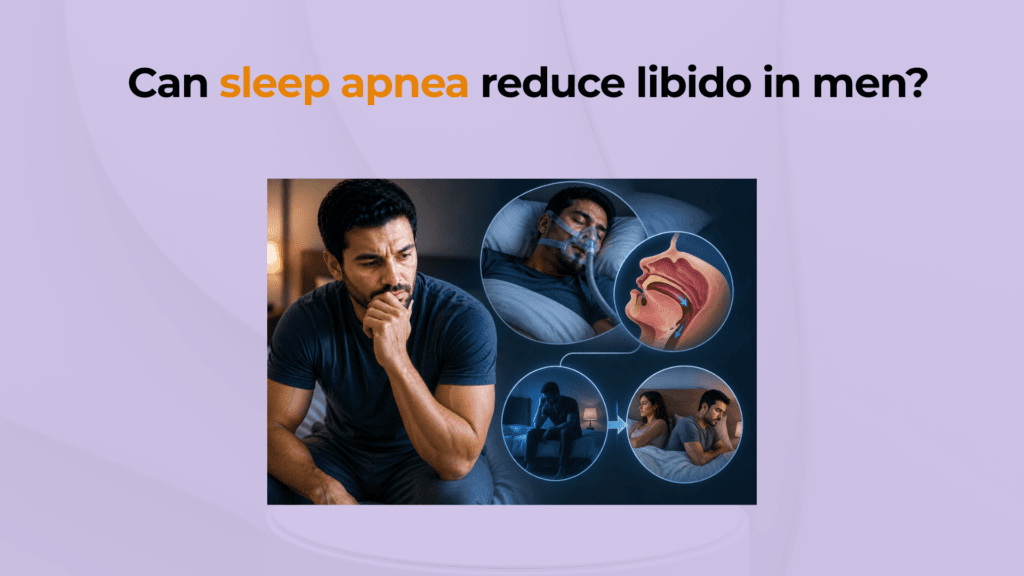
Can Sleep Apnea Reduce Libido in Men?
Sleep apnea is associated with reduced male libido, but low desire does not diagnose sleep apnea and treatment does not guarantee restored sexual interest. Obstructive sleep apnea (OSA) involves repeated narrowing or closure of the upper airway during sleep. Sexual symptoms need assessment alongside breathing symptoms.
What evidence links sleep apnea with low male libido?
Evidence linking sleep apnea with low male libido includes patient surveys and small treatment studies. These studies distinguish sexual desire from erections and testosterone rather than treating all three as the same outcome.
| Study | Population and design | Finding and limitation |
|---|---|---|
| Mun et al., 2018 [1] | 436 untreated men newly diagnosed with OSA; observational study | 99 men, approximately 23%, reported low libido. This is a selected sleep-clinic population, not a prevalence estimate for all men. |
| Melehan et al., 2018 [2] | 61 men with moderate-to-severe OSA and erectile dysfunction; 12-week randomized trial | Adherent CPAP users showed improved sexual desire in a per-protocol analysis. The small adherent subgroup limits certainty. |
| Cignarelli et al., 2019 [3] | 12 studies; 388 men; meta-analysis of CPAP and hormone outcomes | No statistically significant average change in total testosterone. This does not measure a libido treatment response. |
The observational study assessed low libido with a question about loss of sexual interest or pleasure. Men reporting low desire also had more mood symptoms. A cross-sectional finding does not prove that airway obstruction caused each man’s libido change. [1]
How does sleep apnea affect the context of sexual desire?
Sleep apnea affects the context of male libido by interrupting sleep and causing daytime sleepiness. NHLBI lists reduced libido among possible symptoms, alongside snoring, gasping and breathing pauses. The symptom pattern supports evaluation; it does not establish a single cause of low desire. [4]
Record sleep and sexual symptoms separately. A man who avoids intimacy because he feels exhausted describes a different problem from a man who wants sex but cannot maintain an erection. Both problems warrant attention, and both sometimes coexist.
Does CPAP improve libido in men with sleep apnea?
CPAP improved male libido in an adherent subgroup of one small sleep apnea trial, but the result does not guarantee improvement for every patient. CPAP means continuous positive airway pressure. The device uses pressurized air to keep the airway open during sleep. [2] [5]
The 61-man trial compared CPAP with sham CPAP and vardenafil with placebo in a two-by-two design. Fifty-five men completed the study. The per-protocol CPAP comparison included 12 adherent CPAP users and 8 adherent sham users. Adherence-based comparisons differ from the original randomized comparison. [2]
The trial reported improvements in sleep-related erections and overall sexual satisfaction, with additional desire benefits among adherent users. These are separate measures. The study does not establish a reliable percentage chance of libido recovery or a universal recovery timeline. [2]
Does CPAP restore testosterone when sleep apnea lowers libido?
CPAP does not reliably restore testosterone in men with sleep apnea and low libido. The 2019 meta-analysis found an average total testosterone change of 1.08 nmol/L, with a 95% confidence interval from −0.48 to 2.64 nmol/L; the interval includes no change. [3]
The analysis combined 10 prospective cohorts and 2 randomized studies. Heterogeneity was high, with I² = 89%, and CPAP adherence varied. These limitations argue against promising a hormone response. A man’s low testosterone requires direct evaluation even when OSA is already diagnosed. [3]
Which symptoms suggest sleep apnea during a low-libido assessment?
Sleep apnea deserves consideration during a male libido assessment when low desire accompanies witnessed breathing pauses, frequent loud snoring, gasping or daytime sleepiness. A clinician assesses the pattern and determines whether sleep testing is appropriate. [4]
- Record breathing observations: Note pauses, gasping and snoring reported by a partner.
- Describe daytime symptoms: Record sleepiness, concentration problems and unrefreshing sleep.
- Describe sexual symptoms: Separate low interest from erection or orgasm difficulties.
- Bring the treatment history: Include medicines, previous sleep studies and existing CPAP use.
How is sleep apnea assessed when male libido is low?
Sleep apnea assessment for a man with low libido includes a medical history and, when indicated, a sleep study. Polysomnography records sleep-related measurements such as brain activity, breathing, heart rate and blood oxygen. Low libido alone does not establish the diagnosis. [6]
The clinician interprets respiratory findings with the symptom history. A libido score and a breathing-event measure answer different questions. Do not use one as a substitute for the other, or assume that snoring explains all sexual symptoms.
What should men do when libido remains low during sleep apnea treatment?
Men whose libido remains low during sleep apnea treatment need a broader review rather than assuming treatment failure or testosterone deficiency. Review mood, stress, medicines, relationships and other medical conditions. See male libido: meaning and assessment. [7]
Bring device-use information to sleep follow-up, including difficulties with the mask or treatment. NHLBI recommends regular checkups to assess whether sleep apnea treatment is working. Discuss persistent sexual symptoms explicitly rather than waiting for a presumed recovery deadline. [8]
Testosterone deficiency requires compatible symptoms and consistently low testosterone concentrations, confirmed with repeat morning fasting testing. The Endocrine Society recommends against starting testosterone therapy in untreated severe OSA. Tell the prescriber about sleep apnea before considering hormone treatment. [9]
References for sleep apnea and male libido
These sleep apnea and libido references distinguish observational desire data, a small treatment trial, hormone meta-analysis and clinical guidance.
- Mun et al. Sleep and libido in men with obstructive sleep apnea syndrome. 2018.
- Melehan et al. Randomized Trial of CPAP and Vardenafil on Erectile and Arterial Function in Men With Obstructive Sleep Apnea and Erectile Dysfunction. 2018.
- Cignarelli et al. Effects of CPAP on Testosterone Levels in Patients With Obstructive Sleep Apnea: A Meta-Analysis Study. 2019.
- NHLBI: Sleep apnea symptoms.
- NHLBI: CPAP.
- NHLBI: Sleep studies.
- NHS: Low sex drive.
- NHLBI: Living with sleep apnea.
- Endocrine Society: Testosterone therapy for hypogonadism guideline.