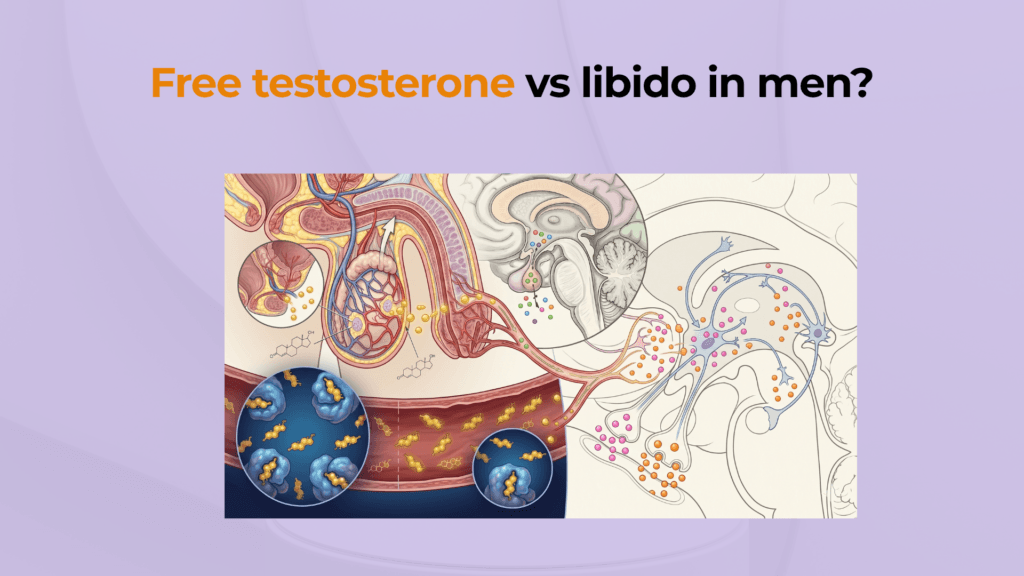
Testosterone is a primary hormonal driver of male libido by activating key brain regions, but sexual desire is a complex interplay of biology, psychology, and lifestyle. Low testosterone can reduce libido, but is not the sole factor.
High Testosterone and Libido in Men? Understanding the Link, Impact, and When to Seek Help
Important Medical/Safety Disclaimer: This article is for informational purposes only and does not constitute medical advice. Consult a qualified healthcare professional for any health concerns or before making any decisions related to your health or treatment.
Testosterone’s Role: A Key Driver of Libido, Not the Whole Story
Testosterone’s role is that of a key biological driver for libido, but it does not represent the entirety of a man’s sexual desire. To understand this complex relationship, it helps to use an analogy: think of testosterone as the high-octane fuel for the “engine” of desire.
While essential for the engine to run powerfully, the experience of the drive is also dictated by the “driver” (your psychological state) and the “road conditions” (your lifestyle and overall health). A full tank of fuel is of little use if the driver is stressed or the road is blocked.
Libido as the *desire* for sex; testosterone as a primary biological *driver* of that desire
Libido is medically defined as the conscious desire for sex, whereas testosterone is the primary biological hormone that helps drive and sustain that desire. It’s crucial not to use these terms interchangeably. Libido is the psychological and emotional state of “wanting,” while testosterone is a neurochemical catalyst that stimulates the brain regions responsible for arousal and sexual motivation.
The core process follows a clear path: Testosterone activates neural pathways, which in turn increases the likelihood of experiencing sexual desire (libido). This is distinct from erectile function, which is the physical ability to achieve and maintain an erection. (Source: Journal of Clinical Endocrinology & Metabolism)
How testosterone levels fluctuate naturally and their effect on desire
Testosterone levels in men fluctuate naturally throughout the day, across the week, and over a lifetime, which can cause subtle, temporary changes in sexual desire. Most men experience a diurnal rhythm, with testosterone levels peaking in the morning and gradually declining throughout the day.
Furthermore, levels tend to decrease by about 1% per year after age 30-40. (Source: Endocrine Society Clinical Guidelines) It’s important to contrast these normal, minor fluctuations with a significant, persistent drop in desire, which could signal a potential clinical issue. The age-related decline is a gradual process, and many older men maintain healthy libidos through a combination of good health and positive lifestyle factors.
Why high testosterone doesn’t always guarantee high libido, and vice versa
High testosterone does not always guarantee a high libido because sexual desire is also heavily influenced by psychological, relational, and lifestyle factors. This is the central misconception that many men have.
Even with optimal hormonal “fuel,” a “driver” who is stressed, anxious, depressed, or in a strained relationship may have no desire to “drive.” The brain’s emotional and stress-response centers can effectively override the signals from testosterone.
Conversely, a man with lower-normal testosterone levels can enjoy a high libido if his psychological health is strong, his relationship is intimate, and his lifestyle is supportive of overall well-being. (Source: Mayo Clinic)
How Does Testosterone Activate Male Sexual Desire?
Testosterone activates male sexual desire primarily by binding to androgen receptors in key brain regions, such as the hypothalamus and amygdala, which regulate arousal and motivation. This biological process transforms a chemical signal into the psychological experience of desire through a clear, step-by-step neurochemical pathway.
The impact of testosterone on brain regions associated with sexual arousal and motivation
The primary impact of testosterone on the brain involves stimulating the medial preoptic area (MPOA) of the hypothalamus, which is a critical control center for male sexual behavior.
In simple terms, the MPOA acts as the brain’s accelerator for sexual interest. Testosterone increases the reactivity of these areas to sexual cues (visual, physical, or mental), making a person more likely to perceive stimuli as erotic and to initiate sexual thoughts and behaviors. (Source: Nature Reviews Neuroscience)
Testosterone’s influence on libido through androgen receptors
Testosterone’s influence on libido is mediated through androgen receptors, which act as docking stations on cells in the brain and body that, once activated by testosterone, trigger a cellular response related to sexual function.
This process works like a “lock and key”: testosterone is the key, and the androgen receptor is the lock. Only when the correct key fits into the lock can the door to a cellular response be opened, initiating the cascade of events that leads to increased desire.
The link between free testosterone and its availability to tissues
The critical link to libido is primarily with free testosterone, which is the unbound, biologically active portion of the hormone that is available to enter tissues and activate androgen receptors.
The vast majority of testosterone in the bloodstream is bound to proteins, primarily Sex Hormone-Binding Globulin (SHBG), rendering it inactive. Only a tiny fraction, typically around 1-2%, is “free.”
This is why a standard total testosterone blood test might not tell the whole story; a man could have normal total testosterone but low free testosterone, leading to symptoms like reduced libido.
Beyond Testosterone: Other Critical Factors Affecting Male Libido
Beyond testosterone, other critical factors affecting male libido include psychological health, lifestyle habits, other hormones, and underlying medical conditions. A holistic understanding requires looking at the entire system, not just a single hormone level.
- Psychological factors: Stress, anxiety, depression, and relationship issues. Mental and emotional states can powerfully override biological drivers. High cortisol levels from stress can suppress testosterone production, while depression can blunt all forms of pleasure and motivation, including sexual desire.
- Lifestyle factors: Diet, exercise, sleep, and substance use. Poor sleep, a sedentary lifestyle, and excessive alcohol consumption all disrupt the endocrine system, deplete energy, and negatively impact mood, each contributing to a lower libido.
- Other hormonal influences: Prolactin, thyroid hormones, and cortisol. Imbalances in other key hormones can suppress libido. High levels of prolactin, or an underactive/overactive thyroid, can directly interfere with testosterone’s effects and reduce sexual desire.
- Medical conditions and medications impacting libido. Certain medical conditions like diabetes and heart disease, along with medications such as antidepressants (SSRIs) and blood pressure drugs (beta-blockers), can significantly impact libido independent of testosterone levels.
| Factor Category | Key Influencers | How It Impacts Libido |
|---|---|---|
| Testosterone | Free Testosterone Levels | Directly fuels the biological drive for sex by activating brain regions for arousal. |
| Psychological | Stress, Anxiety, Depression | Occupies mental bandwidth, increases cortisol, and reduces the capacity for sexual thoughts and intimacy. |
| Lifestyle | Poor Sleep, Diet, Lack of Exercise | Depletes energy, disrupts hormone regulation, and negatively impacts mood and self-esteem. |
| Relational | Conflict, Lack of Intimacy | Emotional distance and unresolved issues can override biological desire. |
| Other Hormones | High Prolactin, Thyroid Issues | Can directly suppress libido and interfere with testosterone’s effects. |
| Medications | SSRIs, Beta-blockers | Can have side effects that directly lower sexual desire or arousal. |
How to Assess Your Own Libido and Potential Testosterone Link
Before seeking medical advice, taking time for structured self-reflection can help you have a more productive conversation with your doctor.
What to note before consulting a healthcare provider
Before consulting a healthcare provider, you should note the duration and severity of your low libido, any accompanying symptoms, and a summary of your lifestyle and stress levels. Use the following checklist to organize your thoughts and observations.
Self-Assessment Checklist
- ✓ Libido Pattern: Has my desire decreased gradually or suddenly? How long has this been an issue?
- ✓ Symptom Tracking: Am I experiencing other symptoms like fatigue, low mood, irritability, or reduced muscle mass?
- ✓ Erectile Function: Is my ability to get or maintain an erection also affected, or is it only a lack of desire?
- ✓ Lifestyle Audit: How has my sleep, diet, exercise, and alcohol/substance use been recently?
- ✓ Mental Health: Am I experiencing high levels of stress, anxiety, or symptoms of depression?
- ✓ Relationship Context: Are there any unresolved issues or emotional distance in my relationship?
When Does Low Libido in Men Warrant Medical Evaluation?
While minor fluctuations in libido are normal, certain situations warrant a professional medical evaluation to rule out underlying conditions. A persistent and bothersome decrease in sexual desire is the primary indicator that you should speak with a doctor. (Source: American Urological Association)
What to expect during a medical evaluation: Blood tests, discussion of symptoms, and treatment options
During a medical evaluation for low libido, you can expect a detailed discussion of your symptoms, a physical exam, and blood tests to check total and free testosterone, among other health markers.
This process helps your doctor get a complete picture of your health to identify the root cause of your low libido. It is not something to be anxious about; it is a standard diagnostic process.
| Symptom / Situation | Recommended Action | Rationale |
|---|---|---|
| Curiosity or minor fluctuation | Monitor & Lifestyle Audit | Normal variations occur; assess lifestyle factors first. |
| Persistent low desire (months) impacting well-being | Schedule a Doctor’s Appointment | A chronic change warrants a baseline check-up and discussion. |
| Low libido PLUS other symptoms (fatigue, depression, ED) | Schedule a Doctor’s Appointment | A cluster of symptoms suggests a potential underlying systemic or hormonal issue. |
| Sudden and complete loss of libido | Schedule an Urgent Doctor’s Appointment | A rapid, severe change could indicate a more acute medical issue. |
The Holistic View: Balancing Testosterone, Health, and Desire
Ultimately, understanding the link between testosterone and libido means embracing a holistic view. Testosterone is a foundational pillar, but it doesn’t hold up the structure of desire on its own.
A healthy and satisfying sex drive is an outcome of overall well-being, reflecting a complex balance between hormones, mental health, physical vitality, and emotional intimacy. Rather than focusing on a single number from a blood test, the most effective approach is to cultivate a lifestyle that supports all these interconnected factors.