Does Low Dopamine Reduce Libido in Men? Understanding the Neurochemical Link
Low dopamine can reduce libido in men by weakening the brain’s motivation and reward-seeking signals, which diminishes the anticipation and drive for sexual activity. This is distinct from physical arousal, which is more hormonally driven.
Important Medical Disclaimer
This article is for informational purposes only and does not constitute medical advice. Consult with a qualified healthcare professional for any health concerns or before making any decisions related to your health or treatment.
Dopamine: The Brain’s Motivation and Reward Driver, Not Just “Pleasure”
Dopamine functions as the brain’s primary motivation and reward-driver, compelling the pursuit of goal-directed behaviors, rather than simply creating the sensation of pleasure.
This distinction is crucial for understanding its role in sexual desire. It is the neurochemical that creates the “wanting” and the “seeking” that precedes any rewarding experience.
Dopamine’s role in seeking and anticipating rewards
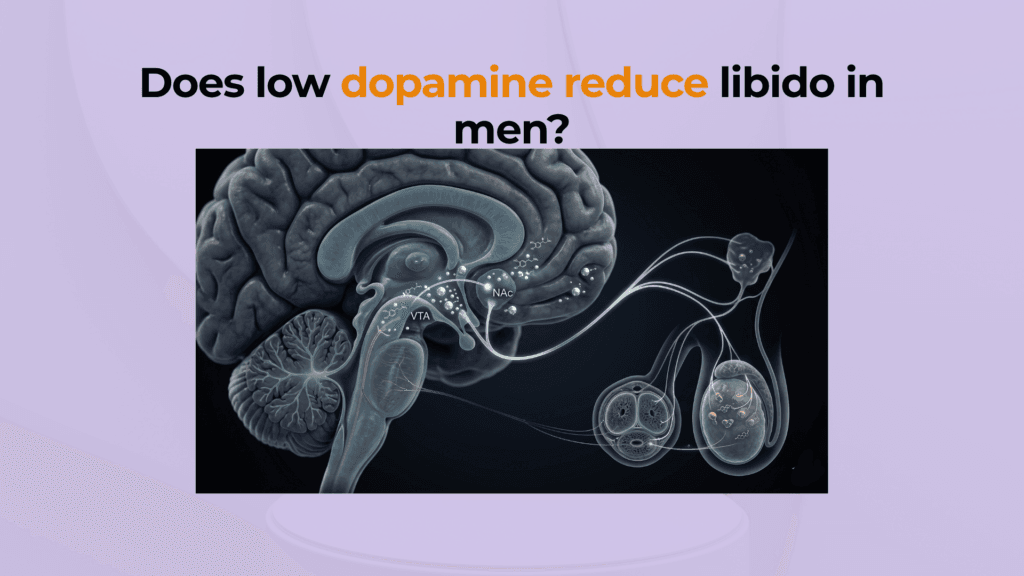
Dopamine’s primary role in the reward system involves driving the seeking and anticipation of rewarding experiences, including sex. When the brain encounters a cue associated with a potential reward (like a sexual opportunity), dopamine is released in the mesolimbic pathway.
This surge doesn’t create pleasure itself but generates a state of heightened motivation and focus, essentially telling the brain, “Pay attention! This is important and worth pursuing.”
How dopamine fuels motivation and goal-directed behavior
Dopamine fuels motivation by assigning “motivational salience” to potential rewards, which prioritizes them and drives goal-directed behavior to obtain them. It acts like a spotlight, highlighting a specific goal (e.g., intimacy) and providing the mental energy needed to initiate and sustain the actions required to achieve it.
This subconscious process is why certain activities feel compelling and worth the effort, while others do not.
Why the “pleasure chemical” label is an oversimplification
The “pleasure chemical” label is an oversimplification because dopamine’s peak activity occurs during the anticipation and pursuit of a reward, not during its consumption. The actual feeling of pleasure or “liking” is more closely associated with the brain’s opioid system.
Dopamine’s job is the “wanting” that gets you to the reward. This is why a lack of dopamine doesn’t necessarily mean an inability to enjoy sex if it happens, but rather a lack of drive to initiate it in the first place.
How Dopamine Fuels the Desire and Motivation for Sex in Men
Dopamine fuels the desire and motivation for sex in men by activating the brain’s reward pathway in response to sexual cues, which creates a powerful drive to seek out sexual opportunities. It is the neurochemical spark that transforms a passive state into active interest.
Dopamine’s effect on sexual interest and arousal initiation
Dopamine directly affects sexual interest by increasing arousal initiation in the presence of sexual stimuli, signaling to the brain that a potential sexual encounter is a highly salient and rewarding goal. While testosterone can be seen as setting the baseline level of “readiness” for sex, dopamine provides the acute “go” signal.
It’s the difference between having a well-fueled car (testosterone) and actually pressing the gas pedal to start moving (dopamine).
The role of the reward pathway in sexual anticipation
The brain’s reward pathway, fueled by dopamine, is central to sexual anticipation, creating the pleasurable feeling of wanting and building the motivation to progress toward a sexual encounter. This is the neurobiological basis for foreplay and the build-up of desire.
A healthy dopamine system makes this anticipatory phase feel exciting and rewarding in its own right, further reinforcing the motivation to continue.
How dopamine signals the brain to seek sexual opportunities
Dopamine signals the brain to actively seek sexual opportunities by lowering the threshold for action and promoting learning, reinforcing behaviors that have previously led to sexual reward. This system is designed to make us repeat what feels good.
By tagging sexual activity as a highly rewarding behavior, dopamine ensures we are motivated to initiate it again in the future, solidifying it as a desirable and prioritized goal.
Can Low Dopamine Levels Lead to Reduced Libido in Men?
Yes, low dopamine levels or disrupted dopamine signaling can directly lead to reduced libido in men by diminishing the motivation and anticipatory pleasure associated with sex. When the “go” signal is weak, the entire process of seeking and desiring sex can stall before it even begins.
How insufficient dopamine signaling can blunt sexual motivation
Insufficient dopamine signaling can blunt sexual motivation by failing to assign the necessary “motivational salience” to sexual cues, making them seem less appealing or important. This is a crucial diagnostic clue, as it can occur even when testosterone levels are normal and physical function is intact.
The man may still love and be attracted to his partner, but the neurochemical drive to act on that attraction is diminished, leading to a state of apathy or indifference towards sex.
The observable impact of low dopamine on a man’s desire for sex
The observable impact of low dopamine on a man’s desire for sex often manifests as a passive disinterest, a lack of sexual thoughts or fantasies, and a reduced initiation of sexual activity. A partner might notice that he rarely or never initiates sex, or seems unresponsive to advances.
This isn’t a rejection of the partner but rather a reflection of a muted internal drive system. It can be a confusing situation, as the physical capacity for sex might still be present, but the mental and emotional “spark” is missing.
Scenarios where low dopamine is a primary driver of low libido
Low dopamine is often a primary driver of low libido in specific scenarios, such as in individuals with Parkinson’s disease, those taking certain antipsychotic medications (dopamine antagonists), or those experiencing chronic anhedonia from depression.
In these cases, the dopamine system is directly compromised, either by disease or medication, making low libido a common and predictable side effect. Recognizing these scenarios helps clinicians pinpoint dopamine as a likely culprit.
Dopamine vs. Testosterone vs. Serotonin: A Comparison
While dopamine, testosterone, and serotonin all influence libido, they play distinct roles: dopamine drives motivation, testosterone sets the baseline sexual drive, and serotonin can act as an inhibitor. Understanding these differences is key to identifying the potential root cause of low libido.
| Chemical | Primary Role in Libido | Function | Analogy |
|---|---|---|---|
| Dopamine | The “Go” Signal (Motivation) | Drives the *wanting*, anticipation, and pursuit of sex. | The Gas Pedal |
| Testosterone | The “Engine” (Baseline Drive) | Sets the overall level of sexual interest and readiness. | The Engine Size |
| Serotonin | The “Brake” (Inhibition/Mood) | Regulates mood and can inhibit dopamine release, often reducing libido at high levels. | The Brakes |
What Factors Can Disrupt Dopamine Levels and Impact Libido?
Multiple factors can disrupt the brain’s dopamine system and negatively impact libido, ranging from lifestyle choices to underlying medical conditions and medications.
Lifestyle factors: Stress, diet, sleep, and addiction
Common lifestyle factors that can disrupt dopamine include chronic stress, a poor diet lacking in tyrosine (an amino acid precursor to dopamine), insufficient sleep, and substance abuse or addiction cycles.
Chronic stress elevates cortisol, which can suppress dopamine signaling. Poor sleep disrupts the brain’s ability to replenish neurotransmitters. Over time, these factors can lead to a downregulation of dopamine receptors, making the system less sensitive and responsive.
Medical conditions affecting dopamine pathways
Certain medical conditions directly affect the brain’s dopamine pathways and can cause low libido, most notably Parkinson’s disease, depression, and ADHD. Parkinson’s involves the death of dopamine-producing neurons.
Depression is often associated with dysregulated reward pathways. These conditions require professional diagnosis and treatment, and addressing them can sometimes improve associated symptoms like low libido.
Medications that influence dopamine levels
Several classes of medications can influence dopamine levels and potentially lower libido, including some antipsychotics, certain antidepressants, and some blood pressure drugs.
Antipsychotics, for example, often work by blocking dopamine receptors (acting as dopamine antagonists) to treat psychosis, but this can have the unintended side effect of blunting motivation and desire across the board.
Important Safety Warning
You should NEVER stop or alter the dosage of a prescribed medication without consulting your prescribing physician. If you suspect a medication is affecting your libido, discuss it with your doctor to explore potential alternatives or management strategies.
Recognizing Symptoms to Discuss With Your Doctor
Recognizing patterns in motivation and other related symptoms can help you have a more productive conversation with your doctor about low libido. This is not a self-diagnosis tool, but a way to gather useful information.
Self-Reflection Checklist for a Doctor’s Visit
Disclaimer: This checklist is for personal reflection to help organize your thoughts before speaking with a healthcare professional. It is not a diagnostic tool.
- Does my lack of interest in sex coincide with a lack of motivation for my work or hobbies?
- Do I feel “flat” or indifferent to new experiences or things I used to find exciting?
- Is my low libido accompanied by other symptoms like persistent brain fog, fatigue, or trouble concentrating?
- Have I recently started a new medication?
- Is my desire for sex low, even if my physical ability to perform is fine?
When to Seek Medical Advice for Low Libido
Seeking medical advice is crucial if low libido is persistent, distressing, or accompanied by other significant symptoms, as it may indicate an underlying medical condition.
Signs that a medical evaluation is necessary
A medical evaluation is necessary if low libido persists for several months, causes significant personal or relationship distress, or is paired with symptoms like profound fatigue or mood changes. A proactive approach is the best way to protect your overall health and quality of life.
How doctors assess potential causes of low libido
Doctors assess potential causes of low libido by taking a detailed medical history, reviewing medications, conducting a physical exam, and ordering blood tests to rule out hormonal causes like low testosterone.
It’s important to understand there is no direct “dopamine blood test” for this purpose; diagnosis is a process of elimination and pattern recognition based on the symptoms and history you provide.
Dopamine’s Crucial Role in Sustaining Male Sexual Desire
Dopamine plays a crucial, distinct role in sustaining male sexual desire by powering the motivation to seek and anticipate sex, acting as the “go” signal within a complex neurochemical and hormonal system.
Libido as a complex interplay, with dopamine as a key motivator
Ultimately, male libido is a complex interplay of hormones, psychology, and neurochemistry, with dopamine serving as the key motivator that translates baseline drive into active desire and pursuit.
While testosterone may set the stage, dopamine is the actor that initiates the scene.
The importance of a balanced neurochemical environment
Sustained sexual desire depends on a balanced neurochemical environment where dopamine, testosterone, and serotonin work in proper relationship to one another. An issue with one component can disrupt the entire system.
Understanding dopamine’s specific role as the engine of motivation offers a critical piece of the puzzle for men seeking to understand and address their low libido.