
Male Sex Drive: Definition, Factors, and Common Myths—A Guide to Understanding Libido and Desire
Listen to Article
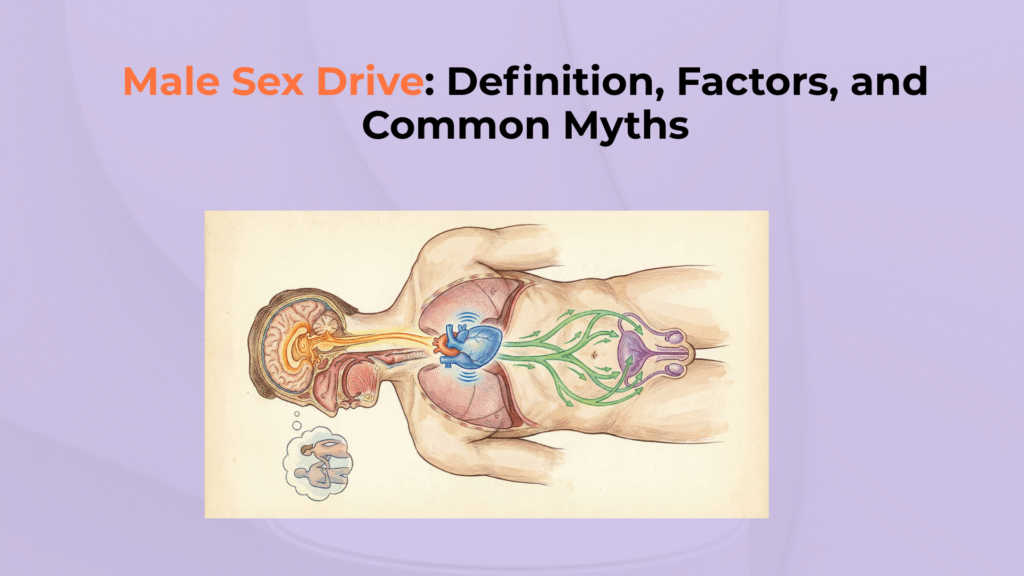
Male sex drive is a complex bio-psycho-social state defined by the motivational urge to seek sexual intimacy, often referred to as male libido, governed by a delicate balance of testosterone, neurotransmitters, sleep, stress biology, and psychological well-being.
It is not just a “hormonal switch” but a dynamic interplay of biology and environment.
Important Medical Disclaimer
This guide is for educational purposes only. A sudden, unexplained loss of sex drive can be a symptom of underlying health issues like hypogonadism, depression, medication side effects, or cardiovascular disease. Consult a licensed clinician for diagnosis and individualized treatment.
Male Sex Drive: At a Glance
- What is it? A motivational state (“wanting”), not just a physical reflex.
- Key Myth: Men do not think about sex every 7 seconds.
- Desire Types: Can be Spontaneous (out of the blue) or Responsive (emerges after intimacy/arousal begins).
- Primary Enemies: Chronic stress (cortisol-linked inhibition) and insufficient sleep (sleep-linked testosterone rhythm disruption).
What Is the Clinical and Psychological Definition of Male Sex Drive?
The clinical and psychological definition of male sex drive frames libido as a motivational force shaped by sexual excitation and inhibition systems, hormonal milieu, reward anticipation, and relationship context.
Defining Sex Drive (Libido as a Biological Urge)
Male sex drive, or libido, is the conscious and unconscious biological urge for sexual activity, driven by reward circuitry and hormonal priming [SD1].
Unlike erectile function (mechanics) or arousal (physiology), libido is the mental appetite; a man can have normal erections with low desire.
Levine distinguishes desire components into biological drive, cognitive motive, and psychological wish [SD1].
Male sex drive acts as a motivational force directing behavior toward sexual intimacy and gratification.
The Premise: Spontaneous vs. Responsive Desire
Desire often appears in two modes: spontaneous libido (desire-first) and responsive libido (arousal/intimacy-first) [SD11], [SD10].
Many men experience spontaneous desire more frequently earlier in life, while responsive desire becomes more common with stress or long-term relationships.
The Dual Control Model explains variability as a balance between sexual excitation and inhibition [SD11].
Both desire types are healthy; what matters is distress, consent, relationship alignment, and underlying health.
What Are the Primary Biological and Psychological Factors Affecting Sex Drive?
The primary factors affecting sex drive include biological “accelerators” (androgens and reward neurochemistry) and biological/psychological “brakes” (stress physiology, mood disorders, and medication effects) [SD3], [SD6], [SD7], [SD13].
To understand how neurotransmitters specifically power this “wanting” system, explore the neurochemical mechanics in our guide on Dopamine and Libido.
The Biological Engine (Testosterone and Dopamine)
The biological engine of sex drive relies on Testosterone as a permissive factor and Dopamine as a reward-motivation driver [SD3], [SD6].
Testosterone modulates sexual interest, while dopamine supports pursuit and anticipation (“incentive salience”) [SD6].
The Endocrine Society emphasizes diagnosis based on symptoms plus consistently low levels, noting that testosterone supports libido as a threshold, not a linear volume knob [SD3].
Adequate testosterone signaling supports reward responsiveness strengthening the subjective experience of sexual motivation.
The Psychological Brakes (Stress, Cortisol, Mood)
Chronic stress can inhibit sex drive by increasing inhibitory tone (fight-or-flight physiology), reducing reward sensitivity, and worsening sleep [SD7].
Evidence links stress biology (including cortisol’s impact on libido) with male sexual function and erectile response [SD7], [SD15].
Calabrò and Hamilton highlight the impact of depression and anhedonia (the inability to feel pleasure) on libido [SD16], [SD7].
High inhibition + low reward responsiveness often looks like “low libido” even when attraction remains.
Lifestyle Influences (Sleep and Medications)
Sleep and medication use can alter sex drive by changing endocrine rhythms, mood, and reward signaling [SD8], [SD12], [SD13].
Sleep restriction reduces daytime testosterone levels; sleep quality interacts with hormonal patterns.
Leproult found that 1 week of sleep restriction lowered T levels by ~15% [SD12], while SSRIs are notorious for dampening libido via serotonin augmentation [SD9].
Chronic sleep deprivation dampens libido by disrupting sleep-linked androgen rhythm lowering daytime sexual motivation.
What Are the Most Common Myths About Male Sex Drive?
Common myths exaggerate how constant male desire is, which creates shame, performance anxiety, and misinterpretation of normal variability.
Myth vs. Fact Matrix
| Common Myth | The Scientific Reality | Impact on Health |
|---|---|---|
| “Men think about sex every 7 seconds.” | In Fisher et al.’s sample, men averaged ~19 sexual cognitions/day [SD4]. | Relieves pressure to meet a fake standard. |
| “Men always want sex (Always On).” | Desire fluctuates with stress, sleep, health, and relationship context [SD11], [SD8]. | Validates that saying “no” is normal. |
| “High drive equals high fertility.” | Libido and sperm quality are governed by different mechanisms [SD15]. | Prevents skipping proper fertility evaluation. |
| “High drive means high Testosterone.” | Libido is influenced by dopamine, mental health, and relationship factors, not just T [SD3], [SD6]. | Prevents unnecessary TRT pressure. |
How Does Age Impact the Evolution of Male Sex Drive?
Age can shift sex drive from frequent spontaneous desire toward more context-driven, responsive desire, alongside average androgen decline and life-stress changes [SD5], [SD11].
The Puberty to Young Adulthood Surge
From puberty through young adulthood, sex drive often rises alongside increases in testosterone and reward sensitivity.
This commonly increases spontaneous desire frequency and novelty seeking.
The Endocrine Society notes these androgen-driven developmental changes establish the adult baseline [SD3].
This period can create a “baseline illusion” that some men try to chase later.
The “Steady State” and Gradual Decline
After age 30, average testosterone trends downward, but the rate varies widely by health, weight, sleep, and comorbidities [SD5].
Longitudinal data suggests total testosterone declines ~1% per year on average [SD5].
Often, spontaneity decreases while responsive intimacy becomes more prominent.
[Checklist] Auditing Your Sex Drive for Health Optimization
Use this audit to identify common physiological, psychological, and lifestyle suppressors of male sex drive.
Functional and Lifestyle Audit
- Blood Work: Consider clinician-guided testing (Total/Free Testosterone, Prolactin) [SD3], [SD15].
- Stress Check: Persistent stress/anxiety can raise inhibitory tone [SD7], [SD15].
- Sleep Audit: Consistent insufficient sleep reduces daytime testosterone [SD12], [SD8].
- Medication Check: SSRIs and other psychotropics commonly affect desire [SD9].
- Mood Check: Anhedonia and depression can reduce libido directly [SD16].
- Safety Rule: Sudden, unexplained libido loss warrants medical assessment.

3 Responses