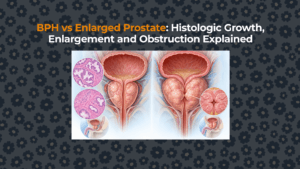
Rezūm is a minimally invasive treatment for urinary symptoms and obstruction associated with benign prostatic hyperplasia and prostate enlargement. The treatment uses controlled water vapor to deliver thermal energy into selected prostate tissue. The treated cells die and are gradually cleared by the body, reducing tissue volume around the urethra and creating more room for urine to pass.
01. Rezūm: Indications, Technique and Treatment Role
What problem is Rezūm intended to treat?
Rezūm is intended to reduce obstruction caused by enlarged benign prostate tissue surrounding the urinary channel.
The prostate sits below the bladder and surrounds the first portion of the urethra. This segment is called the prostatic urethra. When prostate tissue grows inward, the space available for urine can become narrower and resistance to urinary flow can increase.
This relationship is part of the wider prostate health and BPH and enlarged prostate pathway.
Prostate-related outlet obstruction can contribute to:
- a weak urine stream;
- difficulty starting urination;
- intermittent urinary flow;
- straining;
- incomplete bladder emptying;
- urinary frequency or urgency;
- and episodes of urinary retention in some men.
Rezūm differs from operations that physically remove obstructing tissue. It produces a controlled thermal treatment zone and relies on subsequent biological healing and tissue resorption to reduce obstruction.
What happens before and during Rezūm?
Before treatment, the clinician evaluates whether benign prostate enlargement is sufficiently responsible for the urinary symptoms and whether the prostate anatomy is suitable for water-vapor treatment.
Assessment may include symptom scoring, urinalysis, measurement of urinary flow, post-void residual urine and evaluation of prostate size. FBU explains the imaging and calculation process in how prostate volume is measured.
Median-lobe anatomy can also be important. The relationship between middle-lobe growth and the bladder outlet is covered in median lobe prostate enlargement and intravesical prostatic protrusion.
During the procedure, a cystoscopic delivery device is passed through the urethra. A small needle enters selected prostate tissue and delivers controlled water vapor.
The wider treatment context is explained in the BPH surgery and minimally invasive procedures guide.
02. How Is Rezūm Performed?
How does water vapor destroy prostate tissue?
The Rezūm system uses radiofrequency energy to generate water vapor. The vapor contains stored thermal energy.
When the vapor enters prostate tissue, it moves through the interstitial spaces between cells. As the vapor cools and condenses back into liquid water, its stored thermal energy is released into the surrounding tissue.
This produces rapid thermal denaturation of cell membranes and causes cell death within the treatment zone.
A 2025 FDA 510(k) summary describes individual vapor delivery as controlled nine-second treatments.
How many water-vapor treatments are given?
The number and position of treatments depend on the length and configuration of the prostatic urethra and the distribution of obstructing tissue.
EAU guidance describes approximately one to three injections for each lateral lobe, with one or two injections potentially delivered to a median lobe depending on prostate size and anatomy.
Treatment planning is therefore anatomical rather than based on giving every patient an identical number of injections.
Can Rezūm treat a median lobe?
Yes. Water-vapor therapy can be directed into selected median-lobe or central-zone hyperplasia as well as lateral-lobe tissue.
This is clinically relevant because median lobe enlargement can project toward the bladder outlet and may contribute disproportionately to obstruction in some men.
The pivotal Rezūm trial allowed middle-lobe treatment at the physician’s discretion, and later regulatory indications specifically included central-zone and median-lobe hyperplasia.
Which prostate sizes have been studied?
The pivotal randomized five-year study enrolled men with prostate volumes of 30–80 cc.
Evidence has since expanded into larger glands. A 2025 U.S. FDA clearance expanded the indicated prostate-volume range to 30–150 cm³ for men aged 50 years and older.
That regulatory expansion should not be confused with equal amounts of randomized comparative evidence across every prostate size. The original long-term randomized evidence remains strongest in the 30–80 cc population.
03. Rezūm: Outcomes, Recovery and Procedure-Specific Trade-Offs
What does recovery after Rezūm usually involve?
Rezūm can be performed in an office-based or ambulatory setting in appropriately selected patients.
The prostate does not immediately become smaller after treatment. In fact, tissue swelling and inflammation can temporarily worsen urinary symptoms before healing progresses.
Early recovery can therefore include:
- burning during urination;
- urinary urgency;
- increased urinary frequency;
- blood in the urine;
- pelvic or perineal discomfort;
- temporary difficulty urinating;
- and urinary retention requiring temporary catheter drainage in some patients.
A catheter may be placed after the procedure or later if swelling prevents adequate bladder emptying. Whether a catheter is needed and for how long depends on baseline emptying, prostate size, treatment extent and the individual response.
Why can symptoms initially worsen before they improve?
Rezūm deliberately creates a localized inflammatory and healing response.
Immediately after treatment, injected areas can become swollen. Because those areas are already close to the prostatic urethra, temporary swelling may increase outlet resistance before tissue volume begins to decrease.
As inflammation settles and the treated cells are resorbed, the prostatic channel can gradually become less compressed.
This is different from TURP or HoLEP, where obstructing tissue is physically removed during the operation itself.
When does urinary improvement develop?
Improvement is gradual rather than immediate.
In the pivotal randomized trial, significant symptom improvement was evident by three months and remained durable through five years.
At five years, the treated group had a 48% reduction in International Prostate Symptom Score, a 44% improvement in maximum urinary flow and a 45% improvement in quality-of-life measures compared with baseline.
These figures describe the study population and should not be interpreted as guaranteed results for an individual patient.
How durable is Rezūm?
The five-year pivotal study reported a 4.4% surgical retreatment rate.
That provides evidence that many appropriately selected patients maintain benefit for several years after a single procedure.
However, durability comparisons between procedures require caution because trials use different inclusion criteria, retreatment definitions and patient populations.
Which sexual effects should be discussed before Rezūm?
Preservation of erectile and ejaculatory function is one of the important potential advantages of water-vapor therapy.
The five-year pivotal study reported no device- or procedure-related sexual dysfunction and no sustained new erectile dysfunction attributed to the procedure.
EAU evidence reviews likewise describe preservation of erectile and ejaculatory function using validated sexual-function instruments.
This does not mean sexual function is guaranteed to remain completely unchanged in every individual. Baseline function, aging, medication use and unrelated medical conditions can influence erections and ejaculation over time.
04. Who Is Most Likely to Be Considered for Rezūm?
How does Rezūm compare with UroLift and tissue-removing surgery?
Rezūm sits between medication and more invasive tissue-removing surgery, but its mechanism is different from both.
The preceding procedure in this FBU series, UroLift for BPH, mechanically retracts prostate tissue using permanent implants. Rezūm instead creates thermal treatment zones and leaves no permanent prostate implant.
| Feature | Rezūm | UroLift | TURP / HoLEP |
|---|---|---|---|
| Main mechanism | Water-vapor thermal ablation followed by tissue resorption. | Mechanical retraction of prostate tissue with implants. | Physical resection or enucleation of obstructing tissue. |
| Tissue removed during procedure | No. | No. | Yes. |
| Permanent implant | No. | Yes. | No. |
| Speed of improvement | Gradual over weeks to months. | Often relatively rapid. | Often relatively rapid after postoperative swelling settles. |
| Median-lobe treatment | Can be treated in appropriate anatomy. | Depends on anatomy, technique and applicable guidance. | Can generally address obstructing tissue directly. |
| Ejaculatory profile | Generally favorable. | Generally favorable. | Standard TURP and HoLEP commonly alter ejaculation. |
| Objective decompression | Moderate improvement. | Moderate improvement. | Generally stronger improvement in flow and outlet obstruction. |
| Recovery | Outpatient treatment possible; temporary irritation and catheter use may occur. | Typically relatively rapid recovery. | More substantial postoperative recovery. |
Which patients were represented in the pivotal Rezūm trial?
The pivotal randomized study included men older than 50 years with moderate-to-severe lower urinary tract symptoms, an International Prostate Symptom Score of at least 13, maximum urinary flow of 15 mL/s or less and prostate volume of 30–80 cc.
These trial criteria describe the evidence population rather than a complete modern eligibility checklist.
Current clinical use can extend beyond the exact original trial population, particularly because later evidence and regulatory indications include larger prostates.
When may Rezūm be unsuitable or require additional evaluation?
Water-vapor therapy may not be the preferred approach when severe obstruction requires rapid and powerful decompression, when the anatomy cannot be adequately treated, when another procedure offers a better fit for the patient’s goals or when symptoms are not primarily caused by prostate-related outlet resistance.
The distinction between gland size and actual obstruction is important. FBU discusses this relationship in prostate size, obstruction and BPH symptoms.
Likewise, an enlarged prostate does not establish that every urinary symptom comes from BPH. Bladder dysfunction, urethral narrowing and other lower urinary tract disorders can coexist.
The full diagnostic and treatment pathway is covered in the BPH and enlarged prostate guide.
How does current European guidance view water-vapor therapy?
The 2026 EAU guideline discusses convective water-vapor therapy under alternative ablative techniques still requiring stronger comparative evidence.
The guideline recognizes durable symptom improvement, preservation of sexual function and favorable short-term safety, but also notes that objective urinary outcomes such as flow and residual urine are generally improved more strongly by TURP.
This makes informed selection particularly important: minimally invasive treatment does not automatically mean equivalent decompression to conventional surgery.
Summary
- Rezūm is a minimally invasive water-vapor treatment for BPH-related urinary obstruction.
- Radiofrequency energy generates water vapor that is injected into selected prostate tissue.
- When vapor condenses, stored thermal energy is released and causes controlled cell death.
- The body gradually resorbs treated cells, reducing tissue volume around the prostatic urethra.
- Improvement develops over weeks to months rather than immediately.
- Lateral, central and selected median-lobe tissue can be treated.
- The original pivotal five-year trial studied prostates from 30–80 cc; a 2025 U.S. FDA clearance expanded the indicated range to 30–150 cm³.
- Five-year trial data showed durable symptom and flow improvement with a 4.4% surgical retreatment rate.
- Erectile and ejaculatory function were generally preserved in long-term trial data.
- Objective urinary improvement is generally less than after TURP, so Rezūm should not be presented as universally equivalent or superior to tissue-removing surgery.
Educational disclaimer: This article provides general medical education and does not recommend Rezūm or another BPH procedure for an individual. Treatment selection requires assessment of urinary symptoms, prostate anatomy, prostate volume, bladder function, medical risk and patient priorities by an appropriately qualified clinician.
Explore the Prostate and BPH Pathway
To understand the anatomy behind water-vapor therapy, start with Prostate Health and the Prostatic Urethra.
For disease and treatment context, continue through BPH and Enlarged Prostate and BPH Surgery and Minimally Invasive Procedures.
The preceding procedure in this treatment sequence is UroLift for BPH.
Evidence Sources
- European Association of Urology. Management of Non-neurogenic Male LUTS: Convective Water Vapour Energy Ablation.
- McVary KT, et al. Final 5-Year Outcomes of the Multicenter Randomized Sham-Controlled Trial of Water Vapor Thermal Therapy. Journal of Urology.
- U.S. Food and Drug Administration. Rezūm System 510(k) Summary — K250584.