BPH and Enlarged Prostate: Growth, Obstruction, Symptoms, Diagnosis and Treatment
Benign prostatic hyperplasia is a tissue process. Enlargement, obstruction and urinary symptoms are related outcomes—but they are not interchangeable diagnoses.
01. What is BPH—and what is it not?
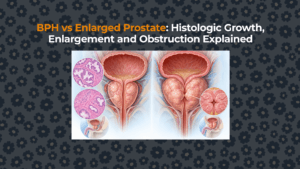
Benign prostatic hyperplasia (BPH) names a microscopic pattern of increased stromal and epithelial cell number. Benign prostatic enlargement (BPE) names an increased gland size. Benign prostatic obstruction (BPO) names outlet obstruction attributed to the prostate. Male lower urinary tract symptoms (LUTS) name what a person experiences. The four can overlap without being equivalent.
The dedicated BPH definition article resolves the tissue terminology; this hub follows the whole clinical pathway.
02. BPH Growth Begins Mainly in the Transition Zone
BPH nodules arise predominantly in the periurethral transition zone. Growth can compress the outer gland into a “surgical capsule” and reshape the channel passing through the prostate. A median lobe may protrude toward the bladder outlet. These spatial relationships explain why two glands with the same total volume can have different effects on flow.
See the transition-zone anatomy and median-lobe geometry for those mechanisms.
03. How can BPH affect urine flow?
Outlet resistance can include a static component from tissue geometry and a dynamic component from smooth-muscle tone in the prostate and bladder neck. The bladder initially compensates by generating higher pressure. With time, some bladders develop detrusor overactivity, incomplete emptying or impaired contraction. Symptoms can therefore persist even when the prostate is not very large.
04. The BPH Symptom Pattern Includes Three LUTS Domains
| Symptom domain | Examples | Why it is not specific for BPH |
|---|---|---|
| Storage | Urgency, frequency, nocturia, urgency leakage | May reflect overactive bladder, excess night-time urine, infection or metabolic disease |
| Voiding | Weak/intermittent stream, hesitancy, straining | May reflect urethral stricture, poor detrusor contraction or neurologic dysfunction |
| Post-micturition | Incomplete-emptying sensation, after-dribble | Sensation does not measure residual urine or prove obstruction |
A validated score such as the IPSS quantifies seven symptoms and quality-of-life impact. It measures burden, not the cause. The size–symptom evidence explains why volume and IPSS correlate only imperfectly.
05. How is suspected BPH evaluated?
EAU guidance treats male LUTS as a differential-diagnosis problem. Core assessment includes medical history, medication review, physical examination including digital rectal examination when appropriate, urinalysis, a validated symptom score, and discussion of bother and goals. A bladder diary is especially useful for nocturia or storage symptoms.
| Measure | Question answered | What it cannot prove alone |
|---|---|---|
| Urinalysis | Blood, infection or glycosuria signal? | BPH |
| PSA, when indicated | Cancer-risk/prostate-volume context? | Cancer or BPH by itself |
| Uroflowmetry | How fast and in what pattern does urine flow? | The anatomical cause of low flow |
| Post-void residual | How much urine remains after voiding? | Obstruction; weak bladder contraction can also raise it |
| Ultrasound/MRI volume | Gland size and anatomy? | Symptom severity or urodynamic obstruction |
| Pressure-flow urodynamics | Pressure–flow evidence of outlet obstruction? | Needed routinely in every uncomplicated case |
The prostate-volume measurement guide explains why ultrasound and MRI can disagree.
06. BPH Red Flags Require Alternative or Complicated Causes to Be Excluded
BPH is benign and does not transform into prostate cancer, but both can coexist. Similar symptoms do not make them the same disease.
07. Who can be monitored without immediate treatment?
Men with mild or minimally bothersome LUTS and no complication may choose watchful waiting with periodic reassessment. Fluid timing, moderation of alcohol/caffeine, reviewing decongestants or other contributing medicines, timed voiding and constipation management may reduce burden. “Watchful” does not mean ignoring change: symptom impact, residual urine and complications determine follow-up.
08. BPH Medicines Target Outlet Tone, Gland Growth or Bladder Storage
| Class | Main target | Time/phenotype | Important trade-offs |
|---|---|---|---|
| Alpha-1 blockers | Relax prostate/bladder-neck smooth muscle | Relatively rapid symptom relief; do not shrink the gland | Dizziness, orthostatic effects, ejaculatory change |
| 5-alpha-reductase inhibitors | Reduce DHT-driven gland growth | Months; greatest role when enlargement/progression risk is demonstrated | Sexual adverse effects; PSA interpretation changes |
| PDE5 inhibitor | Smooth-muscle/signalling pathway | Tadalafil can address LUTS with or without erectile dysfunction | Nitrate interaction and blood-pressure considerations |
| Antimuscarinic or beta-3 agonist | Bladder storage dysfunction | Urgency/frequency phenotype, often after residual-risk assessment | Retention risk and drug-specific adverse effects |
| Combination therapy | More than one mechanism | Selected men with persistent symptoms or progression risk | Additive adverse effects and monitoring burden |
09. What did MTOPS show about progression?
The MTOPS randomized trial enrolled 3,047 men and followed them for a mean 4.5 years. Clinical progression was defined primarily by a ≥4-point AUA symptom-score increase, acute urinary retention, incontinence, renal insufficiency or recurrent urinary infection. Compared with placebo, doxazosin reduced overall progression risk by 39%, finasteride by 34%, and combination therapy by 66%. Finasteride and combination therapy—but not doxazosin alone—significantly reduced acute urinary retention and invasive therapy risk.
Those are relative trial effects in enrolled men, not individual predictions. Baseline prostate size and PSA helped identify higher progression risk, but neither is a universal treatment threshold.
10. BPH Procedures Are Selected by Anatomy, Risk and Patient Priorities
Procedural treatment is considered for refractory bothersome symptoms, recurrent retention, recurrent infection, bladder stones, treatment-resistant visible bleeding attributed to the prostate, upper-tract deterioration, or when a person prefers a procedural solution after informed comparison. Selection depends on prostate size and shape, median-lobe anatomy, anticoagulation, anesthesia risk, durability, local expertise, and priorities for ejaculation and erectile function.
TURP, laser enucleation/vaporization, water-vapor therapy, prostatic urethral lift, waterjet ablation, prostate-artery embolization and simple prostatectomy do not serve identical anatomies or evidence levels. A list without phenotype matching is not a treatment recommendation.
How should BPH treatment be chosen?
Choose by phenotype and goal: symptom domain and bother; evidence of enlargement or obstruction; residual urine and complications; progression risk; sexual priorities; comorbidities; and preference for speed, durability or reversibility. The correct endpoint may be better quality of life, lower retention risk, preserved ejaculation, reduced medicine burden or maximal flow—not merely a smaller prostate.