Does Erectile Dysfunction Reduce Libido in Men?
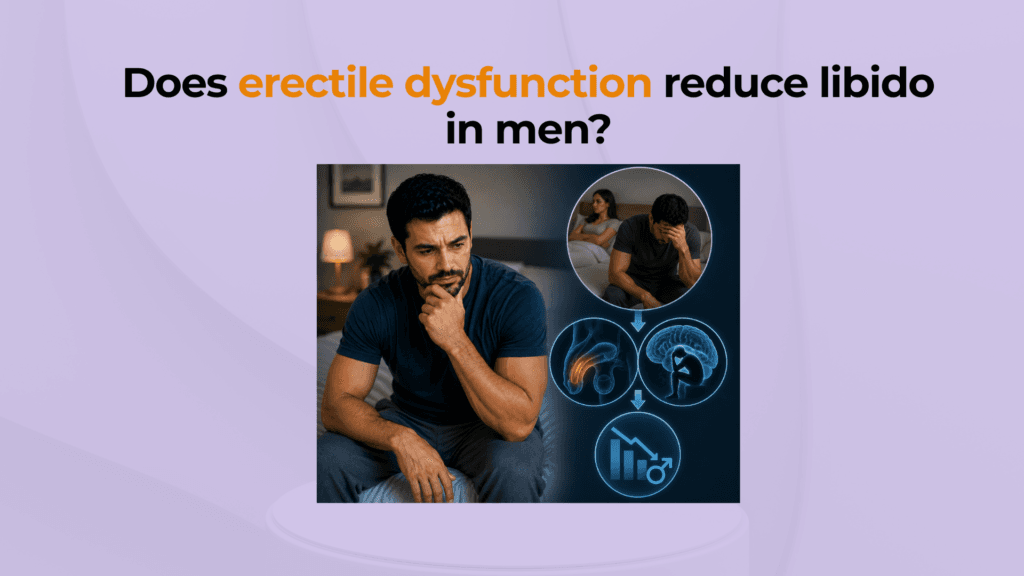
Erectile dysfunction can reduce libido in men, but usually through an indirect pathway. The erection problem itself does not automatically erase sexual desire. The stronger pattern is that repeated erection difficulty can create performance anxiety, loss of confidence, sexual avoidance, relationship tension, and fear of another failed attempt. Over time, those reactions can lower sexual desire even when the original problem began as erection mechanics.
Erectile dysfunction may reduce libido indirectly by making sex feel stressful, unpredictable, embarrassing, or emotionally unsafe. Some men still want sex but avoid it because they fear losing the erection again. Other men develop low desire because ED shares root causes with low libido, including low testosterone, vascular disease, diabetes, depression, anxiety, medication effects, poor sleep, and relationship stress.
Is ED the same as low libido?
ED and low libido are not the same condition. ED describes difficulty getting or keeping an erection firm enough for sex. Low libido describes reduced sexual desire, sexual thoughts, interest, or motivation. A man can have ED while still wanting sex, and a man can have low libido while still being physically capable of erections.
This separation matters because treatment depends on which system is failing first. When the central issue is erection reliability, the next clinical question is blood flow, nerve signaling, medication effects, anxiety, and cardiovascular risk. When the central issue is desire, the next question is mood, sleep, relationship context, hormones, stress, and reward drive. The overlap between libido and erectile function becomes important only after the article has separated desire from erection response.
How can ED reduce libido through performance anxiety?
Repeated erection difficulty can train the brain to expect failure before sex begins. A man may start monitoring his erection, checking whether it is firm enough, rushing penetration, avoiding touch, or mentally predicting embarrassment. That shift turns sex from a reward cue into a threat cue. Once intimacy feels like a test, desire often drops because the nervous system is preparing for protection rather than pleasure.
This pathway is strongest when the man still has sexual interest in private but avoids partnered sex. In that pattern, performance anxiety becomes the bridge between ED and low libido: the original erection problem creates fear, fear creates avoidance, and avoidance gradually reduces sexual motivation.
When does ED reduce libido because of a shared physical cause?
Sometimes ED and low libido appear together because the same physical condition affects both systems. Cardiovascular disease, diabetes, obesity, smoking, hypertension, high cholesterol, sleep apnea, depression, and chronic medication effects can all reduce sexual performance and sexual desire through overlapping pathways.
Vascular disease is especially important because erections require healthy endothelial function and penile blood flow. Poor cardiovascular health can make erections less reliable, and repeated unreliability can reduce desire through lost confidence. In younger men, new or persistent ED can sometimes be an early sign that vascular risk needs attention rather than only a sexual symptom.
Testosterone is another shared pathway. Confirmed low testosterone can reduce sexual thoughts, morning erections, energy, and erectile responsiveness. But testosterone should not be guessed from symptoms alone. It requires properly timed testing and clinical interpretation.
| Pattern | What it may suggest | Why libido may fall |
|---|---|---|
| ED with normal desire | Often points toward erection-specific drivers such as vascular, neurologic, medication, or anxiety-related ED. | Desire may stay intact until repeated failures create fear, avoidance, or relationship pressure. |
| ED with gradually falling desire | Often suggests a feedback loop, confidence loss, stress, depression, or a shared medical cause. | The man may want sex less because sex now predicts embarrassment or disappointment. |
| ED with low desire from the beginning | Raises suspicion for low testosterone, depression, medication effects, sleep problems, substance use, or systemic disease. | Both desire and erection response may be suppressed before sexual situations even begin. |
Can ED medications or other drugs reduce libido?
ED medications such as PDE5 inhibitors are designed to improve erection response, not directly raise libido. If desire improves after ED treatment, it is often because the man feels more confident and less avoidant. If desire remains low after erections improve, the cause may be psychological, hormonal, relational, medication-related, or systemic.
Other medications can affect both erection and desire. Antidepressants, opioids, some blood pressure medications, prostate medications, and substances such as alcohol can contribute to sexual dysfunction in some men. For example, SSRIs and libido are a common clinical discussion because some men experience lower desire, delayed orgasm, or erection difficulty after starting treatment. Medication changes should always be discussed with the prescribing clinician rather than stopped suddenly.
Medication safety boundary
Do not stop antidepressants, blood pressure medicines, opioids, prostate medications, or heart medicines without medical guidance. The safer approach is to review timing, dose, alternatives, cardiovascular risk, mood stability, and sexual side effects with a clinician.
How should a man know whether ED is lowering his libido?
A useful clinical question is whether desire disappeared first, or whether desire fell after repeated erection problems. If sexual interest was normal before ED began, and then desire dropped because sex became stressful, the pathway is probably indirect. If desire and erections dropped together from the beginning, shared causes such as testosterone deficiency, depression, diabetes, medication effects, or sleep problems need stronger attention.
A medical workup may include blood pressure, A1C or glucose, lipids, medication review, mental health screening, sleep review, and morning testosterone testing when symptoms suggest deficiency. If low desire is persistent, a structured low libido lab workup can help separate hormonal, metabolic, medication-related, and psychological contributors instead of assuming ED is the only cause.
| Clinical clue | What it may mean | Better next question |
|---|---|---|
| Desire stayed normal before ED began | ED may be the primary problem, and libido fell secondarily through fear, stress, or avoidance. | Is erection reliability improving with ED-focused treatment and confidence rebuilding? |
| Desire and erections fell together | A shared driver may be present: low testosterone, depression, diabetes, cardiovascular risk, medication effects, or sleep problems. | Are labs, mood, sleep, metabolic risk, and medication timing being checked? |
| ED occurs only with a partner | Performance anxiety, relationship tension, pressure, shame, or partner-specific stress may be more important. | Are solo erections, morning erections, and partner-specific anxiety patterns different? |
- Track onset: record whether ED or low libido appeared first.
- Track context: compare morning erections, masturbation erections, partnered erections, and desire in different situations.
- Review health risks: check diabetes risk, blood pressure, cholesterol, smoking, obesity, sleep apnea, and cardiovascular symptoms.
- Review mental state: assess anxiety, depression, shame, relationship conflict, and fear of failure.
- Review medications: identify antidepressants, opioids, beta blockers, prostate drugs, alcohol, and substances that may affect sexual function.
What helps when ED has started to reduce libido?
The best treatment direction depends on the first failing system. If blood-flow mechanics are the main issue, ED treatment may restore erection reliability and reduce avoidance. If low testosterone is confirmed, endocrine evaluation and treatment discussion may be appropriate. If anxiety is the main pathway, the target is confidence rebuilding, reduced self-monitoring, and safer sexual pacing. If medications are involved, the priority is clinician-guided adjustment rather than stopping therapy alone.
Recovery is strongest when the man stops measuring every sexual encounter as a pass-or-fail erection test. Partner communication, slower non-demand intimacy, exercise, sleep restoration, cardiovascular risk reduction, mental health treatment, and medically appropriate ED care can all help rebuild desire by making sex feel safe and possible again.
FAQ: Erectile dysfunction and libido in men
Does erectile dysfunction directly reduce libido?
Usually not directly. ED most often lowers libido indirectly through anxiety, embarrassment, fear of failure, avoidance, reduced confidence, or relationship tension. However, ED and low libido can share the same underlying cause.
Can a man have ED but still want sex?
Yes. A man can strongly want sex but struggle with erections because of vascular disease, nerve problems, medication effects, diabetes, alcohol, stress, or performance anxiety.
Can ED pills increase libido?
ED pills can improve erection response, but they do not directly create sexual desire. Desire may improve indirectly if erections become reliable and fear of failure decreases.
Can low testosterone cause both ED and low libido?
Yes. Confirmed testosterone deficiency can reduce sexual thoughts, morning erections, energy, and erectile responsiveness. Diagnosis should be based on symptoms plus consistently low morning testosterone, not one random test alone.
When should ED with low libido be checked by a doctor?
Medical evaluation is important when ED is persistent, worsening, sudden, associated with diabetes or heart risk, linked to new medication, paired with loss of morning erections, or accompanied by severe fatigue, depression, pelvic pain, chest pain, or reduced exercise tolerance.
References
- American Urological Association. Erectile Dysfunction: AUA Guideline. 2018.
- American Urological Association. Testosterone Deficiency Guideline. 2018.
- Endocrine Society. Testosterone Therapy for Hypogonadism Guideline Resources. 2018.
- Mayo Clinic. Erectile dysfunction: Symptoms and causes. Updated 2024.
- Mayo Clinic. Erectile dysfunction: A sign of heart disease? Updated 2026.