
Can Sleep Apnea Reduce Libido in Men?
Obstructive sleep apnea can reduce sexual desire by breaking sleep into repeated stress events. The strongest explanation is not one single hormone; it is the combined pressure of oxygen dips, micro-awakenings, daytime fatigue, mood strain, and erectile-function risk.
Yes. Obstructive sleep apnea can reduce libido in men by fragmenting restorative sleep, causing daytime exhaustion, and contributing to erectile dysfunction. Testosterone may be affected in some men, but CPAP should not be presented as a guaranteed testosterone-restoration treatment.
Medical disclaimer
This article is for educational purposes only. It does not diagnose sleep apnea, low testosterone, erectile dysfunction, or any medical condition. Men with loud snoring, witnessed breathing pauses, severe daytime sleepiness, erectile dysfunction, or persistent low libido should speak with a qualified healthcare professional.
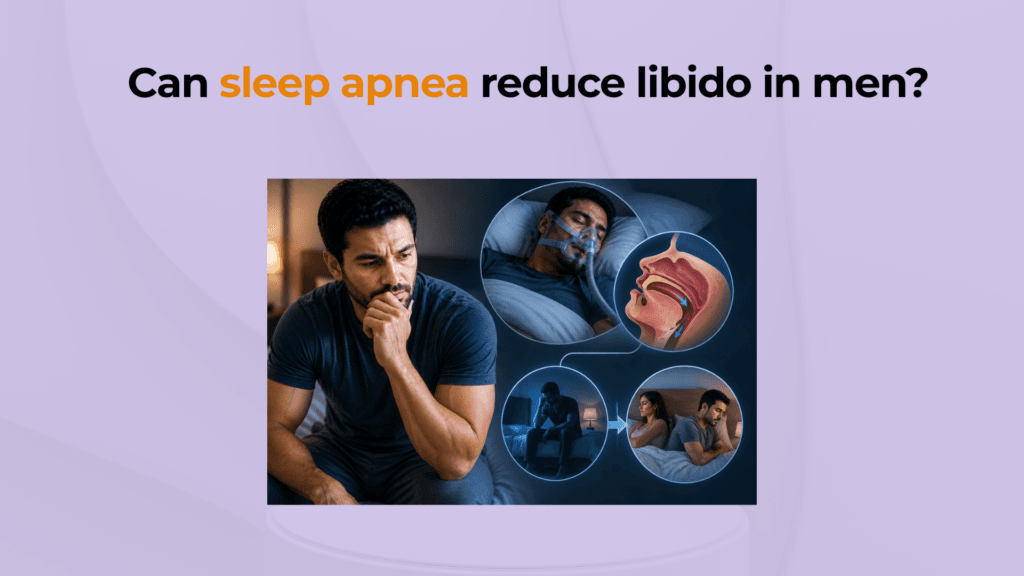
Many men notice low desire and tiredness at the same time, but they do not always connect both symptoms to sleep quality. In obstructive sleep apnea, the airway repeatedly narrows or closes during sleep. Each breathing pause can lower blood oxygen, trigger brief arousal, and prevent the brain from staying in deeper restorative stages long enough to support normal energy, mood, and sexual function.
That is why this topic needs careful wording. Sleep apnea can be part of a low-libido pattern, but it should not be framed as a simple “apnea lowers testosterone, CPAP restores libido” story. A stronger explanation is multi-factorial: breathing instability affects sleep depth, nervous-system tone, fatigue, relationship energy, erection quality, and sometimes hormone evaluation.
How does obstructive sleep apnea affect sexual desire?
Obstructive sleep apnea affects sexual desire by turning sleep into repeated airway-rescue events. Instead of moving smoothly through restorative sleep, the body repeatedly responds to airway narrowing, oxygen dips, and brief awakenings. Over time, this can leave a man awake but not recovered.
The sexual effect usually begins indirectly. Poor sleep lowers daytime alertness, increases irritability, and can make intimacy feel like another demand rather than a natural desire. In men who also have vascular risk factors, sleep apnea may also overlap with erection problems, which can reduce confidence and make desire weaker over time.
Libido needs energy, attention, and a low-stress body state
Sexual desire is not only a testosterone signal. It also needs enough physical energy, emotional bandwidth, and confidence to initiate intimacy. Untreated sleep apnea can drain those systems at the same time.
- Energy loss: repeated arousals can leave a man unrefreshed even after spending enough hours in bed.
- Mood pressure: poor sleep can worsen irritability, low mood, and anxiety, which can reduce sexual interest.
- Erection concerns: OSA is linked with higher erectile dysfunction rates in several studies, and repeated erection difficulty can reduce desire through fear of failure.
- Partner strain: loud snoring, sleeping separately, and daytime exhaustion can reduce closeness before libido is even considered.
Does sleep apnea lower testosterone?
Sleep apnea may contribute to lower testosterone in some men because testosterone rhythm depends partly on sleep integrity. Fragmented sleep and intermittent hypoxia are biologically plausible pathways. However, this should be written cautiously because obesity, age, metabolic health, medications, and baseline hormone status can all influence testosterone at the same time.
Evidence correction
Do not write that CPAP reliably restores testosterone. A meta-analysis reported a neutral average effect of CPAP on serum total testosterone and gonadotropins in men with obstructive sleep apnea. The safer wording is: CPAP may improve sleep quality and some sexual-function outcomes, while persistent low-testosterone symptoms need direct hormone evaluation.
This matters because a man can have untreated sleep apnea and still have normal testosterone. Another man can have low testosterone, but obesity, diabetes, opioid use, pituitary disease, medication effects, or aging may be stronger contributors than OSA itself. If symptoms suggest low testosterone, the correct next step is testing and clinical interpretation, not guessing from snoring or fatigue alone.
The same caution applies to obesity. Excess weight can increase OSA risk and can also lower testosterone through independent metabolic pathways. That overlap makes it easy to over-credit sleep apnea as the only cause when the real pattern may involve sleep, weight, glucose control, cardiovascular health, and sexual confidence together.
Does treating sleep apnea improve libido?
Treating sleep apnea may improve libido in some men, especially when low desire is linked to exhaustion, poor sleep quality, snoring-related relationship strain, or erectile dysfunction. The most evidence-safe wording is “may improve” or “can support,” not “will restore.”
Continuous positive airway pressure, or CPAP, keeps the airway open with steady air pressure during sleep. By reducing breathing interruptions, CPAP can improve sleep continuity and daytime alertness when used consistently. Some studies also report improvements in sexual satisfaction or erectile-function measures, but results are mixed and CPAP is not a replacement for direct ED care when erection problems persist.
What improvements can a man reasonably expect?
The first improvement is often better alertness, not instant sexual desire. When sleep becomes more stable, a man may have more energy, less irritability, and more motivation for intimacy. Sexual confidence can also improve if morning erections, erection quality, or partner closeness improve.
However, persistent erectile dysfunction should not be dismissed as “just sleep apnea.” ED can reflect vascular disease, diabetes, medication effects, psychological pressure, testosterone deficiency, pelvic conditions, or several causes at once. CPAP may support the foundation, but ED often needs its own evaluation.
How can a man know whether sleep apnea is part of his low libido?
Sleep apnea becomes more likely when low libido appears together with loud snoring, witnessed pauses in breathing, choking or gasping during sleep, unrefreshing sleep, morning headaches, high blood pressure, obesity, or daytime sleepiness. The pattern matters more than one symptom alone.
| Observation | Why it matters | What to discuss |
|---|---|---|
| Loud snoring or witnessed pauses | Suggests possible upper-airway obstruction during sleep. | Ask whether a home sleep apnea test or sleep-lab study is appropriate. |
| Waking up gasping, choking, or unrefreshed | Suggests sleep may be repeatedly interrupted even if total hours look normal. | Document frequency, timing, and whether a partner has noticed breathing pauses. |
| Low libido plus severe daytime fatigue | Fatigue can reduce initiation, desire, mood, and partner engagement. | Discuss sleep apnea, insomnia, depression, thyroid disease, and medication effects. |
| Low libido plus erection difficulty | OSA and ED can overlap, but ED also has vascular, metabolic, hormonal, and psychological causes. | Ask about ED evaluation rather than assuming CPAP alone will solve it. |
| Low libido plus low-testosterone symptoms | Sleep disruption may contribute, but testosterone status cannot be confirmed from symptoms alone. | Ask whether morning total testosterone, free testosterone/SHBG, and related labs are needed. |
Internal-link note
Low libido that improves after sleep restoration is usually a sign that fatigue and sleep fragmentation were major drivers. Low libido that persists after sleep improves needs a broader review of hormones, mood, erection quality, medication use, and cardiometabolic health.
Key takeaways
- Sleep apnea can reduce libido, mainly through fragmented sleep, oxygen instability, fatigue, mood pressure, and erectile-function risk.
- Testosterone language must be cautious: sleep disruption may affect hormone rhythm, but CPAP is not proven to reliably restore testosterone in all men.
- CPAP can support sexual health by improving breathing stability and sleep quality, and some studies report sexual-function or satisfaction improvements.
- Persistent ED or low-testosterone symptoms need direct evaluation, not assumptions based only on snoring, fatigue, or a sleep apnea diagnosis.
- The safest clinical step is formal sleep evaluation when low libido appears with loud snoring, witnessed apneas, gasping, unrefreshing sleep, or severe daytime sleepiness.
Recommended next step
If low libido appears with snoring, witnessed breathing pauses, or unrefreshing sleep, prioritize a sleep-apnea evaluation first. If desire, erection quality, or low-testosterone symptoms remain after sleep treatment begins, evaluate those issues directly rather than treating sleep apnea as the only explanation.
FAQs
Can sleep apnea reduce libido in men?
Yes. Sleep apnea can reduce libido by fragmenting sleep, increasing fatigue, worsening mood, and contributing to erectile dysfunction risk. The effect is often indirect and multi-factorial.
Does CPAP restore testosterone?
CPAP can improve breathing stability and sleep quality, but it should not be described as a guaranteed testosterone-restoration treatment. If low-testosterone symptoms are present, testosterone should be tested and interpreted clinically.
Can sleep apnea and erectile dysfunction happen together?
Yes. OSA and ED can co-exist, and studies report high ED prevalence among men with OSA. Still, ED has many possible causes, so persistent erection problems need direct medical evaluation.
When should a man seek help?
A man should seek evaluation if low libido appears with loud snoring, breathing pauses, choking or gasping during sleep, morning headaches, severe daytime sleepiness, or persistent erection problems.