
Does Low Dopamine Reduce Libido in Men? Analyzing Neurotransmitters, Motivation, and Sexual Desire
Listen to Article
Low dopamine signaling can reduce libido in some men by lowering sexual “wanting” (motivation to pursue sex) and, in certain cases, by disinhibiting prolactin pathways that suppress gonadal hormones [C1, C5].
Dopamine serves as the neurochemical “spark” that translates physiological cues into pursuit behavior—the core engine defined in What Is Libido in Men?. Without this signaling, even men with normal testosterone levels may experience a profound lack of initiative.
Important Medical Disclaimer:
This guide is for educational purposes only. Symptoms of anhedonia and low motivation can be signs of clinical depression or other neurological conditions. Consult a healthcare provider for diagnosis.
What Is the Functional Relationship Between Dopamine and Male Libido?
The functional relationship between dopamine and male libido acts as the primary neural driver of Incentive Salience (“Wanting”), converting biological signals into the conscious motivation to pursue sexual activity [C1, C2].
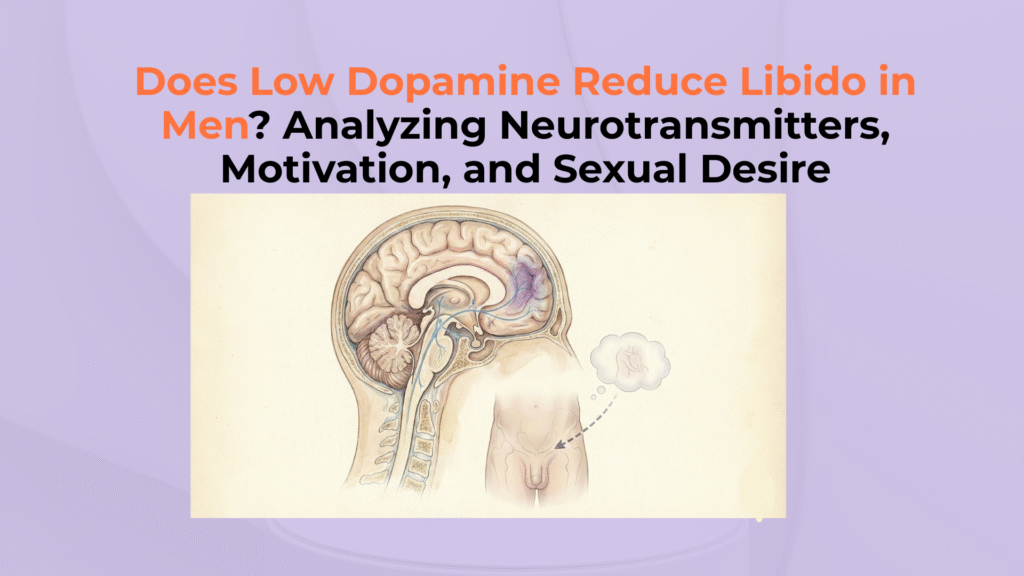
Defining Dopamine as the “Spark” of Desire
Dopamine is the primary neurotransmitter of the brain’s reward system, specifically responsible for the motivation to seek out sexual stimuli (“Wanting”) rather than the hedonic pleasure of the act itself (“Liking”) [C1, C2]. This separation of “wanting” from downstream mechanics is central to understanding Libido vs Arousal in Men.
While Testosterone and Male Libido provide the baseline biological fuel and capacity, Dopamine translates this into active pursuit behavior. Berridge [C1] established this dissociation of wanting vs. liking in reward circuitry.
Dopamine signaling activates incentive salience for sexual cues, increasing pursuit and initiative.
The Premise: The Reward Circuitry and Anticipatory Pleasure
The premise of libido is largely driven by “Anticipatory Pleasure,” where dopamine levels rise prior to the act to drive behavioral pursuit [C2].
Preclinical studies show Dopamine in the Medial Preoptic Area (MPOA) rises during sexual activity [C3]. Sato [C3] and Hull [C4] provide supportive rodent evidence for dopamine’s role in copulatory behavior.
Activation of the reward circuitry signals the expectation of pleasure, motivating the individual to initiate sexual behavior.
How Does Low Dopamine Specifically Impair the Libido Response?
For a comparison with hormonal causes, review the guide on Male Hypoactive Sexual Desire Disorder.
Low dopamine signaling impairs the libido response by blunting reward sensitivity, making standard sexual stimuli insufficient to trigger arousal or motivation [C13].
The Loss of “Wanting” (Anhedonia and Apathy)
The primary symptom of low dopamine signaling is the loss of “Wanting,” clinically manifesting as anhedonia or apathy where the drive to initiate sex is absent [C13].
Often described as “I could perform if I had to, but I don’t care to start,” this state reflects a disconnect between ability and will. Baik [C13] links stress and blunted reward sensitivity directly to this anhedonic state.
Reduced dopaminergic responsiveness blunts the incentive salience of sexual cues, lowering initiation and pursuit.
The Prolactin-Dopamine Inverse Relationship
Dopamine and Prolactin maintain an antagonistic relationship, where reduced dopamine tone allows Prolactin levels to rise, chemically suppressing the sexual drive [C5].
Dopamine acts as a tonic inhibitor; reduced tone permits elevation, a mechanism detailed in Prolactin and Libido in Men. Zeitlin [C7] and StatPearls [C10] confirm that hyperprolactinemia interferes with GnRH.
Lower dopaminergic inhibition allows Prolactin levels to rise, reducing GnRH and testosterone signaling.
What Are the Primary Causes of Low Dopamine in Men?
The primary causes of low dopamine signaling patterns in men include behavioral factors like chronic stress and medical factors such as pharmaceutical side effects [C13, C9]. Reward Adaptation refers to the brain’s tendency to downregulate sensitivity after chronic over-stimulation, leading to a higher threshold for pleasure.
Lifestyle and Behavioral Factors (Over-Stimulation)
Chronic exposure to high-dopamine triggers or chronic stress can lead to reward system adaptation, desensitizing the brain’s response to natural stimuli [C15].
Some studies in behavioral addictions report altered dopaminergic markers like DAT availability. Kuss [C15] and Hou [C16] highlight dopamine alterations in high-stimulation behaviors.
This mirrors the blunting effects seen in Chronic Stress and Libido in Men, where cortisol further perturbs dopamine signaling, potentially blunting natural sexual motivation.
Medical and Pharmacological Causes
Medical causes include the use of medications like antipsychotics or SSRIs, which modulate dopamine or serotonin pathways in ways that suppress libido [C9, C11].
Antipsychotics block D2 receptors (raising prolactin), while SSRIs and Libido in Men explores how serotonergic shifts can specifically dampen dopamine signaling [C9]. Park [C9] and Higgins [C11] detail drug-induced sexual dysfunction.
Neurological conditions like Parkinson’s are also inherently linked to dopamine dysfunction [C18].
Comparison: Dopamine vs. Testosterone vs. Serotonin in Libido
Comparing Dopamine, Testosterone, and Serotonin reveals a neuro-hormonal matrix where each chemical plays a distinct role in incentive, capacity, and modulation.
The Neuro-Hormonal Libido Matrix
| Neuro-Chemical | Role in Libido | Effect of High Levels | Effect of Low Levels |
|---|---|---|---|
| Dopamine | Incentive Salience (“Wanting”) | High Pursuit / Focus [C1] | Apathy / Anhedonia / Low Initiation |
| Testosterone | Baseline Drive / Capacity | High Energy / Support for ED [C8] | Low Desire / Fatigue / ED Risk |
| Serotonin | Inhibitory Modulation (“Brake”) | Reduced Libido / Delayed Orgasm [C11] | Variable; effects depend on context |
[Checklist] Auditing Your Dopamine for Better Sexual Health
Use this functional and behavioral audit to evaluate if dopamine dysregulation may be the underlying cause of your low libido.
Functional and Behavioral Audit
- Initiation Gap: Can perform, but lack motivation to start? (Wanting vs. Ability) [C1].
- Anhedonia: Lack of joy in hobbies/food? (Global reward blunting) [C13].
- Medication Review: Taking antipsychotics or SSRIs? [C9, C11].
- Prolactin Signs: Nipple discharge or gynecomastia? (Check Prolactin) [C6].
- Sleep/Circadian: Poor sleep disrupts dopamine modulation? [C20].
- Safety Rule: Treat persistent low drive as a medical differential diagnosis; seek clinician help.
Conclusion
In conclusion, while Testosterone provides the biological capacity for sex, Dopamine provides the essential motivational “spark” of incentive salience required to pursue it.
Understanding the distinction between “Wanting” and “Liking” [C1], as well as the inhibitory role of Prolactin [C5], is crucial for diagnosing motivation-based libido issues. Reduced initiative is the hallmark of low dopamine.
True sexual health requires balancing the neurochemistry of drive, not just hormones.


3 Responses