
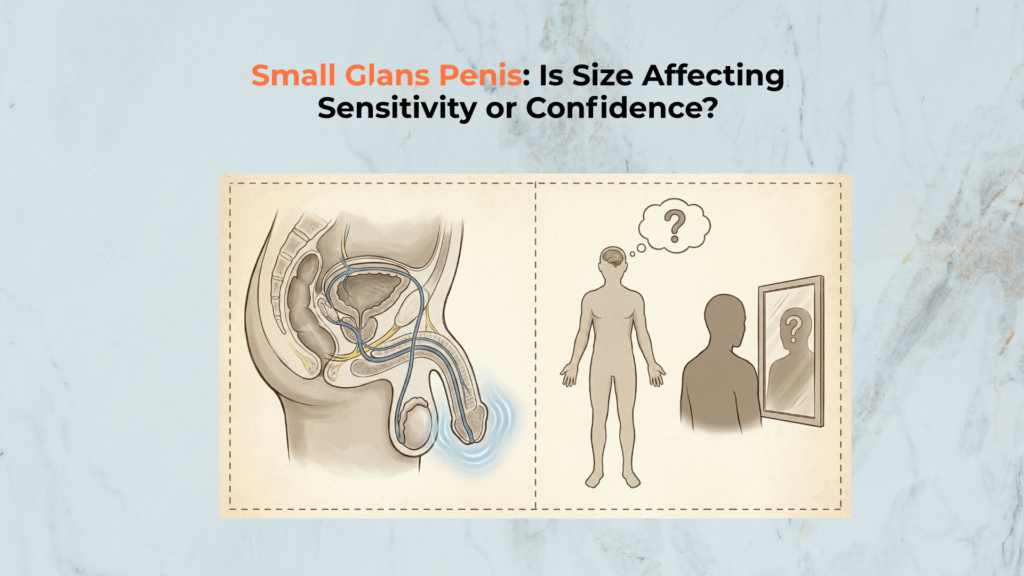
Small Glans Penis: Is Size Affecting Sensitivity or Confidence?
Analyzing Function, Perception, and Friction Mechanics.
The size of a small glans penis rarely affects functional sensitivity negatively; instead, its primary challenge is often Confidence due to media bias, while the reduced frictional surface may be functionally advantageous for male stamina.
Important Medical Disclaimer
This information is for educational purposes only. The small glans is a normal anatomical variant. Confidence issues related to appearance should be addressed through focusing on functional reality, technique, and communication.
Small Glans Penis: At a Glance
- Is it usually normal or serious? For most men with otherwise normal erections, a small glans is a normal size variant, not a disease.
- When should I see a doctor? If you notice new pain, loss of sensation, trouble keeping an erection, or distress that interferes with sex, talk with a urologist or sexual-health professional.
- Can this usually be managed or adapted? Yes. Technique, communication, and positional adjustment can often improve comfort and satisfaction for both partners.
Key Takeaways: Small Glans Functional Reality
- Anatomy: The shaft girth is the widest point (Shaft Dominance).
- Functional Benefit: Reduced localized friction can lead to improved stamina by delaying the ejaculatory reflex.
- Partner Trade-Off: Less effective at creating Entrance Friction (introitus and clitoral hood).
- Compensation: Use Positional Adjustment (Cowgirl) to maximize shaft girth pressure.
- Primary Concern: For most men with otherwise normal anatomy, confidence and media-driven body dysmorphia are a bigger issue than physiological function.
What Is the Anatomical Definition of a Small Glans Penis?
The anatomical definition of a small glans penis is based on the proportionality of the glans relative to the adjacent shaft, leading to a functional shaft dominance.
Defining the Proportionality (Shaft Dominance)
This geometry is characterized by a glans penis (the distal tip of the corpus spongiosum) that is notably narrower or only marginally wider than the adjacent shaft diameter. This contrasts with the Mushroom-Shaped (Wide Glans) Anatomy, which helps separate media-driven perception from physiological necessity. Additionally, cases where the shaft provides uniform girth, such as the Cylindrical Penis Shape, demonstrate how equalized diameter shifts friction away from localized glans sensitivity. Comparing this anatomy against a Large Glans Penis further clarifies how glans-to-shaft ratio directly alters stimulation distribution.
Clinical anatomy texts define the glans as the expanded distal end of the corpus spongiosum and the structural endpoint of the erectile bodies [1]. This establishes the anatomical reality where the shaft, not the glans, dictates the widest girth.
The Premise: The Reduced Frictional Surface
The glans contains a very high density of sensory nerve endings, making its surface area crucial for localized friction. The functional premise is reduced localized friction at the tip upon entry into the Vaginal Introitus.
Anatomy reviews note the glans is the most densely innervated and sensitive part of the penis, receiving afferents primarily from the Dorsal Nerve of the Penis [1-3]. A smaller glans surface area results in lower localized friction at the vaginal entrance, shifting the stimulation focus to the mid-shaft.
How Does a Small Glans Penis Affect Functional Sensitivity?
A small glans penis impacts functional sensitivity by altering the threshold for the ejaculatory reflex, often resulting in a potential benefit for stamina.
Impact on Male Sensitivity (Functional)
Sensory input from the glans is a major contributor to the ejaculatory reflex. A smaller surface area receives less intense, localized friction during intercourse. This reduced friction can lead to a benefit in terms of stamina by making the ejaculatory reflex harder to trigger quickly.
Guidelines for premature ejaculation (PE) recommend treatments reducing penile sensitivity to improve control, supporting the idea that reduced glans stimulation can lengthen ejaculation time [4,5]. Functionally, a smaller glans may be advantageous for prolonging intercourse for some men. If stamina and ejaculatory latency are primary benefits under discussion, the underlying vascular logic is further explained in High Rigidity Penis Mechanics, where control depends on blood trapping rather than tip size.
Impact on Partner Sensation (Mechanical)
The core trade-off for the partner is reduced Entrance Friction at the highly sensitive introitus and surrounding clitoral hood. The small glans is less effective at applying the stretching pressure required to engage the Vaginal Introitus and vulvar vestibule compared to a wide glans.
Anatomical reviews show that the vulvar vestibule and lower third of the vagina are highly innervated by the pudendal nerve, making this zone critical for sensation [7-9]. The focus shifts entirely to the shaft's girth and the mechanical pressure it provides deeper inside, away from the entrance.
How Do You Compensate for Reduced Entrance Friction?
Compensation for reduced entrance friction requires positional adjustment to leverage the maximum girth of the shaft and prioritizing non-phallic stimulation.
Positional Adjustment (Leveraging the Shaft)
Positional Adjustment aims to use positions that maximize the pressure from the shaft's girth, shifting the functional emphasis away from the glans. Positions like Cowgirl or Reverse Cowgirl allow the partner to compress the shaft and control the angle to maximize friction and fullness.
Clinical guidance suggests partners utilize hip compression, rotation, or shallow missionary strokes to increase shaft-to-vaginal wall contact. This technique leverages Shaft Dominance to achieve full internal pressure. For men seeking deeper pressure rather than entrance stimulation, the Tapered Penis Shape shows a related mechanical strategy where distal narrowing emphasizes shaft engagement.
Non-Phallic Stimulation Priority
Since the penis is less effective at stimulating the external clitoral area due to the small glans, direct manual or oral clitoral stimulation becomes essential. The functional anatomy of the small glans requires explicit attention to the Clitoris and other sensitive areas near the Introitus [10–12].
Why Is Confidence the Primary Concern for the Small Glans Penis?
Confidence is the primary concern for the small glans penis because for men with otherwise normal anatomy, the challenge is usually psychological (based on media bias) rather than physiological (function).
The Media Perception Bias
Media often features the Bell/Mushroom shape, creating an unrealistic expectation. This forces males with a smaller glans to develop self-consciousness or body dysmorphic disorder (BDD) regarding their appearance [14-16].
Confidence vs. Functional Reality
The size of the glans is not identified in AUA guidelines as a factor in erectile function. Rigidity relies on veno-occlusive function, not the size of the tip [6].
When Should You Seek Evaluation?
You should seek evaluation for anxiety or functional issues whenever persistent self-distress, erectile difficulty, or symptoms of premature ejaculation occur. If intercourse causes ongoing sharp, burning or tearing pain for either partner, stop rather than pushing through and speak with a healthcare professional.
Red Flags Requiring Specialist Consultation
- Persistent Anxiety: Recurrent intrusive thoughts about genital size or shape (Body Dysmorphia).
- Erectile Dysfunction (ED): Inability to achieve or maintain sufficient rigidity for intercourse.
- Ejaculatory Problems: Sudden or persistent Premature Ejaculation that causes personal distress.
- Loss of Sensation: New or progressive loss of glans sensitivity or ability to climax. When reduced sensation raises concern, distinguishing anatomical variation from pathology is essential, particularly against Cold Glans Physiology, which involves vascular signaling rather than surface geometry.
Functional Summary Checklist
- Sensitivity Check: Is the male partner experiencing satisfactory duration/stamina? (The smaller glans may help).
- Partner Audit: Is the focus of satisfaction shifted to deep pressure (shaft) rather than superficial friction?
- Confidence Check: Is the user's primary concern based on appearance rather than performance?
Glossary of Anatomical and Functional Terms
| Term | Definition |
|---|---|
| Small Glans Penis | An anatomical variant where the glans is only marginally wider than the adjacent shaft, resulting in shaft dominance. |
| Reduced Frictional Surface | The effect of a smaller glans receiving less intense, localized friction, which can delay the ejaculatory reflex. |
| Entrance Friction | The pressure applied to the highly sensitive vaginal introitus and clitoral hood (maximized by a large glans). |
| Ejaculatory Reflex | The physiological response triggered primarily by sensory input from the glans and other structures. |
| Positional Adjustment | The technique of using certain positions (Cowgirl) to compensate for reduced glans friction by leveraging shaft girth. |
Frequently Asked Questions About the Small Glans Penis
Is a small glans penis normal?
Yes. A small glans penis is usually just a normal anatomical variant where the shaft is the widest part (shaft dominance), not a sign of disease or a defect. If erections are otherwise normal and painless, it is typically considered a normal size variation.
Does a small glans penis reduce sexual sensitivity?
For most men, a small glans penis does not cause a harmful loss of sensitivity. The glans still contains dense sensory nerve endings, but the smaller surface area means less intense, localized friction at the entrance and a stronger focus on shaft stimulation instead [1–3].
Can a small glans penis improve stamina?
It can. Because there is less concentrated friction on the glans, the ejaculatory reflex may take longer to trigger, which can help some men last longer. This is consistent with premature ejaculation treatments that work by reducing penile sensitivity to improve control [4,5].
Will my partner feel less pleasure if I have a small glans penis?
Not necessarily. The small glans penis creates less entrance friction but still allows strong internal pressure from the shaft. Partner pleasure usually depends more on comfort, clitoral stimulation, communication, and technique than on glans size alone [8–13,17].
Can I make my glans bigger?
There is no medically recommended, proven method to safely “enlarge” only the glans. Most urology guidelines focus on function, not cosmetic glans size. If you feel distressed about appearance, speaking with a urologist or mental health professional familiar with body dysmorphic disorder and penile dysmorphic disorder can be helpful [14–16].
Does glans size affect erections or fertility?
No. Major guidelines define erectile dysfunction by the ability to achieve and maintain sufficient rigidity for sex, not by glans size [6]. Fertility depends on sperm health, hormones, and other factors, not on whether the glans is small or large.
When should I talk to a doctor about a small glans penis?
Speak with a healthcare professional if the small glans penis is causing persistent distress, relationship problems, erectile difficulty, premature ejaculation that feels out of control, or new loss of sensation [4–6,13]. Also seek care if sex causes ongoing sharp, burning, or tearing pain for you or your partner instead of pushing through it.
Conclusion
In conclusion, the small glans penis is a normal anatomical variant that offers a potential beneficial reduction in localized friction for improved stamina; while confidence may be affected by media bias, functional satisfaction relies on mechanical adaptation.
Talking to Your Partner: Key Sentences
"My anatomy is specialized for deep pressure, so let's try a position that focuses on your hips."
"I'm focusing on your pleasure first; let me know if manual stimulation helps more than thrusting."
At FactBasedUrology, we believe anatomical truth empowers better sexual technique. Embrace the stamina advantage and master the art of positional adjustment.
References
- Sam P. Anatomy, Abdomen and Pelvis, Penis. StatPearls [Internet]. NCBI Bookshelf. https://www.ncbi.nlm.nih.gov/books/NBK482236/
- Weech D. Anatomy, Abdomen and Pelvis, Penis Dorsal Nerve. StatPearls [Internet]. NCBI Bookshelf. https://www.ncbi.nlm.nih.gov/books/NBK525966/
- Panchatsharam PK. Physiology, Erection. StatPearls [Internet]. NCBI Bookshelf. https://www.ncbi.nlm.nih.gov/books/NBK513278/
- Crowdis M, et al. Premature Ejaculation. StatPearls [Internet]. NCBI Bookshelf. https://www.ncbi.nlm.nih.gov/books/NBK546701/
- Shindel AW, et al. Disorders of Ejaculation: An AUA/SMSNA Guideline. American Urological Association. https://www.auanet.org/guidelines-and-quality/guidelines/disorders-of-ejaculation
- Leslie SW, et al. Erectile Dysfunction. StatPearls [Internet]. NCBI Bookshelf. https://www.ncbi.nlm.nih.gov/books/NBK562253/
- Nguyen JD. Anatomy, Abdomen and Pelvis: Female External Genitalia. StatPearls [Internet]. NCBI Bookshelf. https://www.ncbi.nlm.nih.gov/books/NBK547703/
- Yavagal S, et al. Normal Vulvovaginal, Perineal, and Pelvic Anatomy. Obstet Gynecol. Full text via PMC: https://pmc.ncbi.nlm.nih.gov/articles/PMC3312145/
- Azadzoi KM, et al. Neurologic Factors in Female Sexual Function and Dysfunction. J Sex Med. Full text via PMC: https://pmc.ncbi.nlm.nih.gov/articles/PMC2907491/
- Mayo Clinic Staff. Female orgasm: No climax with vaginal penetration? Mayo Clinic. https://www.mayoclinic.org/diseases-conditions/female-sexual-dysfunction/expert-answers/female-orgasm/faq-20058215
- Mayo Clinic Staff. Anorgasmia in women: Symptoms and causes. Mayo Clinic. https://www.mayoclinic.org/diseases-conditions/anorgasmia/symptoms-causes/syc-20369422
- Cleveland Clinic. Clitoris: Anatomy, Location, Purpose & Conditions. https://my.clevelandclinic.org/health/body/22823-clitoris
- Mayo Clinic Staff. Female sexual dysfunction: Diagnosis and treatment. Mayo Clinic. https://www.mayoclinic.org/diseases-conditions/female-sexual-dysfunction/diagnosis-treatment/drc-20372556
- Mayo Clinic Staff. Body dysmorphic disorder: Symptoms and causes. Mayo Clinic. https://www.mayoclinic.org/diseases-conditions/body-dysmorphic-disorder/symptoms-causes/syc-20353938
- Nicewicz HR, et al. Body Dysmorphic Disorder. StatPearls [Internet]. NCBI Bookshelf. https://www.ncbi.nlm.nih.gov/books/NBK555901/
- International Society for Sexual Medicine (ISSM). What is Penile Dysmorphic Disorder? https://www.issm.info/sexual-health-qa/what-is-penile-dysmorphic-disorder
- Cleveland Clinic. Sexual Dysfunction. https://my.clevelandclinic.org/health/diseases/9121-sexual-dysfunction
One Response