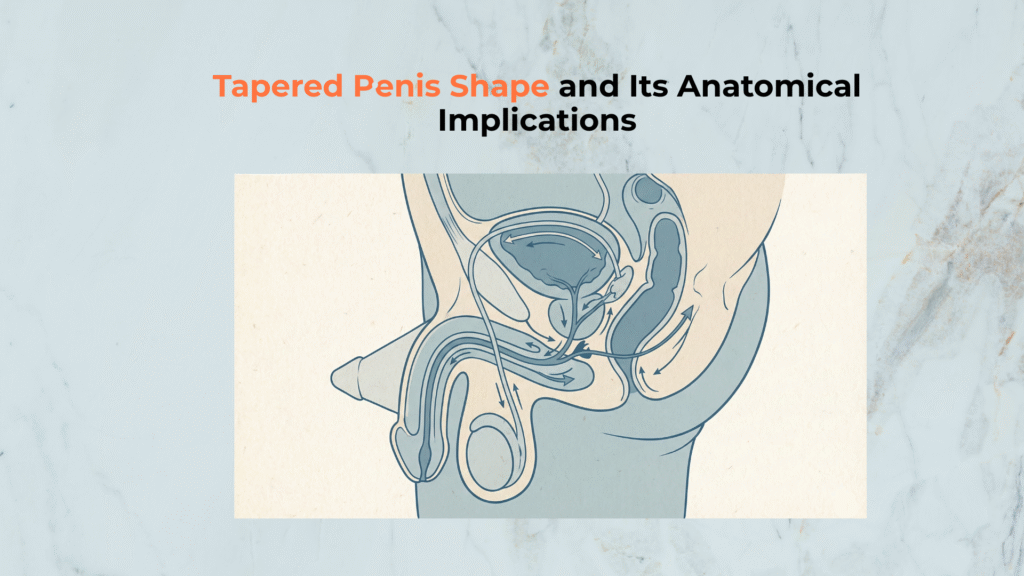
A tapered penis describes a gradual change in width along the shaft. It is an appearance term, not a clinical diagnosis. This guide compares tapering with other descriptive shapes and distinguishes a longstanding contour from a newly acquired narrowing.
How does tapering differ from a cone-shaped penis?
In everyday language, the labels can overlap. “Tapered” describes a width gradient; “cone-shaped” describes a particular silhouette that narrows toward one end. There is no validated percentage difference in girth that establishes either category.
| Term | What it describes | Related guide |
|---|---|---|
| Tapered | Gradual change in shaft width | This comparison guide |
| Cone-shaped | A silhouette narrowing toward the tip | Cone-shaped appearance |
| Mushroom-shaped | A glans wider than the adjacent shaft | Flared glans |
Does tapering identify a specific tissue abnormality?
No. A descriptive contour does not establish the condition of the erectile tissues. The corpora cavernosa and corpus spongiosum are anatomical structures; shape labels do not replace their clinical assessment.
What is known about tapered-shape prevalence and sexual function?
This guide does not assign a prevalence percentage or claim a performance advantage. The cited clinical literature does not validate the earlier 20–25% prevalence, 15% classification cutoff or a shape-specific sexual technique. A geometric analogy does not prove a clinical outcome.
When does narrowing need medical assessment?
A newly acquired indentation, hourglass contour, curve or firm plaque warrants assessment, especially with pain or difficulty with erections or intercourse. Peyronie’s disease can involve several kinds of deformity. A clinician uses history and examination to distinguish causes.
How can a change in shape be described clearly?
Describe where the width changes, when it began and whether it is stable. Note associated symptoms. A change that appeared recently is different from a contour present for many years, even if both are described as tapered.
For a broader comparison, see penis appearance terms explained. This guide is educational and cannot diagnose an individual shape.