What Is Prostatic Fluid? Composition, Function and Contribution to Semen
Prostatic fluid is the secretion released from prostate acini through small ducts into the urethra. It is only one part of seminal plasma. Its unusually high citrate and zinc content, active enzymes and acidic tendency distinguish it from seminal-vesicle fluid and explain how the mixed ejaculate changes after ejaculation.
01. Where is prostatic fluid made?
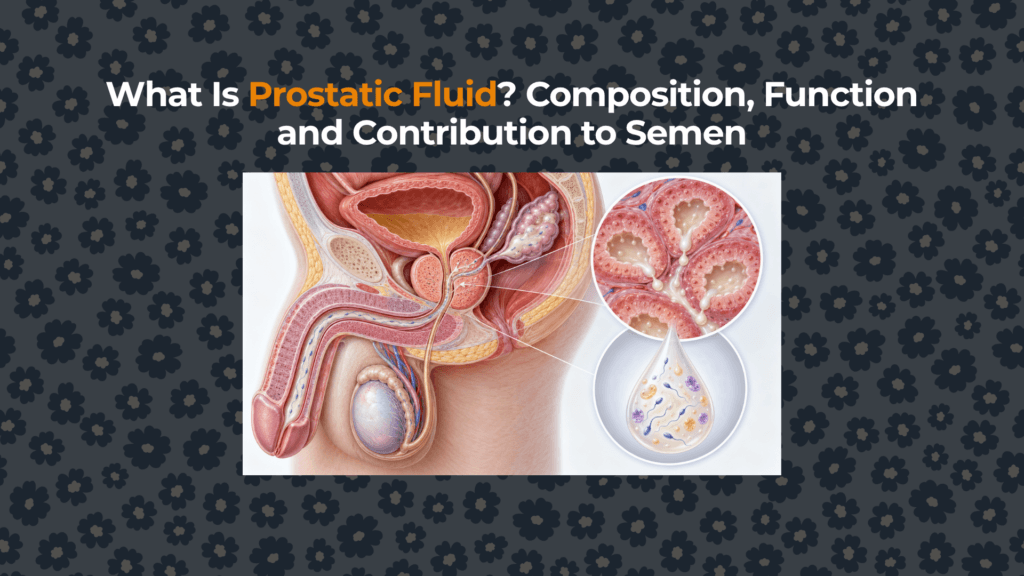
Secretory epithelial cells lining prostate acini manufacture the fluid. It accumulates within glandular lumina and travels through branching ducts that open into the prostatic urethra. Smooth muscle within fibromuscular stroma contracts during emission, helping express the secretion.
The peripheral zone contains a large share of the gland’s secretory tissue and is especially associated with citrate and zinc accumulation. This chemical specialization adds a functional layer to the anatomical zone map.
02. What is in prostatic fluid?
| Constituent | Source relationship | Functional evidence | Clinical caution |
|---|---|---|---|
| PSA | Produced by prostate epithelium | Cleaves semenogelin proteins after ejaculation | Blood PSA is not cancer-specific and does not directly measure semen function |
| Citrate | Produced and secreted at unusually high concentration | Binds zinc; contributes buffering and ion chemistry | Semen citrate is not a stand-alone cancer or fertility test |
| Zinc | Highly accumulated by differentiated prostate cells | Regulates proteins and PSA activity; redistributes after mixing | Concentration does not justify unsupervised supplementation |
| Acid phosphatase | Historically used as a prostate-associated marker | Hydrolytic enzyme in prostatic secretion | Largely replaced by PSA for prostate-cancer assessment |
| Calcium and magnesium | Closely correlated with citrate-rich secretion | Participate in sperm signaling and enzyme systems | Whole-semen levels reflect mixing and cannot isolate one gland perfectly |
| Spermine | Prostate-enriched polyamine | Influences ionic, antimicrobial and biochemical properties | Many proposed roles remain incompletely established in humans |
03. How much semen comes from the prostate?
A frequently cited physiological breakdown assigns about 20–30% of ejaculate volume to the prostate, 50–65% to the seminal vesicles, about 5% to testicular/epididymal contributions and less than 5% to bulbourethral glands. These are approximate proportions, not fixed quotas.
Volume depends on abstinence interval, collection completeness, age, androgen status, medicines, duct patency and prior treatment. Prostate volume itself does not translate directly into fluid volume.
04. Is prostatic fluid alkaline?
This distinction matters because prostatic fluid and whole semen are not interchangeable. Endotext describes typical whole-semen pH around 7.35–7.50 in its composition table, while contemporary semen laboratories follow standardized WHO methods and interpret pH with other findings.
05. How do citrate and zinc work together?
Normal secretory prostate epithelium accumulates zinc, which inhibits mitochondrial aconitase. That limits citrate oxidation and allows citrate to accumulate for secretion. In prostatic fluid, citrate is a principal low-molecular-weight ligand for zinc.
After ejaculation, seminal-vesicle proteins bind much of the zinc. Semenogelin binding reduces free zinc effects and participates in regulating PSA protease activity. PSA then cleaves semenogelin, linking products from two glands in a timed biochemical system. The broader prostate function article explains this sequence at organ level.
06. Can prostatic fluid be tested?
Researchers and specialist clinicians can study expressed prostatic secretion, post-massage urine, split-ejaculate fractions or whole semen. These materials answer different questions and are not directly interchangeable. Expressed secretion is harder to obtain consistently; whole semen is easier but contains several gland sources.
| Sample | What it contains | Typical use | Main limitation |
|---|---|---|---|
| Expressed prostatic secretion | Fluid released after prostate massage | Selected prostatitis research or microscopy/culture protocols | Collection variability, discomfort and contamination |
| Post-massage urine | Urine carrying material expressed from prostate/urethra | Localization within selected infection evaluations | Dilution and imperfect anatomical specificity |
| Split ejaculate | Sequential fractions enriched differently by gland | Research into contribution and composition | Fractions overlap and collection timing is difficult |
| Whole semen | Sperm plus all accessory-gland fluids | Standard fertility-focused semen analysis | Cannot isolate prostate function from one value |
| Blood PSA | PSA crossing into circulation | Risk assessment and monitoring in clinical context | Not a direct sample of prostatic fluid |
07. What changes prostatic-fluid composition?
Inflammation can reduce citrate, zinc and several enzyme activities while raising pH toward a less acidic pattern. Cancer cells also tend to lose the differentiated ability to accumulate zinc and secrete citrate. These group-level biochemical changes are scientifically important but do not create reliable do-it-yourself diagnostic tests.
Androgen signaling, age, medications, duct obstruction, ejaculation frequency and prostate procedures may also alter volume or composition. For inflammatory symptoms, use the prostatitis evidence hub; for malignant risk, biochemical findings must be interpreted within the prostate-cancer diagnostic pathway.
08. Essential distinctions
| Do not confuse | Correct distinction |
|---|---|
| Prostatic fluid vs semen | Prostatic fluid is one component; semen is the final mixed ejaculate containing sperm and several gland secretions. |
| Fluid PSA vs serum PSA | PSA is concentrated in reproductive secretion; a small circulating fraction is measured in blood. |
| Prostatic acidity vs semen pH | Normal isolated prostate secretion tends acidic; larger alkaline seminal-vesicle input raises final semen pH. |
| Biochemical association vs diagnosis | Disease-related group differences do not make a single semen constituent diagnostic. |
| Prostate secretion vs sperm production | The prostate supports seminal plasma; testes produce sperm. |
Summary
Prostatic fluid is a zinc- and citrate-rich secretion containing PSA, phosphatases, polyamines, ions, lipids and water. It contributes about one-quarter of typical semen volume and interacts with seminal-vesicle proteins to control coagulation and liquefaction. Its isolated pH is commonly mildly acidic, even though the final semen mixture is usually alkaline. Laboratory measurements reveal prostate biology, but no single prostatic-fluid constituent diagnoses fertility or disease.
Educational information only; laboratory findings require interpretation by qualified clinicians.
Evidence sources
- Endotext: Composition of Human Semen.
- pH and biochemical relationships in 328 human prostatic-fluid samples.
- Ionic composition of human prostatic and seminal fluid.
- Zinc in normal prostate function and metabolism.
- Semenogelin–zinc binding and PSA regulation.
- WHO Laboratory Manual for Examination and Processing of Human Semen, 6th edition.