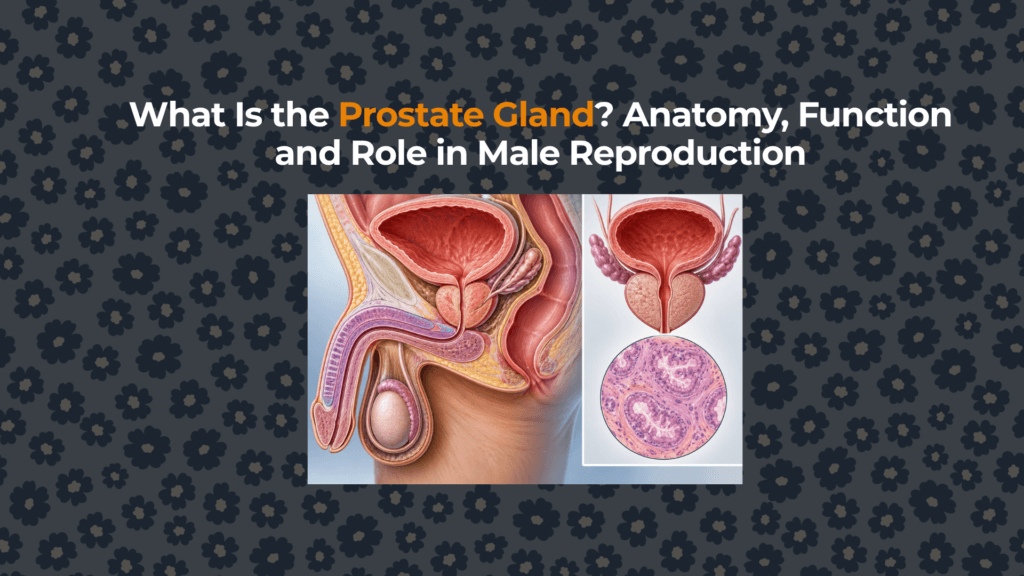
The prostate gland is a male reproductive organ located below the bladder and in front of the rectum. It surrounds the proximal urethra, produces fluid that becomes part of semen and contracts during ejaculation.
Its location connects reproductive function with the lower urinary tract. Prostate tissue does not store urine or produce sperm. It supports semen formation and ejaculation while forming a ring of tissue around the channel that carries urine and semen out of the body.
Medical boundary
Urinary symptoms do not prove prostate disease. Bladder disorders, urethral narrowing, infection, medicines and neurologic conditions can produce similar symptoms. Persistent or severe symptoms require clinical evaluation.
The prostate is both a gland and a muscular organ
The prostate combines glandular tissue, connective tissue and smooth muscle. Glandular cells produce secretions. Fibromuscular tissue supports the organ and contracts during ejaculation. This dual structure explains why the prostate contributes biochemical material to semen and mechanical force to emission.
The broader prostate anatomy and function cluster separates the gland from its zones, capsule, ducts, urethral segment and neighboring reproductive structures.
Where is the prostate located?
The prostate sits deep in the pelvis at the bladder outlet. Its base contacts the bladder neck, while its apex points downward toward the external urinary sphincter. The rectum lies behind it, allowing part of the gland to be assessed through a digital rectal examination.
The gland wraps around the first segment of the urethra. This prostate location relative to the bladder, urethra and rectum explains why prostate enlargement or inflammation can affect urine flow without turning every urinary symptom into a prostate diagnosis.
| Relationship | Anatomical position | Clinical significance |
|---|---|---|
| Bladder | The prostate base lies beneath the bladder neck. | Growth near the outlet can increase resistance to urine flow. |
| Urethra | The prostatic urethra passes through the gland. | Compression and smooth-muscle tone can influence the urinary stream. |
| Rectum | The rectum lies posterior to the prostate. | The posterior surface can be partly assessed by digital rectal examination. |
| Seminal vesicles | Paired vesicles lie behind the bladder and above the prostate. | Their ducts join the vas deferens and pass through the prostate as ejaculatory ducts. |
What are the main zones of the prostate?
The zonal model divides the prostate into peripheral, transition and central zones plus anterior fibromuscular stroma. These are anatomical regions with different tissue relationships and different patterns of common disease.
The zones of the prostate should not be confused with surgical lobes or cancer stages. A zone describes where tissue sits inside the gland; it does not describe how advanced a disease is.
Peripheral zone
The peripheral zone forms much of the posterior and lateral gland. Many prostate adenocarcinomas arise here, which helps explain why some lesions are accessible to rectal examination.
Transition zone
The transition zone surrounds the proximal urethra. Benign prostatic hyperplasia commonly develops here and can narrow the outlet as tissue grows.
Central zone
The central zone surrounds the ejaculatory ducts near the prostate base. It represents a smaller portion of glandular tissue than the peripheral zone.
Anterior fibromuscular stroma
This nonglandular anterior region contains smooth muscle and dense connective tissue. It contributes structural and contractile support.
What does the prostate gland do?
The prostate produces and releases fluid into the urethra during ejaculation. This secretion mixes with sperm from the testes and fluid from the seminal vesicles and other glands. Semen is therefore a combined product, not prostate fluid alone.
The gland’s smooth muscle contracts during emission. This action helps move prostatic secretions and the contents of the ejaculatory ducts into the urethra. The prostatic urethra serves as the shared channel through which these materials enter the distal urinary passage.
The prostate contributes fluid, not sperm
Sperm develop in the testes and mature in the epididymis. The prostate supports the seminal environment through its secretions. The paired seminal vesicles supply a substantial portion of seminal fluid, so prostate function must be understood as one component of an integrated reproductive pathway.
Prostate contraction supports emission
Emission moves sperm and glandular secretions into the posterior urethra before expulsion. Sympathetic signaling coordinates smooth-muscle contraction in reproductive ducts and glands. Pelvic-floor muscles then contribute to the expulsive phase of ejaculation.
How does the prostate relate to fertility?
The prostate supports fertility by contributing fluid and enzymes to semen, but fertility depends on the entire reproductive system. Sperm production, sperm transport, ejaculatory-duct patency, seminal-vesicle function, ejaculation and female reproductive factors all influence conception.
Removal of the prostate and seminal vesicles during radical prostatectomy prevents natural ejaculation of semen. This outcome demonstrates the gland’s reproductive role, but it does not mean ordinary variations in prostate size directly measure fertility.
How is the prostate examined and measured?
A digital rectal examination assesses part of the posterior gland for size, tenderness, symmetry, consistency or nodularity. Ultrasound and MRI estimate volume and show internal structures more directly. PSA testing measures a prostate-derived protein in blood; it does not measure gland function and does not diagnose cancer by itself.
- Digital rectal examination provides a limited tactile assessment of the posterior surface.
- Transrectal or transabdominal ultrasound estimates volume and can support selected procedures.
- Magnetic resonance imaging characterizes anatomy and suspicious lesions using multiple imaging sequences.
- Biopsy samples tissue when histologic diagnosis is required.
What conditions affect the prostate gland?
| Condition | Core process | Typical clinical question |
|---|---|---|
| Benign prostatic hyperplasia | Noncancerous stromal and epithelial growth, commonly in the transition zone. | Is growth contributing to symptoms or obstruction? |
| Prostatitis | Bacterial infection or a chronic pelvic-pain syndrome, depending on subtype. | Is infection present, and what explains the pain pattern? |
| Prostate cancer | Malignant cellular growth, most often adenocarcinoma. | What is the grade, stage and risk of progression? |
The detailed prostate function pathway keeps these diseases separate from the organ’s normal role. A normal function page should explain physiology; disease pages should own diagnosis and treatment.
When should prostate symptoms be evaluated?
Evaluation is appropriate for persistent urinary symptoms, pelvic pain, painful ejaculation, recurrent urinary infection, visible blood in urine or semen, or concern about prostate-cancer risk. Urgent assessment is required for inability to urinate, fever with urinary symptoms, confusion, severe weakness or rapidly worsening pain.
The prostate’s anatomy explains possible symptom pathways, but it does not establish the diagnosis. Clinical evaluation identifies whether the prostate, bladder, urethra, nervous system or another structure is responsible.
Summary: the prostate gland’s defining attributes
- Identity: The prostate is a glandular and fibromuscular organ of the male reproductive system.
- Location: It lies below the bladder, in front of the rectum and around the proximal urethra.
- Structure: It contains peripheral, transition and central zones plus anterior fibromuscular stroma.
- Function: It adds fluid to semen and contracts during emission and ejaculation.
- Boundary: It does not produce sperm, store urine or make every male urinary symptom a prostate disorder.
Medical sources
- National Institute of Diabetes and Digestive and Kidney Diseases. Prostate Problems.
- National Cancer Institute. Understanding Prostate Changes.
- National Center for Biotechnology Information. Endotext: Benign Prostatic Hyperplasia.
FactBasedUrology provides medical education, not personal diagnosis or treatment. Consult a qualified healthcare professional for individual symptoms or screening decisions.