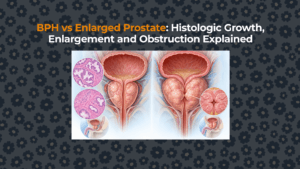
Prostatitis and benign prostatic hyperplasia (BPH) are different prostate conditions even though both can cause urinary frequency, urgency, weak flow, hesitancy or incomplete emptying. BPH refers to benign hyperplastic growth of prostate tissue and is closely associated with age-related prostate enlargement and, in some men, bladder outlet obstruction. Prostatitis includes bacterial prostate infections and chronic pelvic pain syndromes in which pain, inflammation, infection or pelvic-floor mechanisms may be more important than prostate size.
01. What Is the Difference Between Prostatitis and BPH?
BPH is not simply another name for an enlarged prostate
The terminology around BPH is often simplified in everyday conversation, but the medical distinctions are useful.
Current EAU male lower urinary tract symptom guidance separates:
- benign prostatic hyperplasia (BPH): the characteristic histological growth pattern within prostate tissue;
- benign prostatic enlargement (BPE): an increase in prostate size;
- benign prostatic obstruction (BPO): bladder outlet obstruction attributed to benign prostate enlargement.
These concepts are related, but they are not identical.
A man can have histological BPH without severe urinary symptoms. Another can have a large prostate without proportionate obstruction. A third can have troublesome lower urinary tract symptoms partly caused by the bladder rather than the prostate.
For the broader BPH pathway, see Benign Prostatic Hyperplasia and Prostate Enlargement.
What does prostatitis mean?
Prostatitis covers several clinically different prostate and pelvic-pain conditions.
The major categories include:
- acute bacterial prostatitis: a sudden bacterial infection involving the prostate;
- chronic bacterial prostatitis: persistent or recurrent bacterial infection associated with the prostate;
- chronic prostatitis/chronic pelvic pain syndrome (CP/CPPS): persistent or recurrent pelvic or prostate-region pain without a proven bacterial infection explaining the syndrome;
- asymptomatic inflammatory prostatitis: inflammation identified without the typical prostatitis symptom syndrome.
These categories are explained in more detail in Prostatitis and Prostate Pain.
Does prostatitis mean the prostate is enlarged?
No.
An acutely infected prostate can become swollen, but prostate enlargement is not the defining feature of prostatitis.
Similarly, chronic pelvic pain can be substantial even when prostate volume is not particularly large.
This is one of the most important differences from BPH-related enlargement: the severity of prostatitis pain cannot be inferred from prostate size.
Does BPH mean the prostate is inflamed?
No.
Inflammation and fibrosis may participate in the biology of BPH in some men, but BPH is not diagnosed as an inflammatory prostate disorder.
The defining pathological concept is benign hyperplastic growth.
Calling BPH “prostatitis” simply because inflammatory cells can sometimes be present would confuse two different clinical diagnoses.
02. Which Symptoms Point More Toward Prostatitis or BPH?
Why are these conditions easy to confuse?
Both can produce lower urinary tract symptoms (LUTS).
Shared symptoms can include:
- urinary frequency;
- urgency;
- nocturia;
- hesitancy;
- weak urinary stream;
- intermittent flow;
- straining;
- and a feeling of incomplete emptying.
Those symptoms alone do not establish either diagnosis.
Current EAU guidance emphasizes that male LUTS are multifactorial. They can arise from benign prostatic obstruction, bladder dysfunction, detrusor underactivity, overactive bladder, infection and other urological conditions.
Which symptoms are more characteristic of BPH-related obstruction?
BPH-related disease becomes more likely when the dominant pattern is chronic lower urinary tract dysfunction without an inflammatory or infectious illness.
Common complaints include:
- slow urinary stream;
- hesitancy before urine starts;
- intermittent flow;
- straining to void;
- post-void dribbling;
- incomplete emptying;
- increased daytime frequency;
- urgency;
- and waking at night to urinate.
However, none of these symptoms proves that benign prostate enlargement is the sole cause.
Which symptoms make prostatitis more likely?
Pain and infectious features help separate prostatitis from uncomplicated BPH.
Features that increase suspicion for prostatitis include:
- perineal pain;
- penile or scrotal pain;
- deep pelvic or prostate-region pain;
- painful ejaculation;
- pain or burning with urination;
- fever or chills in acute bacterial disease;
- a markedly tender prostate;
- and recurrent documented urinary infections in chronic bacterial prostatitis.
For the wider symptom pattern, see Prostatitis Symptoms.
Is pelvic pain typical of BPH?
Pelvic or perineal pain is not a defining feature of BPH.
A man can certainly have BPH and pelvic pain at the same time, but severe perineal, penile, ejaculatory or prostate-region pain should not automatically be blamed on prostate enlargement.
Other causes—including prostatitis, CP/CPPS, pelvic-floor dysfunction, infection and other pelvic conditions—may need evaluation.
Is fever typical of BPH?
No.
BPH does not normally produce fever, chills or systemic infection.
Fever in a man with urinary difficulty should change the clinical concern toward infection or another acute process.
Sudden fever combined with pelvic pain and urinary symptoms is particularly important because it can fit acute bacterial prostatitis.
Can both conditions cause urinary retention?
Yes, but through different mechanisms.
In BPH-related disease, urinary retention can occur when benign prostate enlargement and outlet resistance make it progressively difficult for the bladder to empty.
During acute bacterial prostatitis, inflammatory swelling around the prostatic urethra can rapidly impair urine flow.
Complete inability to urinate requires prompt medical assessment regardless of the suspected cause.
03. How Do Doctors Tell Prostatitis and BPH Apart?
The diagnostic question is different for each condition
For prostatitis, clinicians ask: Is there infection, inflammation or a chronic pelvic-pain syndrome?
For BPH-related disease, the question is closer to: Is benign prostate enlargement contributing to bothersome lower urinary tract symptoms or true bladder outlet obstruction?
Those questions require different evidence.
What tests are useful when prostatitis is suspected?
Depending on the clinical pattern, evaluation can include:
- history of pain, urinary symptoms and fever;
- urinalysis;
- midstream urine culture;
- careful digital rectal examination;
- blood testing in acute systemic infection;
- two-glass or four-glass prostate localization testing in selected chronic bacterial cases;
- pelvic-floor examination when CP/CPPS is suspected;
- and imaging when an abscess or another complication needs to be excluded.
The full process is explained in How Is Prostatitis Diagnosed?.
What tests are useful when BPH or benign obstruction is suspected?
Evaluation of male LUTS can include:
- medical history;
- validated symptom scoring;
- physical and digital rectal examination;
- urinalysis;
- post-void residual urine measurement;
- uroflowmetry;
- prostate imaging when prostate size will influence treatment;
- PSA when its result would change management or help estimate prostate volume/progression risk;
- and urodynamic pressure-flow testing in selected cases where the mechanism of obstruction remains uncertain.
EAU guidance emphasizes that prostate volume becomes particularly important when considering 5-alpha-reductase inhibitors or choosing an intervention.
Can a digital rectal examination tell the difference?
It can provide useful clues, but not a definitive diagnosis by itself.
During acute bacterial prostatitis, the gland can be markedly tender or swollen.
With BPH-related enlargement, the prostate may feel enlarged without the severe tenderness expected in an acute infection.
However, examination alone cannot reliably determine:
- whether urinary symptoms are caused by obstruction;
- whether bacteria are present;
- or whether chronic pelvic pain originates from the prostate, pelvic floor or another structure.
Does prostate size distinguish BPH from prostatitis?
Not reliably.
A large prostate supports benign prostate enlargement, particularly in the appropriate age and urinary-symptom context, but it does not prove that enlargement is causing all symptoms.
Likewise, a normal-sized prostate does not exclude prostatitis or CP/CPPS.
What does uroflowmetry show?
Uroflowmetry measures how urine flow changes while a patient voids.
A reduced maximum flow rate can support the presence of voiding dysfunction, but low flow is not specific to BPH.
It can also occur with:
- bladder outlet obstruction;
- urethral stricture;
- weak detrusor contraction;
- or inadequate bladder volume during the test.
For this reason, a slow flow curve should not automatically be translated into “the prostate is enlarged.”
What does post-void residual urine show?
Post-void residual urine estimates how much urine remains in the bladder after urination.
An elevated residual can occur when bladder emptying is impaired, but the test does not by itself establish whether the cause is benign prostate obstruction, weak bladder contraction or another condition.
Can PSA distinguish BPH from prostatitis?
No.
PSA is produced by prostate tissue and can be affected by several prostate conditions.
BPH and larger prostate volume can be associated with higher PSA, while active prostatitis can also temporarily raise PSA.
PSA therefore cannot be used as a simple “BPH versus prostatitis” test.
During active prostatitis, current EAU infection guidance advises against using PSA as a diagnostic test for the inflammatory episode because it does not provide useful information for establishing prostatitis.
For the specific relationship between infection and PSA, see Can Prostatitis Raise PSA?.
04. How Do Prostatitis and BPH Treatments Differ?
Why can alpha blockers be used for both conditions?
Alpha blockers are one reason patients sometimes assume the conditions are the same.
Medicines such as tamsulosin can reduce smooth-muscle tone around the prostate and bladder-neck region.
In men with BPH-related LUTS, alpha blockers are commonly used to improve urinary symptoms.
In CP/CPPS, current chronic-pelvic-pain guidance also supports alpha blockers in selected patients—particularly when voiding dysfunction is an important component.
The fact that one medicine can help symptoms in two conditions does not mean the conditions share the same underlying disease process.
Are 5-alpha-reductase inhibitors used for prostatitis?
Not as routine infection or chronic pelvic-pain treatment.
Medicines such as finasteride and dutasteride target androgen-dependent prostate growth and can reduce prostate volume over time in appropriately selected men with enlarged prostates.
That makes them primarily relevant to the BPH/BPE pathway rather than bacterial prostatitis.
For the distinction between the major BPH medication classes, see Alpha Blockers vs 5-Alpha-Reductase Inhibitors.
Are antibiotics used for BPH?
No, not simply because a man has BPH.
Antibiotics treat bacterial infection.
They are therefore central to treatment of acute and chronic bacterial prostatitis when clinically indicated, but they do not shrink benign hyperplastic tissue or correct benign prostatic obstruction.
The different bacterial and nonbacterial prostatitis treatments are explained in How Is Prostatitis Treated?.
Is pelvic-floor physical therapy a BPH treatment?
Not for benign prostate enlargement itself.
Pelvic-floor therapy can be useful when chronic pelvic pain includes muscle overactivity, myofascial trigger points or impaired pelvic-floor relaxation.
That makes it particularly relevant to selected men with CP/CPPS.
If a man has both BPH and pelvic-floor dysfunction, the conditions can require separate treatment strategies.
When are BPH procedures considered?
Procedures are generally considered when bothersome urinary symptoms or benign prostatic obstruction justify intervention, particularly when:
- medication provides insufficient benefit;
- complications develop;
- urinary retention becomes clinically important;
- or the patient prefers procedural treatment after shared decision-making.
Procedure selection depends on factors such as:
- prostate size;
- prostate anatomy;
- severity of obstruction;
- bleeding risk;
- sexual-function priorities;
- durability expectations;
- and local expertise.
The major options are compared in the BPH Procedures Guide.
Does prostate surgery treat CP/CPPS?
Not routinely.
Current EAU chronic-pelvic-pain guidance states that evidence does not support procedures such as TURP or radical prostatectomy as treatment for primary prostate pain syndrome simply to remove chronic pain.
This is clinically important because urinary symptoms and prostate-region pain can coexist.
A man should not undergo tissue-removing BPH surgery solely on the assumption that all chronic pelvic pain comes from benign prostate enlargement.
Can someone have BPH and prostatitis at the same time?
Yes.
These diagnoses are not mutually exclusive.
An older man with established benign prostate enlargement can develop a bacterial urinary infection or acute bacterial prostatitis.
A man with BPH can also develop CP/CPPS or another pelvic-pain condition.
When conditions coexist, treatment may need to address each problem separately.
Can BPH increase the risk of infection?
Significant bladder outlet obstruction and incomplete emptying can create urinary stasis, which can contribute to urinary complications in some men.
That does not mean BPH itself is an infection.
If infection occurs, it should be evaluated as a separate clinical problem.
What if urinary symptoms remain after prostatitis treatment?
Persistent urinary symptoms after the infectious episode has resolved should not automatically trigger more antibiotics.
Depending on the patient, clinicians may reassess:
- urine culture;
- prostate size;
- uroflowmetry;
- post-void residual urine;
- bladder function;
- pelvic-floor muscle function;
- and whether benign prostatic obstruction or another urinary condition is present.
What if pelvic pain remains after BPH treatment?
Improving obstruction does not guarantee that unrelated chronic pelvic pain will disappear.
Persistent perineal pain, penile pain, painful ejaculation or pelvic-floor tenderness after successful BPH treatment should prompt evaluation for another pain source rather than assuming the prostate remains mechanically obstructed.
Prostatitis vs BPH: Side-by-Side Comparison
| Clinical feature | Prostatitis | BPH / benign prostate enlargement |
|---|---|---|
| Core condition | Includes acute bacterial infection, chronic bacterial infection and nonbacterial chronic pelvic pain syndromes. | Benign hyperplastic growth of prostate tissue, often associated with enlargement as men age. |
| Does it require prostate enlargement? | No. | BPH is histological; clinically relevant BPE refers specifically to enlargement. |
| Does it require bacterial infection? | Only bacterial prostatitis does. CP/CPPS does not. | No. |
| Main urinary symptoms | Frequency, urgency, dysuria, hesitancy, weak flow or incomplete emptying can occur. | Weak stream, hesitancy, intermittency, straining, frequency, urgency, nocturia and incomplete emptying can occur. |
| Pelvic or perineal pain | Common and often diagnostically important. | Not a defining feature. |
| Painful ejaculation | Can occur, particularly in chronic prostatitis/CPPS. | Not a defining feature of BPH itself. |
| Fever / chills | Can occur in acute bacterial prostatitis. | Not caused by uncomplicated BPH. |
| Age pattern | Can affect men across adulthood; prostatitis is particularly important in younger and middle-aged men. | Becomes increasingly common with advancing age; symptoms are uncommon in younger men. |
| Urine culture | Important for bacterial prostatitis. | Not used to diagnose BPH itself, although urinalysis is part of LUTS evaluation. |
| Pelvic-floor examination | Can be important in CP/CPPS. | Not a routine test for establishing BPH. |
| Prostate volume measurement | Does not establish the diagnosis. | Can guide medication and procedural selection. |
| Uroflowmetry / residual urine | May be useful if urinary dysfunction needs characterization. | Commonly useful in male LUTS evaluation. |
| Antibiotics | Used for bacterial prostatitis. | Not treatment for BPH itself. |
| Alpha blockers | May help CP/CPPS when voiding symptoms are present. | Common BPH/LUTS medication class. |
| 5-alpha-reductase inhibitors | Not routine treatment for bacterial prostatitis or CP/CPPS. | Used in selected men with enlarged prostates and progression risk. |
| Pelvic-floor physical therapy | Can be useful for CP/CPPS with myofascial dysfunction. | Does not treat benign prostate enlargement itself. |
| Prostate procedures | Not routine treatment for CP/CPPS. | Can treat clinically significant benign prostatic obstruction. |
Common Questions About Prostatitis vs BPH
| Question | Practical answer |
|---|---|
| Are prostatitis and BPH the same condition? | No. |
| Is BPH inflammation of the prostate? | No. BPH is a benign hyperplastic tissue-growth process, although inflammatory mechanisms may coexist. |
| Is prostatitis caused by an enlarged prostate? | No. Prostatitis includes infectious and chronic pain conditions that do not require enlargement. |
| Can prostatitis enlarge the prostate temporarily? | Acute inflammation can cause swelling, but this is different from benign prostatic enlargement due to BPH. |
| Can both cause weak urine flow? | Yes. |
| Can both cause urinary frequency? | Yes. |
| Can both cause incomplete emptying? | Yes, although the mechanism may differ. |
| Which is more associated with pelvic pain? | Prostatitis and CP/CPPS. |
| Which is more associated with nocturia and chronic voiding symptoms? | BPH-related LUTS commonly produce this pattern, although nocturia is not specific to BPH. |
| Does fever suggest BPH? | No. Fever should prompt evaluation for infection or another acute illness. |
| Can BPH cause painful ejaculation? | It is not a defining BPH symptom; prostatitis or another pelvic condition should be considered if ejaculatory pain is prominent. |
| Does a large prostate prove BPH is causing symptoms? | No. Prostate volume is only one part of the evaluation. |
| Can a normal-sized prostate have prostatitis? | Yes. |
| Can PSA be high in both? | Yes. BPH/prostate volume and active prostatitis can both influence PSA. |
| Does PSA distinguish BPH from prostatitis? | No. |
| Are alpha blockers used for both? | They can be. In both settings the target is urinary/voiding symptoms, not infection. |
| Do antibiotics treat BPH? | No. |
| Do finasteride or dutasteride treat prostatitis? | They are primarily BPH/prostate-growth treatments and are not routine therapy for bacterial prostatitis or CP/CPPS. |
| Does TURP treat chronic pelvic pain? | It is a treatment for selected benign prostatic obstruction, not a routine treatment for CP/CPPS. |
| Can a man have both BPH and prostatitis? | Yes. |
| What symptom requires urgent care? | Complete inability to urinate requires prompt assessment. Fever, chills, confusion or rapidly worsening illness with urinary symptoms also requires urgent medical evaluation. |
Summary
- Prostatitis and BPH are different prostate conditions.
- BPH is fundamentally a benign hyperplastic growth process within prostate tissue.
- Benign prostatic enlargement refers to increased prostate size.
- Benign prostatic obstruction refers to bladder outlet obstruction attributable to benign prostate enlargement.
- BPH, prostate enlargement and obstruction should not be treated as interchangeable terms.
- Prostatitis includes acute bacterial prostatitis, chronic bacterial prostatitis, CP/CPPS and asymptomatic inflammatory prostatitis.
- Bacterial prostatitis involves infection; CP/CPPS does not have a proven bacterial infection explaining the chronic syndrome.
- Prostatitis does not require an enlarged prostate.
- BPH is not diagnosed as an infectious prostate condition.
- Inflammation may contribute to BPH biology without making BPH equivalent to prostatitis.
- BPH and prostatitis can both cause urinary frequency, urgency, hesitancy, weak stream and incomplete emptying.
- Lower urinary tract symptoms are not specific to BPH.
- Current EAU guidance emphasizes that male LUTS can arise from several prostate and bladder mechanisms.
- Pelvic or perineal pain is more characteristic of prostatitis/CPPS than uncomplicated BPH.
- Painful ejaculation can occur in prostatitis and CP/CPPS.
- Fever and chills are not features of uncomplicated BPH.
- Sudden fever, pelvic pain and urinary symptoms raise concern for acute bacterial prostatitis.
- Both severe BPH-related obstruction and acute inflammatory swelling can contribute to urinary retention.
- A digital rectal examination can provide useful clues but cannot establish the entire diagnosis.
- Prostate size does not determine prostatitis severity.
- A large prostate does not prove that all urinary symptoms are caused by BPH.
- Uroflowmetry measures urinary flow but low flow is not specific to benign prostate obstruction.
- Post-void residual urine measures incomplete bladder emptying but does not identify the cause by itself.
- Prostate imaging becomes important when prostate size will affect BPH treatment selection.
- Urinalysis and culture become particularly important when bacterial prostatitis is suspected.
- Pelvic-floor assessment can reveal myofascial dysfunction in CP/CPPS.
- PSA cannot reliably distinguish BPH from prostatitis.
- Active prostatitis can temporarily increase PSA.
- Alpha blockers can be used in both BPH-related LUTS and selected CP/CPPS patients with voiding symptoms.
- The use of the same drug in both conditions does not make them the same disease.
- 5-alpha-reductase inhibitors primarily target androgen-dependent prostate growth and are used in selected BPH patients.
- Antibiotics treat bacterial prostatitis but do not treat uncomplicated BPH.
- Pelvic-floor physical therapy can help selected CP/CPPS patients but does not shrink benign prostate enlargement.
- BPH procedures treat clinically important benign prostatic obstruction and should not be used simply to remove chronic pelvic pain.
- BPH and prostatitis can coexist in the same patient.
- Persistent urinary symptoms after prostatitis treatment may require evaluation for BPH, bladder dysfunction or another urinary condition.
- Persistent pelvic pain after BPH treatment should not automatically be attributed to remaining obstruction.
- The most useful distinction is therefore mechanism: benign tissue growth and possible obstruction versus infection or chronic pelvic-pain mechanisms.
Educational disclaimer: This article provides general medical education about prostatitis and benign prostatic hyperplasia. Weak urinary flow, frequency, urgency, pelvic pain and incomplete emptying can result from several prostate, bladder and urinary conditions. Complete inability to urinate requires prompt medical assessment. Fever, shaking chills, confusion or rapidly worsening illness with urinary symptoms may indicate infection rather than uncomplicated BPH and should also be evaluated promptly.
Explore the Prostate Health Pathways
For the complete distinction between bacterial prostate infection, inflammation and chronic pelvic pain, see Prostatitis and Prostate Pain.
For benign prostate growth, enlargement, urinary symptoms and obstruction, continue to Benign Prostatic Hyperplasia and Prostate Enlargement.
If the main uncertainty is whether urinary symptoms represent prostate infection or urinary infection elsewhere in the urinary tract, see Prostatitis vs UTI.
For how infection, pelvic pain and prostate examination are evaluated, see How Is Prostatitis Diagnosed?.
For how antibiotics, alpha blockers, pain treatment and pelvic-floor rehabilitation fit into the different prostatitis subtypes, see How Is Prostatitis Treated?.
If BPH treatment is being considered, the distinction between symptom-relieving and prostate-shrinking medicines is explained in Alpha Blockers vs 5-Alpha-Reductase Inhibitors, while procedural options are compared in the BPH Procedures Guide.
The next comparison explains how prostatitis differs from prostate cancer, including symptom patterns, PSA interpretation, imaging, infection and when further cancer evaluation may be appropriate.
Evidence Sources
- European Association of Urology. Management of Non-neurogenic Male LUTS — Terminology and the distinction between BPH, LUTS and benign prostatic obstruction.
- European Association of Urology. Male LUTS — BPH, Benign Prostatic Enlargement, Benign Prostatic Obstruction and Other Causes of Lower Urinary Tract Symptoms.
- European Association of Urology. Male LUTS — Diagnostic Evaluation, Prostate Volume, Uroflowmetry and Imaging.
- European Association of Urology. Male LUTS — Conservative, Medical and Surgical Management of Benign Prostatic Obstruction.
- European Association of Urology. Urological Infections Guidelines — Acute and Chronic Bacterial Prostatitis.
- European Association of Urology. Chronic Pelvic Pain Guidelines — Primary Prostate Pain Syndrome and Chronic Pelvic Pain Classification.
- European Association of Urology. Chronic Pelvic Pain — Diagnostic Evaluation of Primary Prostate Pain Syndrome.
- National Institute of Diabetes and Digestive and Kidney Diseases. Prostate Problems — Prostatitis, BPH, Symptoms, Diagnosis and Treatment.