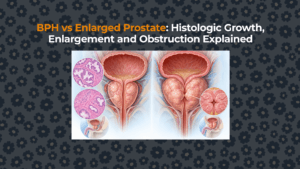
BPH treatment is chosen according to symptom burden, risk of progression, prostate anatomy, evidence of obstruction, bladder function, complications and patient priorities. A larger prostate or higher symptom score does not automatically mean surgery.
01. Benign Prostatic Hyperplasia: Treatment Options and Decision Factors
Which management or treatment categories are used for benign prostatic hyperplasia?
| Category | Best aligned clinical problem | Main limitation |
|---|---|---|
| Watchful waiting and self-care | Mild or moderately bothersome uncomplicated LUTS with acceptable risk | Requires follow-up; symptoms or residual urine may progress. |
| Alpha-1 blockers | Faster improvement of moderate-to-severe LUTS | Do not shrink the prostate or prevent long-term retention/surgery. |
| 5-alpha-reductase inhibitors | Enlarged prostate with increased progression risk | Slow onset; sexual adverse effects and PSA interpretation changes. |
| Storage-symptom medicines | Urgency, frequency or urgency incontinence after assessing emptying | Require PVR and adverse-effect review in appropriately selected men. |
| PDE5 inhibitor | Male LUTS, particularly when erectile dysfunction coexists | Contraindicated with nitrates; effect on measured obstruction is limited. |
| Minimally invasive or surgical treatment | Complications, persistent bother, objective obstruction or preference for durable relief | Suitability and sexual, bleeding, anaesthetic and retreatment risks vary. |
When is observation or conservative management appropriate?
Observation is appropriate when symptoms are mild or acceptable, evaluation shows no urgent complication and the patient understands follow-up. The EAU strongly recommends watchful waiting for men with mild-to-moderate LUTS who are minimally bothered. Useful measures include timing fluid intake, moderating caffeine and alcohol, treating constipation, reviewing medicines, relaxed or double voiding and monitoring change.
Conservative care is active management, not neglect. Increasing bother, recurrent retention, infection, stones, haematuria, renal impairment or a rising residual should trigger reassessment.
02. How Is Benign Prostatic Hyperplasia Managed or Treated?
Which medicines and procedures are used for benign prostatic hyperplasia?
Alpha blockers such as tamsulosin, alfuzosin, doxazosin, terazosin and silodosin reduce smooth-muscle tone and act relatively quickly. EAU trials show typical IPSS reductions of about 30–40% and Qmax increases of 20–25%, but they do not reduce prostate size or prevent long-term retention.
Finasteride and dutasteride are 5-alpha-reductase inhibitors for men with enlargement and higher progression risk. After two to four years, the EAU reports approximately 15–30% IPSS improvement, 18–28% prostate-volume reduction and a 1.5–2.0 mL/s Qmax increase. They also reduce long-term acute-retention and surgery risk. Antimuscarinics or beta-3 agonists target storage symptoms in selected men; tadalafil can improve male LUTS with or without erectile dysfunction.
Procedures include prostate-lifting or water-vapour approaches for selected anatomy, endoscopic resection or incision, laser vaporisation or enucleation, waterjet ablation, prostate-artery embolisation in selected settings, and simple prostatectomy for some very large glands. Each technique has separate selection criteria and should not be treated as interchangeable.
How do symptoms, anatomy and disease risk affect treatment choice?
Voiding-predominant symptoms may align with outlet-directed therapy; urgency and frequency may require bladder-focused treatment. Prostate volume and median-lobe anatomy affect medication benefit and procedural eligibility. Recurrent retention, bladder stones, recurrent infection, treatment-resistant bleeding or upper-tract effects strengthen the case for intervention. Detrusor underactivity can reduce expected benefit even when resistance is relieved.
03. Benign Prostatic Hyperplasia: Treatment Selection, Outcomes and Trade-offs
What outcomes matter when comparing management options?
Relevant outcomes include symptom and quality-of-life improvement, flow, residual urine, avoidance of retention, durability, retreatment, recovery time and preservation of continence, erection and ejaculation. A large IPSS change is valuable only if it improves the symptoms and activities that matter to the patient.
Which adverse effects or trade-offs should be considered?
| Option | Important trade-offs | Monitoring point |
|---|---|---|
| Alpha blocker | Dizziness, orthostatic hypotension, ejaculatory dysfunction; floppy-iris risk around cataract surgery | Blood pressure, falls, urinary response; inform eye surgeon. |
| 5-ARI | Reduced libido, erectile/ejaculatory effects, breast symptoms; slow benefit | PSA falls about 50% by 6–12 months and needs adjusted interpretation. |
| Antimuscarinic | Dry mouth, constipation, possible rising residual urine | Symptoms and PVR; EAU advises against use when PVR exceeds 150 mL. |
| Procedure | Bleeding, infection, stricture, incontinence, ejaculatory change, anaesthetic and retreatment risks vary | Match technique, anatomy, risk and desired durability. |
04. How Is the Best-Fit Management Strategy Chosen for Benign Prostatic Hyperplasia?
When should treatment be changed, escalated or de-escalated?
Change treatment when benefit is inadequate after an appropriate trial, adverse effects outweigh benefit, adherence is poor, priorities change or objective risk increases. Escalate promptly for recurrent or refractory retention, recurrent infection, bladder stones, treatment-resistant visible haematuria or renal/upper-tract consequences attributed to obstruction. De-escalation may be reasonable when symptoms remain controlled and the original indication no longer applies, but medication should be reviewed with the prescriber.
How should response be monitored over time?
Reassess the same outcomes that justified treatment: symptom score and bother, adverse effects, blood pressure when relevant, urinary flow or PVR when results would change care, and PSA interpretation during 5-ARI therapy. After a procedure, monitor symptom relief, emptying, infection, bleeding, continence, sexual outcomes and need for retreatment. New haematuria, pain, infection or neurologic symptoms requires a fresh diagnosis rather than assuming BPH progression.
Summary
- Observation, medicines and procedures address different BPH-related problems.
- Prostate size, symptom score and obstruction are related but not interchangeable.
- Alpha blockers act quickly; 5-ARIs act slowly and reduce progression risk in appropriately selected enlarged prostates.
- Best-fit treatment balances benefit, complications, anatomy, sexual priorities, adverse effects and durability.
Educational disclaimer: This article provides general medical education and cannot select treatment for an individual or replace assessment by a qualified clinician.