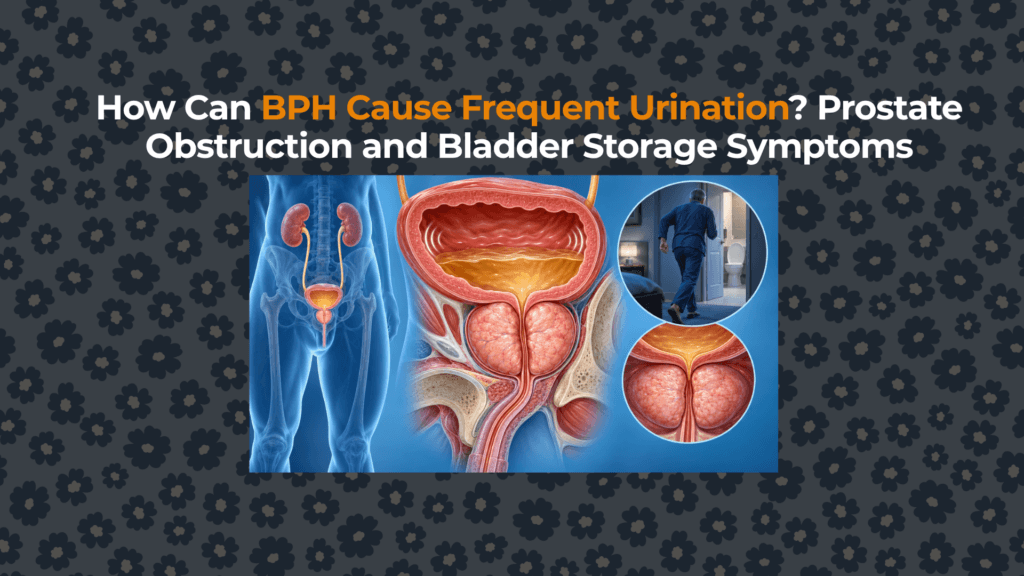
How Can BPH Cause Frequent Urination? Prostate Obstruction and Bladder Storage Symptoms
Urinary frequency is a complaint that voiding occurs more often than the individual considers normal. BPH can contribute when outlet resistance reduces effective capacity or changes bladder behavior—but the number of bathroom trips cannot identify the cause.
Frequency is a pattern—not a fixed number
The International Continence Society defines increased urinary frequency by the patient’s perception that voiding occurs more often than normal. More than eight voids per 24 hours is often used in trials, but it is not a universal diagnostic threshold. Fluid intake, climate, medicines, occupation and usual bladder capacity change the expected count.
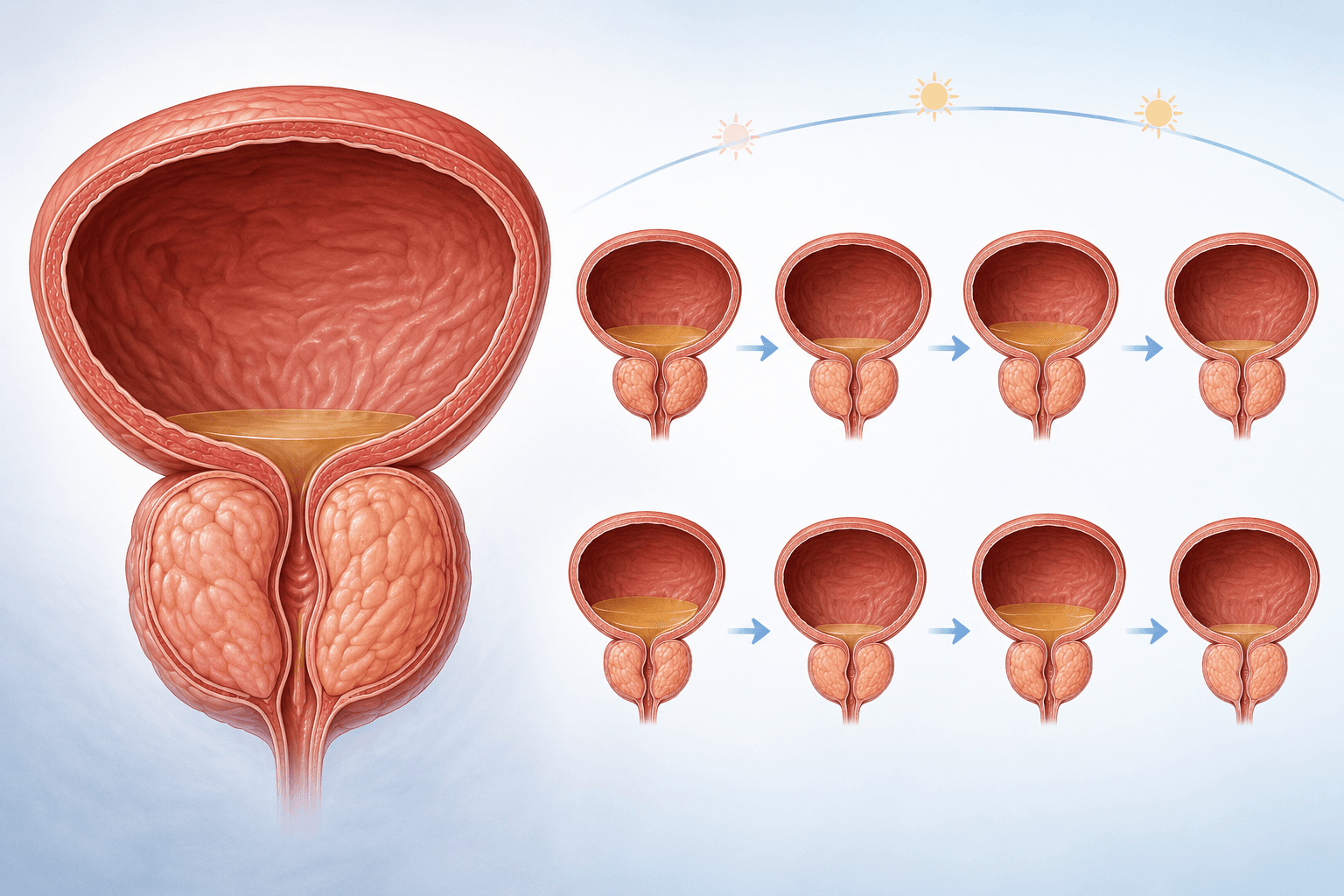
Four ways BPH can shorten the interval between voids
BPH usually develops around the prostatic urethra. Tissue geometry and smooth-muscle tone can increase outlet resistance. The resulting BPH–lower urinary tract relationship may affect storage as well as emptying.
| Pathway | Mechanism | Expected pattern | Diagnostic limit |
|---|---|---|---|
| Residual urine | Incomplete emptying leaves less available capacity | Short refill interval; PVR may be elevated | PVR can also reflect weak detrusor contraction |
| Reduced functional capacity | Urgency occurs at a smaller volume | Repeated small-to-moderate voids | Not specific to prostate disease |
| Detrusor overactivity | Involuntary bladder contractions may coexist with obstruction | Urgency, frequency, sometimes leakage | Symptoms do not prove urodynamic overactivity |
| Behavioral adaptation | Fear of urgency/poor flow promotes pre-emptive voids | Frequent low-volume “just-in-case” trips | Can persist after outlet treatment |
Frequent small voids are not the same as polyuria
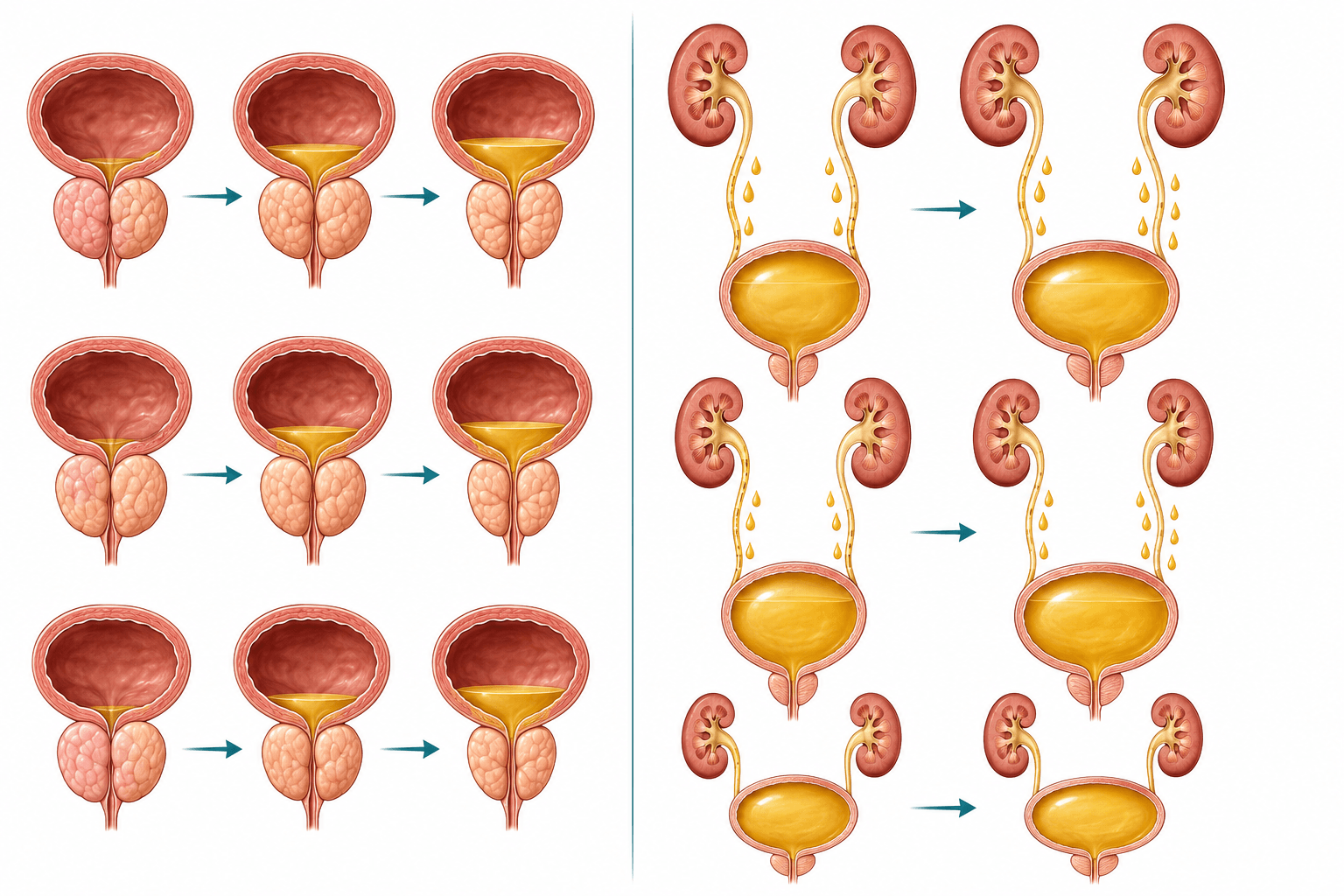
Urinary frequency describes timing and count. Polyuria describes excessive total urine volume. A person with BPH-related storage dysfunction may void ten times but pass little urine each time; a person with diabetes or high fluid intake may void frequently because the kidneys are producing large volumes.
| Ledger pattern | More compatible with | Questions/tests | What it cannot prove |
|---|---|---|---|
| Many small voids + urgency | Reduced capacity/OAB phenotype, inflammation | Diary, urinalysis, PVR | That BPH caused the storage symptoms |
| Small voids + high PVR/weak stream | Impaired emptying or obstruction | PVR, uroflow; selected pressure–flow | That prostate size equals obstruction |
| Many large voids | High intake, diuretic effect, diabetes or other polyuria | 24-hour output, intake/medication review, targeted labs | A bladder-storage disorder |
| Frequency + pain/burning | UTI, stone, inflammation or other pathology | Urinalysis/culture and clinical assessment | Uncomplicated BPH |
A three-day diary turns frequency into evidence
A frequency-volume chart records every void time and volume. A fuller bladder diary also records intake, urgency and leakage. EAU evidence indicates that three-day charts provide reliability comparable to seven days with less burden. The useful outputs are void count, volume distribution, 24-hour total, maximum voided volume, intake timing and day-versus-night pattern.
| Measure | Question answered | Interpretation boundary |
|---|---|---|
| Daytime void count | Is the perceived increase measurable? | No universal normal count fits every person |
| Median/maximum voided volume | Are trips small because capacity is limited? | Functional volume is not anatomical capacity |
| 24-hour urine volume | Is excess production driving frequency? | Requires complete collection |
| PVR | How much remains after voiding? | High PVR may arise from obstruction or weak contraction |
| Qmax/flow curve | Is emptying flow objectively reduced? | Low flow does not identify its cause |
Which findings make a prostate contribution more plausible?
A prostate contribution becomes more plausible when frequency coexists with objective emptying findings, such as a persistently reduced flow pattern, elevated residual, enlarged or protruding prostate anatomy, or pressure–flow evidence of obstruction. Even then, storage symptoms may have a separate bladder component. The weak-stream evidence page explains flow testing; the previous BPH–nocturia bridge separates nighttime production from storage.
Will treating BPH reduce frequency?
It may when outlet resistance, residual urine or secondary bladder dysfunction is important. Alpha blockers target smooth-muscle tone; 5-alpha-reductase inhibitors target progression in selected enlarged glands; procedures widen the outlet. Persistent frequency after improved emptying may reflect overactive bladder, high urine production, infection, metabolic disease or learned frequent voiding. The next article addresses BPH and urinary urgency without treating urgency as proof of obstruction.
When should frequent urination be assessed promptly?
Evidence synthesis
BPH can contribute to frequent urination by reducing effective capacity through residual urine, outlet-related bladder changes and urgency. The symptom becomes clinically meaningful only when count is paired with voided volume and total 24-hour output. A representative diary, urinalysis, PVR and selected flow/anatomy testing distinguish prostate-linked small-volume frequency from polyuria and other bladder or systemic causes.
Educational information only. Individual diagnosis and treatment require a qualified clinician.
Evidence sources
- EAU Guidelines: Diagnostic Evaluation of Non-neurogenic Male LUTS.
- International Continence Society: Increased Daytime Frequency.
- International Continence Society: Overactive Bladder Factsheet.
- American Urological Association: BPH Guideline (2026).
- AUA/SUFU Guideline on Idiopathic Overactive Bladder.
- NIDDK: Enlarged Prostate (BPH).