Short & Thick Penis: Perception vs. Performance
A clinical analysis of radial girth dominance and volume optimization.
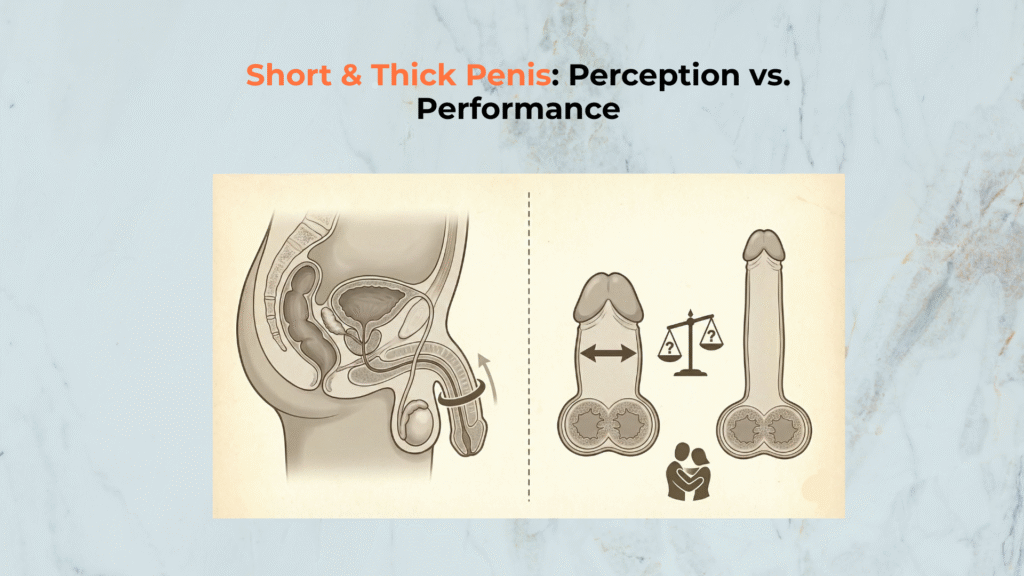
The Short & Thick Penis is a biomechanical phenotype characterized by dominant Radial Girth relative to Axial Length, creating a distinct functional profile that prioritizes Radial Compression and Volume Engagement within the vaginal canal. This morphology is defined by erection mechanics where the Tunica Albuginea constrains and directs expansion, resulting in proportionally greater Radial Girth than Axial Length [C10].
While this guide focuses on biomechanics, functional confidence often relies on understanding the distinction between body image perception and actual physiological performance.
Important Medical Disclaimer
This guide is for educational purposes only. If you experience persistent pain during intercourse, tearing at the introitus, or sudden injury, consult a urologist or sexual medicine specialist immediately to rule out dyspareunia or tissue trauma.
Short & Thick Penis: At a Glance
- What is it? An anatomical variation where girth percentile exceeds length percentile.
- Primary Strength: Superior Radial Compression (wall-to-wall contact).
- Primary Risk: Entry discomfort (introitus stretch) requiring lubrication.
- Key Mechanic: Volume Engagement rather than deep targeting.
Why Is Girth the Performance Driver of the Short & Thick Penis?
Radial Girth (the circumferential volume of the shaft) is the performance driver of the Short & Thick Penis because it dictates the capacity for Radial Compression and immediate sensory volume engagement within the vaginal canal. This morphology maximizes resistance against the vaginal walls, creating high sensory feedback through circumferential volume and mid-shaft fullness rather than depth. This contrasts with Mushroom-Shaped anatomies where friction is primarily driven by the distal head rather than the shaft itself.
How Is the Short & Thick Penis Defined Clinically?
Clinically, the ‘Short & Thick’ morphology is defined by a divergence in measurement percentiles: a lower-percentile axial length combined with an upper-percentile radial girth [C1].
While averages vary, this morphology represents a specific biomechanical phenotype where girth acts as the primary contact driver during intercourse. Reference to large population nomograms by Veale D, et al. (2015) [C1] validates that length and girth dimensions vary independently, creating distinct functional shapes compared to the neutral Cylindrical Penis baseline.
A Short & Thick morphology (Entity) corresponds to high circumferential volume relative to length (Action), optimizing stimulation for Mid-Vaginal Compression (Result).
If you want the full classification context, see the Penis shape overview for how this morphology compares to other penis types.
| Morphology Type | Anthropometric Profile | Biomechanical Implication |
|---|---|---|
| Short & Thick | Low Length Percentile + High Girth Percentile | Maximize Introitus and Mid-Vaginal Friction. |
| Long & Thin | High Length Percentile + Low Girth Percentile | Deep Targeting of Cervical/Posterior Fornix. |
| Proportional | Consistent Percentiles | Versatile mechanics. |
How Does the Short & Thick Penis Influence Versatility?
The Short & Thick Penis influences versatility by providing high-volume Radial Compression that maximizes stimulation across the vaginal walls immediately upon entry.
Because contact begins at the Vaginal Introitus, Volume Engagement can be achieved effectively without requiring deep penetration to reach the fornices.
Evidence from Barnhart [C2] and ACOG [C11] supports that vaginal dimensions and comfort thresholds vary, suggesting that comfort should guide depth rather than arbitrary norms.
The wide circumference (Entity) maximizes Radial Pressure against the vaginal walls (Action), ensuring immediate sensation of tissue stretch and contact (Result).
Functional Considerations for Volume
- Compression: High volume creates superior Wall-to-Wall Friction.
- Risk: May reduce likelihood of deep Cervical Impact [C6] (though discomfort can still occur).
- Technique: Excels in shallow to mid-depth maneuvers where girth is felt most acutely.
What Anatomical Constraints Govern Axial Length in the Short & Thick Penis?
Axial Length in the Short & Thick Penis is governed by the structural properties of the Tunica Albuginea, which coordinates Radial Expansion relative to Corpora Cavernosa extension [C10].
This is a structural trade-off in the expansion mechanics, where circumferential capacity takes precedence over longitudinal stretch. For readers asking “what tissue is actually expanding?”, the hydraulic engine is the Corpora Cavernosa, but the shape is dictated by the Tunica.
Which Anatomical Structures Govern the Profile?
The penile profile is governed by the elasticity and collagen fiber architecture of the Tunica Albuginea, which dictates the geometry of erection [C10].
This phenotype is consistent with mechanics where the tunica directs expansion pressure outward rather than forward. Udelson D, et al. [C10] demonstrate that collagen fiber orientation determines these expansion limits.
The Tunica Albuginea properties (Entity) determine the ratio of expansion (Action), resulting in greater girth volume in this specific phenotype (Result).
How Does the Friction Profile Compare (Girth vs. Length)?
The Short & Thick Penis friction profile relies on high Distributed Radial Compression, contrasting with the focused Targeted Pressure of Long & Thin anatomies.
“Distributed Pressure” ensures full wall-to-wall contact throughout the mid-canal, rather than relying on depth to find friction. This contrasts with Targeted Pressure which typically relies on hitting the deep fornices [C7].
The friction profile (Entity) relies on high Distributed Radial Compression (Action), ensuring full wall-to-wall contact (Result).
| Mechanical Feature | Short & Thick Penis | Long & Thin Penis |
|---|---|---|
| Primary Friction | Radial Compression (Girth) | Axial Thrusting (Targeting) |
| Optimal Depth | Shallow to Mid-Canal | Maximum Penetration |
| Sensation Focus | Vaginal Introitus / Mid-Shaft | Deep Fornix / Cervix [C7] |
Which Positional Strategies Maximize Radial Girth?
Before choosing positions, review the Sexual mechanics guide for penetration mechanics and comfort fundamentals that apply to all anatomies. Positional strategies maximize Radial Girth when they facilitate high Radial Compression and focus engagement on the shallow-to-mid depth zones where volume is most effective. This prioritizes Introitus Activation over depth.
Why Does the Short & Thick Penis Excel in Missionary and Cowgirl?
These positions excel because they allow for immediate Introitus Activation and utilize gravity or leg positioning to enhance the sensation of fullness [C8].
Cowgirl positions allow the partner to control the rate of dilation, maximizing comfort and sensation. MRI coital kinematics by Faix A, et al. [C8] confirm that supine positions (Entity) naturally facilitate mid-depth insertion (Action), maximizing Introitus Activation and mid-shaft compression (Result).
Which Positional Modifications Dictate Deep Compression Strategy?
Positional modifications dictate Deep Compression Strategy by using leg placement (e.g., adduction) to increase the resistance and contact pressure around the shaft.
Adducting the legs (bringing them together) increases vaginal wall contact, which amplifies the sensation of girth. Adducting the legs (Entity) increases vaginal wall contact (Action), maximizing the high Radial Girth sensation (Result).
| Positional Strategy | Functional Goal | Compression Rationale |
|---|---|---|
| Missionary (Legs Together) | Maximize Radial Compression | Increases resistance and contact pressure. |
| Side-Lying (Spooning) | High Friction | Creates sustained pressure on lateral walls. |
| Doggy Style (Deep) | Variable Effectiveness | Girth volume may be less perceptible if posterior wall is lax. |
How Do Techniques Overcome Axial Length Perception?
Techniques overcome Axial Length perception by utilizing the ‘Volume Engagement Stroke,’ which maximizes the duration of high Radial Compression in the mid-canal. This reframes the “short stroke” not as a limitation, but as a strategic optimization for Constant Contact.
How to Execute “The Short Stroke” Technique
Executing ‘The Short Stroke’ maximizes the duration of high Radial Compression in the sensory-rich mid-canal area, rather than prioritizing depth.
The motion involves maintaining short-range rhythmic motion (pulsing) in the shallow-to-mid canal zone. Utilizing short, rhythmic strokes (Entity) ensures focus on the mid-canal area (Action), maximizing the duration of high Radial Compression (Result).
Execution of the Volume Engagement Stroke
- Start at shallow-to-mid depth and adjust based on comfort (avoiding “bottoming out” attempts).
- Maintain rapid, shallow thrusts (pulsing).
- Focus movement on the mid-shaft zone where girth provides constant contact.
How to Mitigate Risk of Entry Discomfort
Mitigating the risk of entry discomfort relies on gradual entry and adequate External Lubrication to prevent acute stretch pain at the Vaginal Introitus [C11].
High girth can cause acute friction or tearing if the introitus is not fully dilated. ACOG [C11] and Cleveland Clinic [C5] emphasize the necessity of lubrication and foreplay.
Implementing gradual entry (Entity) allows the introitus to dilate slowly (Action), preventing acute stretch discomfort (Result). Discomfort can also be exacerbated by a Large Glans or friction at a Pronounced Corona.
Safety Checklist for Entry Comfort
- Partner Lead: Partner controls initial entry rate.
- Preparation: Ensure adequate foreplay for maximum dilation.
- Lubrication: Essential for minimizing acute stretch pain at the Introitus.
Conclusion: What Final Action Protocol Ensures Optimal Use?
The final action protocol establishes Radial Girth as the dominant functional driver, prioritizing Distributed Radial Compression over Axial Length.
Functional success relies on mastering the biomechanics of Volume—ensuring adequate lubrication to mitigate introitus stretch, while utilizing shallow, pulsing strokes to maximize wall-to-wall contact.
Final Optimization Checklist
- Motion Shift: Prioritize Shallow Pulsing and Mid-Shaft Engagement.
- Risk Focus: Ignore Length Perception; focus on Volume Performance.
- Position Priority: Favor positions that maximize Compression (e.g., Legs-Together Missionary).
- Preparation: Ensure Introitus preparation before full entry.
FBU Clinical AI
Biomechanical ExpertHi! I’m reading the guide on the Short & Thick morphology. Ask me about volume engagement, radial compression, or techniques!