How Does Testosterone Affect Libido in Men?
A Clinical Guide to Brain Signaling, Free Testosterone, SHBG, and Hormonal Thresholds
Testosterone affects male libido by supporting androgen signaling in brain networks that regulate sexual motivation, but the clinical meaning of testosterone depends on symptoms, hormone fraction, SHBG status, and repeat morning testing—not on one lab number alone.
Libido is a complex neuro-endocrine behavior. It is shaped by testosterone, dopamine signaling, sleep, metabolic health, psychological state, and relationship context.
This guide will clarify three key areas: understanding the biological mechanism, interpreting total versus free testosterone, and distinguishing low testosterone from other causes of low desire.
Importantly, low desire alone does not immediately prove hypogonadism; comprehensive clinical evaluation is essential.
Important Medical Disclaimer
This guide is educational and does not diagnose hypogonadism. Clinicians diagnose testosterone deficiency only when symptoms or signs are present alongside consistently low morning testosterone on repeat testing. Low libido can also reflect depression, poor sleep, medication effects, relationship distress, obesity, metabolic disease, or vascular illness.
Testosterone and Libido: At a Glance
- ▶Brain effect: Testosterone supports sexual motivation partly through hypothalamic and reward-circuit signaling.
- ▶Best symptom clue: Low sexual desire is more specifically associated with low testosterone than severe ED.
- ▶Testing nuance: Total testosterone is the starting test; free testosterone becomes more important when SHBG is altered or total testosterone is borderline.
- ▶Threshold reality: AUA uses <300 ng/dL as a reasonable diagnostic support threshold, but symptoms do not begin at one identical number in every man.
- ▶Estradiol nuance: Testosterone’s conversion to estradiol is part of normal male physiology; both deficiency and imbalance can affect sexual function.
How Does Testosterone Biologically Influence Sexual Desire?
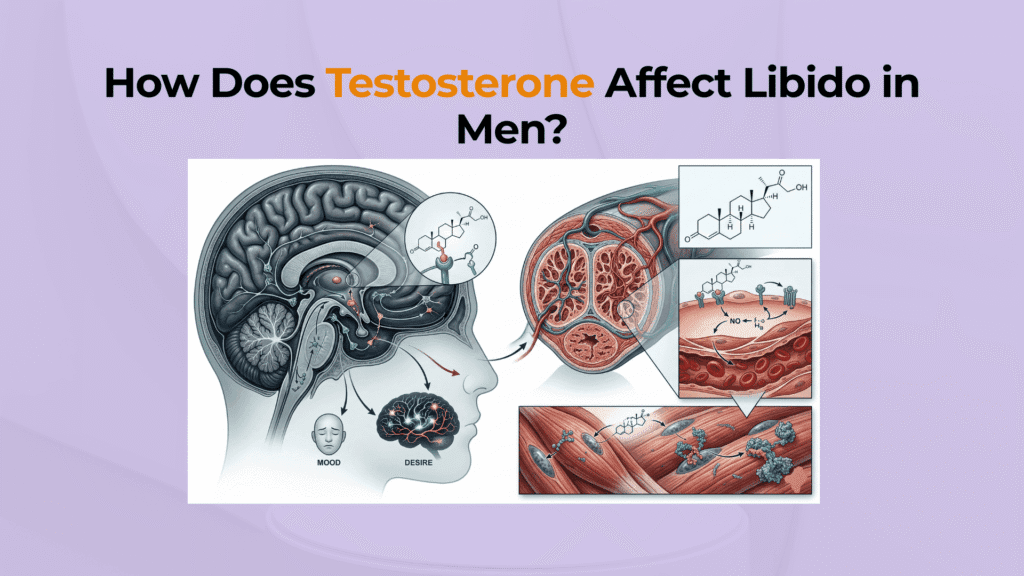
Testosterone influences sexual desire by enhancing androgen-dependent signaling in brain regions that process sexual cues, motivation, and reward.
What Role Does the Medial Preoptic Area (MPOA) Play?
The MPOA acts as a central sexual integration hub, and testosterone helps keep this circuitry responsive to erotic stimuli and mating-related motivation.
Located in the hypothalamus, the MPOA relies on circulating androgens to maintain neuroplasticity and receptor density.
Animal and neurobiologic literature repeatedly link MPOA activity and localized dopamine release with male sexual behavior.
However, it is vital not to view the MPOA as an isolated “libido switch.”
It operates as part of a broader, highly interconnected network spanning emotional, visual, and memory centers.
How Does Dopamine Interact With Testosterone?
Testosterone does not replace dopamine; it helps create the hormonal conditions under which dopamine-mediated sexual motivation is more likely to activate.
Dopamine is heavily tied to anticipation, pursuit, and reward.
When testosterone drops, the threshold for dopamine release rises, which clinically presents as diminished “sexual interest” or reduced spontaneous sexual thoughts, rather than a purely mechanical failure.
Note that while animal models provide excellent isolated mechanistic views, human desire is filtered heavily through cortex-level cognition and context.
Why Is Free Testosterone Often More Useful Than Total Testosterone for Libido Interpretation?
Free testosterone is often more useful than total testosterone for interpreting libido symptoms when SHBG is abnormal, because total testosterone alone may not reflect how much hormone is readily available to tissues.
How Does SHBG Change the Meaning of a Testosterone Result?
SHBG (Sex Hormone-Binding Globulin) changes the meaning of a testosterone result by binding a large fraction of circulating testosterone and altering how well total testosterone reflects biologically available hormone.
SHBG binds testosterone tightly.
Consequently, men with elevated SHBG can exhibit a normal total testosterone level but an abnormally low free testosterone level, making libido symptoms clinically plausible.
Because tissue exposure depends more on the available fraction than the total lab number alone, the next step is understanding how free testosterone affects male libido.
Conversely, conditions like obesity often lower SHBG, which can yield a low total testosterone level but preserved free testosterone and normal androgenicity.
When altered SHBG and borderline testosterone are occurring in the setting of central adiposity, it helps to review how obesity influences male libido.
SHBG does not render total testosterone “useless”; rather, it dictates how that number must be interpreted.
What Is Bioavailable Testosterone?
Bioavailable testosterone refers to the free fraction plus the loosely albumin-bound fraction that is more readily available to tissues than SHBG-bound testosterone.
Unlike SHBG, albumin binds testosterone weakly.
When blood passes through capillary beds, the weak albumin-testosterone bond readily dissociates, adding to the pool of hormones that can enter target cells.
While the strict “free-hormone hypothesis” emphasizes the immediately diffusible free fraction, the bioavailable pool is generally considered the clinically active portion for peripheral tissues and brain centers.
What Testosterone Level Is Actually Linked to Libido Symptoms?
No single testosterone value predicts libido perfectly, but guideline diagnosis usually relies on symptoms plus repeated low morning testosterone, with <300 ng/dL commonly used as a support threshold.
Is Below 300 ng/dL the Libido Cutoff?
A total testosterone value below 300 ng/dL supports the diagnosis of testosterone deficiency, but it is not a universal point at which libido suddenly fails in every man.
Once the threshold discussion becomes clinical rather than purely numeric, the natural next question is what low testosterone actually does to male libido.
Symptom thresholds vary widely across individuals.
Evidence indicates some symptom clustering (including decreased libido) often appears in the low-300 range, but clinical interpretation must always combine patient-specific symptoms, repeat lab values, age, and comorbidities.
Treating a number without clinical context is strongly advised against by urologic and endocrine guidelines.
Can a Man Have Normal Total Testosterone but Low Libido?
Yes—normal total testosterone can coexist with low libido when free testosterone is low, SHBG is high, comorbidity is present, or the cause of low desire is not hormonal.
Studies like EMAS have shown that men with normal total testosterone but low free testosterone can still exhibit symptomatic profiles akin to classic hypogonadism.
This mismatch emphasizes exactly why assessing the free or bioavailable fraction is sometimes necessary when the clinical picture contradicts the basic total testosterone lab.
Does More Testosterone Always Mean More Libido?
More testosterone does not guarantee more libido once levels are already physiologic, because sexual desire remains constrained by receptor biology, estradiol balance, comorbidity, and non-hormonal factors.
What Is the Safer Way to Explain “Saturation”?
The safest clinical explanation is diminishing returns: restoring low testosterone often improves desire, but pushing testosterone beyond physiologic need does not create unlimited increases in libido.
The concept of a “saturation model” posits that once androgen receptors are adequately populated, excess hormone provides no additional sexual benefit.
Randomized trials demonstrate that therapeutic improvement in libido occurs primarily in properly selected, symptomatic men starting with true deficiency, and the effect is generally modest and plateau-bound.
How Does Aromatase and Estradiol Change the Story?
Aromatase changes the story because some testosterone is converted to estradiol, and male sexual function depends on that balance rather than testosterone alone.
It is a misconception that estradiol strictly opposes male libido.
Experimental data confirm that maintaining a normal level of estradiol is necessary for optimal male sexual behavior and bone health; extremely low estradiol can independently reduce sexual function.
Conversely, excessive aromatization leading to disproportionately high estradiol can also blunt libido.
The goal is physiological balance, not estrogen eradication.
How Do You Distinguish Low Testosterone Libido Loss From Erectile Dysfunction?
Low libido and erectile dysfunction often overlap, but low libido describes reduced sexual desire whereas erectile dysfunction describes difficulty achieving or maintaining an erection.
They are distinct disorders with different primary etiologies.
If you want a cleaner separation between mental desire and mechanical erectile response, review the difference between libido and erectile function.
Which Sexual Symptom Is More Testosterone-Specific?
Reduced sexual desire is generally the most testosterone-specific sexual symptom, whereas severe erectile dysfunction is more strongly shaped by age, vascular disease, and comorbid illness (such as diabetes and hypertension).
A man with severe peripheral artery disease may possess a strong desire to engage sexually (healthy libido) but suffer from complete ED.
Conversely, a man with profound hypogonadism may have fully patent penile vasculature but completely lack the psychological urge to initiate intimacy.
Where Do NPT and Morning Erections Fit?
Reduced nocturnal penile tumescence (NPT) or infrequent morning erections can support suspicion of androgen deficiency, but they are supportive clues rather than standalone proof of low testosterone.
The absence of morning erections often correlates with diminished androgen status or poor sleep architecture, prompting further lab investigation.
What Is the Correct Lab Workup for Suspected Testosterone-Related Low Libido?
The correct lab workup starts with repeated early-morning testosterone testing and then expands to hormone-interpretation markers that identify whether the problem is testicular, pituitary-hypothalamic, or non-hormonal.
Core Endocrine Testing Protocol
- Measure morning total testosterone on two separate days.
- Add free testosterone when SHBG is altered (e.g., obesity, aging) or total testosterone is borderline.
- Measure LH (Luteinizing Hormone) and FSH (Follicle-Stimulating Hormone) to separate primary from secondary hypogonadism.
- Measure prolactin, and repeat when elevated to investigate further when the pattern suggests pituitary disease. When prolactin is elevated, the next diagnostic step is understanding how prolactin can reduce male libido.
- Do not interpret testosterone in isolation from obesity, diabetes, sleep, medications, mood, or relationship context.
Comparison Matrix: How Should Testosterone Results Be Interpreted Clinically?
| Pattern | Typical Interpretation | Libido Relevance |
|---|---|---|
| Low TT + Low FT | Stronger biochemical support for hypogonadism. Pair with symptoms + repeat testing. | Libido loss becomes more plausibly androgen-related. |
| Low TT + Normal FT | Often seen with low SHBG states such as obesity. Explains preserved androgenicity. | Low desire may or may not be androgen deficiency. |
| Normal TT + Low FT | Often seen with high SHBG or altered binding state. Important advanced diagnostic scenario. | Libido symptoms can still be androgen-related despite “normal” total. |
| Normal TT + Normal FT | Hormonal cause becomes less likely. Search broader causes of low desire. | Emphasize non-hormonal differential diagnosis. |
Checklist: How Should a Man Audit Testosterone-Related Libido Symptoms Before Assuming “Low T”?
Use this checklist to separate a possible androgen problem from a broader libido problem involving sleep, metabolic health, vascular status, mood, or relationship factors.
-
☑Track sexual desire: Note whether the mental desire and motivation itself is lower, not just mechanical erection quality.
-
☑Track spontaneous thoughts: Note whether random sexual thoughts and anticipatory interest have declined over months.
-
☑Track morning erections: Observe the frequency, but do not use this alone as a definitive hormonal diagnosis.
-
☑Measure metabolic context: Check for visceral fat gain, diabetes risk, or worsening sleep architecture.
-
☑Review medication and mood context: Consider antidepressants, opioids, stress, anxiety, and clinical depression as parallel (and potent) causes of low desire.
-
☑Schedule morning labs correctly: Use early-morning repeat testing instead of relying on one random afternoon testosterone value.
-
☑Escalate clinically: Seek medical evaluation when low desire is persistent, distressing, or accompanied by fatigue, infertility, shrinking testes, or marked erectile decline.
Frequently Asked Questions
Does low testosterone always cause erectile dysfunction?
No.
Low testosterone is more tightly linked to reduced sexual desire than to severe ED, and many cases of ED are primarily vascular, neurologic, psychogenic, or medication-related.
Can testosterone therapy improve libido?
It can improve sexual desire in appropriately selected men with confirmed testosterone deficiency, but benefits are usually modest rather than transformative.
Why is morning testing important?
Because testosterone varies across the day, following a diurnal rhythm.
Guidelines recommend repeat early-morning testing to avoid misclassification based on a natural afternoon dip.
Can estradiol affect male libido too?
Yes.
Human data indicate that both testosterone and estradiol contribute to sexual function in men.
Both excessively low and excessively high estradiol levels can negatively impact libido and erectile quality.