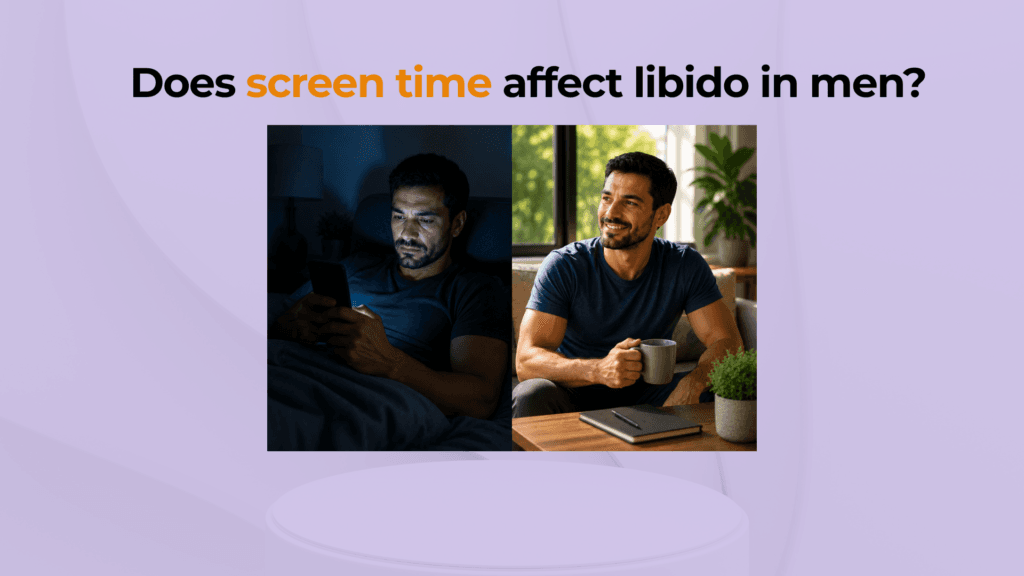
Does Screen Time Affect Libido in Men?
Screen time can affect libido in men, but usually indirectly. The strongest pathways are late-night light exposure, shortened sleep, sleep fragmentation, sedentary behavior, stress, and high-stimulation content that competes with real-world intimacy. A phone does not instantly lower testosterone, and screen time alone should not be treated as a complete diagnosis.
Excessive screen time may reduce male libido when it pushes sleep later, increases mental stimulation at night, keeps the body sedentary, raises stress, or trains sexual motivation toward high-novelty digital cues. The evidence is stronger for sleep disruption and general sexual-health risk factors than for a simple claim that “screens directly lower libido.”
How can screen time affect male libido?
Screen time affects libido through context, not through the screen alone. Evening light can delay circadian timing. Late-night scrolling can keep the brain alert. Long sitting can reduce cardiometabolic fitness. Work notifications can maintain stress. High-stimulation sexual content can separate solo arousal from partnered desire.
This is why the first clinical question is not simply “How many hours are you on a phone?” The better question is whether screen habits are replacing sleep, movement, calm attention, or real intimacy. If the main problem is short sleep, sleep deprivation should be treated as a primary libido risk rather than blaming screens alone.
Nighttime screen exposure can delay sleep readiness through light, alerting content, and habit loops.
Restricted sleep may reduce testosterone in some studies, but evidence is not perfectly uniform across all experiments.
Long sitting and low activity can worsen vascular and metabolic health, both of which matter for arousal.
Fast, high-novelty digital content may fragment attention and compete with slower partnered intimacy.
Why does late-night screen use matter for sleep and testosterone?
Late-night screen use may reduce libido when it delays sleep, shortens sleep duration, or fragments sleep quality. Light at night can suppress melatonin and shift circadian timing. Interactive content can also keep the brain alert even when light exposure is reduced. The practical result is often later sleep, less recovery, lower morning energy, and weaker sexual interest.
Testosterone is partly sleep-linked. A classic small JAMA study found that one week of sleep restriction to 5 hours per night reduced daytime testosterone by about 10% to 15% in healthy young men. Later evidence has been more mixed, so the safest article language is “sleep restriction may lower testosterone in some contexts,” not “one night of screen time kills testosterone.”
Does screen time affect libido through dopamine?
Screen time can affect sexual motivation when digital content becomes highly stimulating, rapidly changing, and emotionally absorbing. This does not mean normal phone use is a proven “dopamine addiction.” A safer explanation is reward learning and attention competition: the brain may begin to prefer fast, controllable stimulation over slower real-world intimacy.
Pornography-specific screen use should be separated from ordinary work, messaging, gaming, or social media. Sexual novelty may affect arousal differently than non-sexual scrolling. If the issue is specifically a split between solo screen-based arousal and partnered desire, dopamine and libido should be explained through motivation, salience, and cue learning rather than guaranteed receptor damage.
Can sedentary screen time reduce arousal?
Long screen sessions often mean long sitting. Sedentary behavior can indirectly affect sexual function by reducing physical activity, worsening cardiometabolic risk, and lowering vascular fitness. Libido and erection quality are not identical, but vascular health affects arousal confidence, and low confidence can feed back into desire.
Screen-based sitting should be treated as one lifestyle risk factor among several. Men with persistent low desire should also review exercise, waist circumference, blood pressure, glucose risk, sleep quality, and mood. When inactivity is central, sedentary lifestyle is the stronger root problem, not the screen itself.
| Pathway | Screen-related trigger | Possible libido effect | Evidence-safe wording |
|---|---|---|---|
| Sleep / circadian | Bright screens, late scrolling, interactive content near bedtime | Lower energy, weaker morning desire, poorer recovery | May affect libido indirectly through sleep loss and circadian disruption. |
| Reward / attention | High-novelty or sexual digital content | Reduced interest in slower partnered cues in some men | May condition attention and sexual motivation; do not call all use addiction. |
| Vascular / metabolic | Long sitting and low physical activity | Lower arousal confidence and poorer erection support | Screen time may be a marker for sedentary behavior and cardiometabolic risk. |
| Stress / mood | Work alerts, conflict, doomscrolling, social comparison | Mental overload, anxiety, and reduced sexual presence | Psychological stress can suppress libido even when hormones are normal. |
How can men reduce screen-related libido risks?
The goal is not complete digital abstinence. The goal is to protect sleep, movement, attention, and intimacy. A practical plan should reduce the riskiest screen behaviors first: late-night bright light, compulsive scrolling, sexual novelty escalation, and long sitting without movement breaks.
Practical digital hygiene plan
- Set a screen cutoff: stop high-stimulation scrolling 60–90 minutes before sleep when possible.
- Dim the environment: use warmer, lower-intensity lighting at night instead of only relying on blue-light filters.
- Move the phone out of bed: charge it away from the sleeping area to reduce automatic late-night checking.
- Break sitting time: add 5 minutes of walking or mobility after every 45–60 minutes of desk or phone use.
- Separate sexual content from bedtime: avoid using high-stimulation sexual content as the final input before sleep.
- Check the full libido picture: if low desire continues, assess sleep, stress, mood, medications, cardiovascular risk, and testosterone testing with a clinician when appropriate.
Best clinical framing
Screen time is best treated as a lifestyle pattern that can disturb sleep, movement, attention, stress, and intimacy. It is rarely the only cause of low libido, but it can become a powerful amplifier when it consistently replaces the habits that support sexual health.
FAQ: Screen time and male libido
Does screen time directly lower testosterone?
Not directly in a simple one-to-one way. The stronger concern is that late-night screen use can reduce or delay sleep, and repeated sleep restriction may affect testosterone, energy, mood, and libido in some men.
Is blue light the only problem?
No. Blue light matters, but screen content, emotional stimulation, notifications, doomscrolling, work stress, and bedtime habits can also keep the brain alert and delay sleep.
Can social media reduce libido?
Social media may reduce libido indirectly if it increases anxiety, social comparison, late-night scrolling, poor sleep, or compulsive attention patterns. It should not be treated the same as pornography-specific arousal conditioning.
Can reducing screen time improve libido?
It may help if screen time is harming sleep, exercise, attention, or relationship quality. Improvement is usually gradual and depends on the underlying cause of low libido.
When should I see a doctor?
See a clinician if low libido persists despite better sleep and lifestyle changes, or if it appears with erectile dysfunction, low mood, fatigue, pain, medication changes, diabetes symptoms, or loss of morning erections.
References
- Zhong C, et al. Electronic Screen Use and Sleep Duration and Timing in Adults. JAMA Network Open. 2025.
- Leproult R, Van Cauter E. Effect of 1 Week of Sleep Restriction on Testosterone Levels in Young Healthy Men. JAMA. 2011.
- Smith I, et al. Sleep Restriction and Testosterone Concentrations in Young Healthy Males. 2019.
- Harvard Health Publishing. Blue Light Has a Dark Side. Updated 2024.
- Wang X, et al. A Cross-Sectional Analysis of the Association Between Screen-Based Sedentary Behavior and Erectile Dysfunction. Scientific Reports. 2025.
- da Silva ML, et al. Influence of Physical Activity Practice on Sexual Function in Men. Sexual Medicine Reviews. 2025.