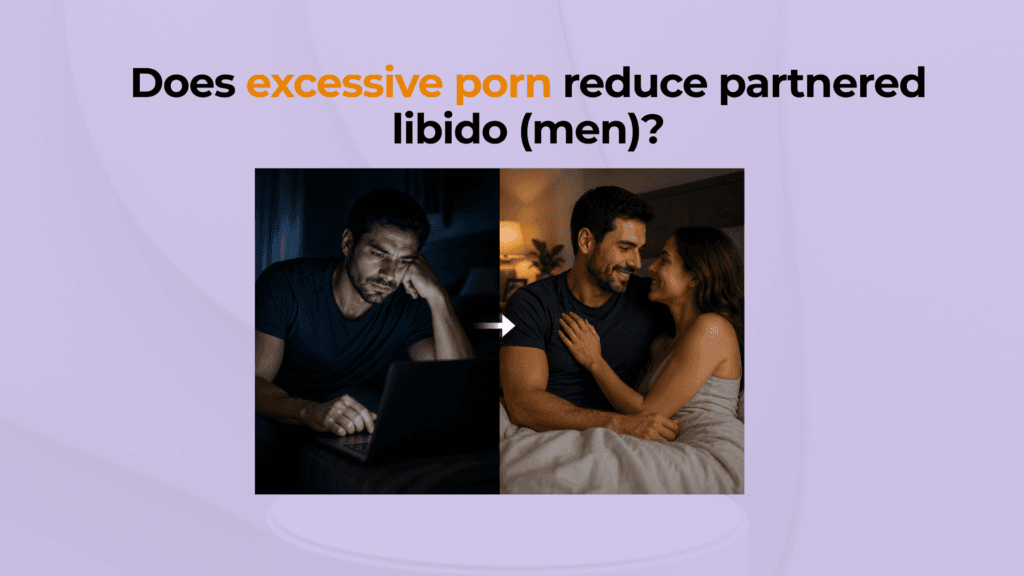
Does excessive porn reduce partnered libido (men)?

FactBasedUrology · Libido Guide

Does Excessive Porn Reduce Partnered Libido in Men?

Excessive or problematic pornography use can reduce partnered libido in some men, but the safest answer is not “porn destroys dopamine.” The stronger clinical explanation is that repeated solo sexual routines can train arousal toward novelty, fast switching, privacy, fantasy, or shame while partnered intimacy requires a different arousal context.

Direct answer

Excessive porn may lower partnered libido when a man still has solo desire but loses interest, arousal, or sexual confidence with a real partner. This pattern is possible, but it is not universal. Research on pornography and sexual function is mixed, so the article should frame porn as one possible contributor—not the only cause and not a guaranteed diagnosis.

Medical note: This article is educational and does not diagnose porn addiction, erectile dysfunction, low testosterone, depression, or relationship problems. Persistent loss of desire, distress, compulsive behavior, pain, erectile difficulty, or major relationship impairment should be discussed with a qualified clinician, sex therapist, or urologist.

Why can excessive porn reduce partnered libido in some men?

Excessive porn can reduce partnered libido when the man’s sexual reward pattern becomes more responsive to solo cues than relational cues. Porn provides instant novelty, rapid scene changes, specific fantasies, and a private masturbation rhythm. Partnered intimacy usually requires emotional presence, slower arousal, mutual timing, communication, and tolerance for normal human variation.

The key distinction is not “high libido versus low libido.” Many men in this pattern still have strong solo arousal. The problem is a split between solo arousal and partnered arousal. In that situation, libido and arousal should be assessed separately because desire, erection quality, mental focus, and emotional readiness can move in different directions.

1. Cue conditioning

The brain learns that arousal starts with screen-based novelty, quick switching, and private control rather than relational closeness.

2. Novelty preference

Familiar partnered sex may feel less stimulating when the sexual routine has been trained toward constant new visual inputs.

3. Shame and secrecy

Guilt, concealment, moral conflict, or fear of being discovered can suppress desire before intimacy even begins.

4. Relationship strain

Conflict, mistrust, avoidance, and pressure can make partnered sex feel like a test rather than a place of connection.

Reward cue learning network and partnered libido A medical-style conceptual diagram showing prefrontal control, nucleus accumbens salience, amygdala stress response, VTA dopamine signaling, and contextual partnered cues as interacting pathways rather than a single proven receptor-damage mechanism. Conditioned reward cues can shift partnered libido through interacting brain systems Prefrontal control attention · inhibition · choice VTA dopamine signal motivation and cue learning Nucleus accumbens reward salience, not proof of damage Amygdala stress node shame, threat, pressure High-novelty cue stack rapid switching · visual intensity Partnered context safety · connection · communication Conceptual, not diagnostic: the figure shows reward learning and context mismatch without claiming irreversible receptor injury. factbasedurology
Figure 1: Reward cue learning network. This upgraded figure shows prefrontal control, limbic stress, salience, and dopamine-based cue learning as interacting pathways. It avoids the over-strong claim that a reader has measurable receptor damage.

Why can solo libido stay high while partnered libido drops?

Solo libido can remain high because masturbation and partnered sex are not identical sexual tasks. Solo arousal is often controlled, private, predictable, and visually driven. Partnered arousal is interactive. It includes body confidence, emotional safety, partner response, communication, erection confidence, and the ability to stay present without checking performance.

This is why porn-associated libido problems are often described as a mismatch rather than a total loss of desire. A man may still feel desire when alone, but partnered sex may trigger distraction, anxiety, pressure, or reduced stimulation. When fear of failure becomes part of the sexual pattern, performance anxiety can turn one difficult experience into repeated self-monitoring and arousal loss.

Brain spinal autonomic pathway and partnered arousal mismatch A medical-style diagram showing how cognitive load, sympathetic threat signaling, parasympathetic pelvic outflow, dorsal nerves, arteries, veins, and erectile tissue can interact during partnered arousal. Partnered arousal depends on brain focus, autonomic tone, pelvic nerves, and vascular response Screen-trained cue load visual novelty · fast switching private control Cognitive threat load shame · self-monitoring fear of failure Dorsal artery red: arterial inflow Deep dorsal vein blue: venous outflow Dorsal nerve signal yellow: sensory pathway Conceptual anatomy: the same sexual cue may perform differently when attention, stress, and autonomic tone change. factbasedurology
Figure 2: Brain-spinal-autonomic pathway. This upgraded figure connects partnered libido to cognitive load, pelvic nerve signaling, arterial inflow, venous outflow, and erectile tissue response instead of showing only abstract curves.

What does the evidence say about porn and sexual function?

The evidence is mixed. Some studies and clinical reports suggest that problematic or high-frequency porn use may interfere with partnered sexual response in vulnerable men. Other studies report weak, inconsistent, or no negative association between porn use and erectile function, sexual desire, or relationship outcomes. A 2024 review summarized the field as controversial and cautioned against strong universal claims.

This means the article should not claim that porn automatically causes low libido. A stronger and safer statement is this: problematic porn use may contribute to low partnered libido when it coexists with loss of control, escalation, distress, relationship impairment, shame, anxiety, or a clear split between solo desire and partnered desire.

Clinical questionEvidence-aligned interpretationWhat to avoid saying
Does porn always lower libido?No. Effects vary by use pattern, distress, relationship context, and whether use is compulsive or non-problematic.“Porn destroys male libido.”
Can solo desire stay high?Yes. Some men report high masturbation desire but reduced partnered desire, suggesting a context-specific arousal pattern.“Low partnered libido means total loss of libido.”
Is this proven dopamine damage?No. Dopamine may be involved in reward learning, salience, and novelty, but receptor damage should not be presented as proven in an individual reader.“Your dopamine receptors are damaged.”
Is it a diagnosis?Not by itself. ICD-11 recognizes compulsive sexual behavior disorder, but distress from moral disapproval alone is not enough for diagnosis.“Anyone who watches porn has an addiction.”

Important correction: avoid the “dopamine damage” trap

Dopamine is part of sexual motivation, novelty, and reward learning, but this article should not diagnose receptor downregulation from reading behavior alone. A safer phrase is dopamine-based reward learning, because it explains motivation without overstating permanent brain damage.

How can a man tell if porn may be affecting partnered libido?

Porn is more likely to be relevant when the pattern is specific, repeated, and distressing. The question is not simply “How many times does he watch porn?” The better question is whether porn use has become difficult to control, has displaced partnered intimacy, or has created a sexual response that works alone but fails with a partner.

  • Solo-partner split: desire is strong during porn or masturbation but weak with a partner.
  • Escalation: stimulation has become more intense, more specific, or harder to satisfy over time.
  • Loss of control: repeated attempts to reduce use fail despite distress or relationship consequences.
  • Avoidance: partnered sex is avoided because solo stimulation feels easier, safer, or more predictable.
  • Shame loop: guilt, secrecy, and fear reduce confidence before intimacy starts.
  • Relationship pressure: arguments, mistrust, or resentment make desire feel forced instead of natural.

These signs do not prove that porn is the only cause. Low desire can also come from sleep loss, depression, chronic stress, alcohol, medications, low testosterone, diabetes, obesity, relationship conflict, or erectile dysfunction. If relationship conflict is a major trigger, relationship stress can suppress libido even when porn is not the central driver.

How can partnered libido improve after excessive porn use?

Partnered libido can improve when the sexual system is retrained toward real-life cues. The goal is not fear-based abstinence or shame. The goal is to reduce compulsive triggers, rebuild attention, restore partner safety, and check medical factors that can lower desire.

Animated cue reconditioning pathway for partnered libido An animated process diagram showing how reducing high-novelty trigger load while increasing partner-safe cues may shift attention and arousal conditioning toward partnered intimacy over time, without promising a fixed recovery timeline. Reconditioning is a cue-practice process, not a guaranteed receptor recovery clock Reduce trigger load high novelty · fast switching privacy-only routineIncrease partner-safe cues touch · trust · slower arousal communicationAttention control prefrontal regulation Partnered libido outcome presence · confidence arousal flexibility Animated dot shifts from the high-novelty lane toward the partner-safe cue lane as trigger load decreases and relational practice increases. factbasedurology
Figure 3: Animated cue reconditioning pathway. This upgraded process diagram uses CSS keyframes to show attention shifting away from high-novelty triggers and toward partner-safe cues. It avoids promising a fixed recovery timeline.

Practical action plan

  • Track the pattern for 2–4 weeks: note porn use, masturbation frequency, morning erections, sleep, stress, mood, alcohol, and partnered desire.
  • Reduce high-novelty triggers: remove the fastest, most compulsive formats first rather than relying on willpower alone.
  • Separate sex from performance testing: rebuild touch, affection, and communication before making intercourse the only success marker.
  • Repair the shame loop: guilt and secrecy can keep the nervous system in threat mode, which blocks arousal.
  • Check medical variables: if low desire is persistent, ask a clinician whether sleep, mood, medication, diabetes risk, cardiovascular health, or testosterone testing should be reviewed.

The wider recovery goal is not only “stop porn.” The goal is to rebuild a sexual life that is controlled, relational, psychologically safe, and medically healthy. For men who want a broader lifestyle framework, libido improvement should include sleep, stress, physical activity, relationship quality, and medical review rather than a single-cause solution.

When should a man seek professional help?

Professional help is appropriate when porn use feels out of control, causes marked distress, harms a relationship, interferes with work or daily life, escalates despite attempts to stop, or continues even when the man gets little satisfaction from it. Help is also important when low libido appears with erectile dysfunction, depression, anxiety, pelvic pain, medication changes, diabetes symptoms, or loss of morning erections.

The clinical goal is not to shame the person. The goal is to identify whether the problem is compulsive sexual behavior, relationship distress, anxiety, depression, medical disease, medication effect, or a combination. Treatment may include psychotherapy, couples therapy, CBT-based strategies, medication review, lifestyle correction, and medical testing when indicated.

Best clinical framing

Porn should be investigated as a possible contributor when partnered libido is low, but the article should always keep a differential diagnosis open. That protects the reader from shame and protects the article from overclaiming.

FAQ: Excessive porn and partnered libido in men

Can excessive porn reduce libido even if I still masturbate?

Yes. Some men do not lose all sexual desire; they lose partnered desire. That means arousal still works in a private, porn-linked setting but becomes weaker in a real-life relational setting.

Is porn-induced low libido the same as porn addiction?

No. Low partnered libido is a symptom pattern, not a diagnosis. Compulsive sexual behavior disorder requires loss of control, persistence over time, distress or impairment, and cannot be explained only by moral disapproval.

How long does it take for partnered libido to improve?

There is no reliable universal timeline. Improvement depends on frequency, compulsive features, relationship safety, anxiety, sleep, mood, medical health, and whether the man changes the surrounding routine.

Should I blame my partner if porn arouses me more?

No. Arousal mismatch is not proof that the partner is unattractive. It may reflect conditioning, anxiety, novelty preference, emotional distance, relationship stress, or a medical factor that needs assessment.

Should I see a doctor or a therapist?

See a clinician if low desire persists, porn use feels out of control, erectile function changes, morning erections disappear, mood is low, anxiety is high, or relationship harm is significant. A urologist can assess medical causes, while a sex therapist or mental health professional can assess compulsive patterns and relationship factors.

References

  1. Rowland DL. Pornography and Sexual Dysfunction: Is There Any Relationship? Current Sexual Health Reports. 2024.
  2. Dwulit AD, Rzymski P. The Potential Associations of Pornography Use with Sexual Dysfunctions: An Integrative Literature Review of Observational Studies. Journal of Clinical Medicine. 2019.
  3. Carvalheira A, Træen B, Štulhofer A. Masturbation and Pornography Use Among Coupled Heterosexual Men With Decreased Sexual Desire. Journal of Sex & Marital Therapy. 2015.
  4. Prause N, Pfaus J. Viewing Sexual Stimuli Associated with Greater Sexual Responsiveness, Not Erectile Dysfunction. Sexual Medicine. 2015.
  5. Rowland DL, Hevesi K, Conway GR, Kolba TN. Do pornography use and masturbation play a role in erectile dysfunction and relationship satisfaction in men? International Journal of Impotence Research. 2023.
  6. Grubbs JB, Perry SL, Wilt JA, Reid RC. Pornography Problems Due to Moral Incongruence: An Integrative Model with a Systematic Review and Meta-Analysis. Archives of Sexual Behavior. 2019.
  7. Mayo Clinic. Compulsive sexual behavior: Diagnosis and treatment. 2023.

Related articles

Facebook
Twitter
LinkedIn
WhatsApp
X

Leave a Reply

Your email address will not be published. Required fields are marked *

Written by factbasedurology.

This guide was created by factbasedurology, an educational platform committed to publishing evidence-based insights on men’s sexual wellness. All content is built from credible medical literature and scientific sources, with a focus on synthesizing complex topics into accessible information. We are dedicated to helping men understand their bodies, build confidence, and take informed action

⚠️ This content is for informational purposes only and does not substitute professional medical advice. Always consult a licensed urologist for personal health concerns.

Our goal is to turn clinical knowledge into confidence — with facts you can trust.