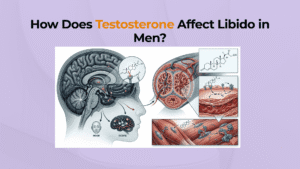
Low testosterone can suppress libido by reducing androgen signaling in the brain circuits that generate sexual desire.
Decreased testosterone and sexual desire present a complex clinical picture that requires structured morning lab testing rather than subjective guesswork.
This guide explains the biological link, locks the diagnostic testing pathway, and compares medical therapies against lifestyle optimization protocols.
Important Medical Disclaimer
This guide is for educational purposes only. Testosterone deficiency requires formal clinical diagnosis using symptoms plus repeat morning testing and guideline-based interpretation. Seek evaluation with a board-certified endocrinologist or urologist to rule out metabolic, cardiovascular, medication-related, or pituitary causes.
Understand the Biological Link Between Low Testosterone and Libido
The link exists because adequate free testosterone sustains androgen receptor activation in brain reward/motivation circuits that generate sexual desire.
The Biological Mechanism of Desire
Testosterone initiates libido upstream of erection mechanics. Testosterone drives desire signaling rather than directly producing penile blood flow.
Androgen receptor activation in the brain depends on bioavailable free testosterone, shaping sexual motivation and reward response. Because “bioavailable” is the clinical hinge here, it helps to review what free testosterone means for libido signaling.
A patient with normal vascular function lacks desire initiation due to low androgen signaling in the CNS.
MANDATORY CLINICAL DISTINCTION
Libido is desire circuitry; erections are vascular mechanics. Testosterone primarily primes desire; it does not directly create penile blood flow. If you’re unsure whether the core problem is desire or mechanics, read how libido differs from erectile function before assuming testosterone is the only variable.
Define What “Low Testosterone” Means When Libido Is the Complaint
“Low testosterone” in libido complaints means symptoms consistent with testosterone deficiency plus repeatedly low morning serum testosterone supporting clinical hypogonadism.
The Clinical Standard for Low T Diagnosis
Diagnosing hypogonadism requires symptoms plus consistently low laboratory testosterone.
Evaluate free testosterone when total testosterone is borderline or SHBG is abnormal because free testosterone reflects bioavailable hormone. Render the diagnostic rule box exactly.
Diagnostic Rule Box: The Clinical Standard for Low T
- • Requirement 1: Presence of consistent primary symptoms (e.g., persistently low libido).
- • Requirement 2: Consistently low total testosterone confirmed on at least two separate morning measurements.
Identify the Symptoms of Low Testosterone-Linked Libido Decline
Identify low testosterone-linked libido decline by separating primary sexual desire changes from non-specific systemic symptoms.
Symptom Self-Assessment
Symptoms are non-specific; confirm with formal lab testing rather than interpreting fatigue alone.
- Monitor a sustained drop in sexual desire or spontaneous sexual thoughts.
- Track changes in morning erections as a supporting signal, not a standalone diagnosis.
- Record persistent fatigue that remains despite adequate sleep opportunity.
- Assess loss of lean mass or increased central fat patterning.
- Note brain fog or depressive symptoms and cross-check medication/sleep contributors.
How to Get Tested for Low Testosterone-Related Libido Decline
Correct testing requires repeat morning testosterone measurement plus classification labs to locate the failure point in the HPG axis.
Hormone Panel Testing Matrix
A complete workup measures testosterone status, binding, pituitary signaling, and estrogen conversion to classify primary vs secondary patterns.
According to the AUA Guideline, <300 ng/dL is a commonly used diagnostic support threshold and must be combined with repeat early morning testing.
| Biomarker | Clinical Function & Diagnostic Role |
|---|---|
| Total Testosterone | Establishes baseline; morning measurement; <300 ng/dL often supports deficiency context (interpret with symptoms). Endocrine Society recommends morning fasting measurement. |
| Free Testosterone | Bioavailable testosterone; critical when SHBG is abnormal. |
| LH & FSH | Classifies primary vs secondary; high suggests primary, low/normal suggests secondary. |
| Prolactin | Screens secondary causes including prolactin elevation patterns. |
| SHBG & Estradiol | Checks binding + aromatization; flags high estrogen conversion patterns. |
Secondary Hypogonadism Etiology Branch
When LH/FSH are low or inappropriately normal with low testosterone, clinicians evaluate secondary hypogonadism pathways including prolactin-related causes.
Rule Box: Secondary Hypogonadism Etiology Branch
- Measure prolactin if LH/FSH are low/normal with low testosterone. Once prolactin enters the workup, the next step is understanding how elevated prolactin can suppress male libido.
- Consider pituitary imaging when prolactin is elevated or pituitary-mass symptoms exist (headache, vision changes).
Compare Treatment Options for Low Testosterone and Libido
Treatment choice balances symptom severity, fertility goals, monitoring tolerance, and whether hypogonadism is confirmed.
Treatment Pathways and Trade-Offs
TRT, SERMs, and lifestyle optimization serve different clinical contexts and are not interchangeable in confirmed endocrine deficiency.
| Pathway | Clinical Utility & Trade-Offs |
|---|---|
| Lifestyle Optimization | Improves systemic drivers; slow; insufficient for severe confirmed deficiency. |
| Evidence-Based Adjuncts | Supports foundations; does not replace treatment for confirmed hypogonadism. |
| TRT | Effective symptom relief; requires ongoing monitoring; fertility suppression risk. |
| Clomid/Enclomiphene | Fertility-preserving pathway under supervision; side effects possible. |
| Monitoring Protocol | Cadence & Safety Focus |
|---|---|
| TRT | Fertility suppression risk; labs every 3–6 months; hematocrit/estrogen-related risks. |
| Clomid/Enclomiphene | Fertility preservation; labs every 3–6 months; rare visual/mood effects. |
| Lifestyle | Positive systemic impact; annual review; requires behavioral commitment. |
Fix Other Health Factors That Suppress Libido Even If Testosterone Is Borderline
Non-hormonal suppressors can flatten libido and mimic hypogonadism even when testosterone is borderline. Low libido reflects desire circuitry, not erection hydraulics.
Troubleshooting Non-Hormonal Libido Suppressors
Removing physiological brakes can restore baseline desire by reducing stress hormones, medication suppression, and sleep-disruption effects.
Because chronic cortisol elevation can blunt the HPG axis even when testosterone is borderline, review how chronic stress lowers male libido.
| Condition | Action | Outcome |
|---|---|---|
| Chronic stress | Sleep hygiene + stress reduction | Lower cortisol burden → baseline desire improves |
| SSRI use | Clinician-guided alternatives | Less medication-driven libido suppression |
| High abdominal fat | Structured deficit | Less aromatase activity → improved androgen availability |
| Sleep apnea signs | Sleep study + treatment if positive | Better sleep architecture → supports hormonal rhythm |
| Heavy alcohol/opioids | Clinician-supported reduction | Less HPG-axis suppression |
Use This Final Checklist to Address Low Testosterone and Libido
Execute this checklist in order: confirm symptoms, secure repeat morning labs, classify etiology, then choose treatment with fertility and monitoring constraints.
- Track primary/secondary symptoms daily for one week.
- Request the full panel: Total T, Free T, SHBG, LH, FSH, prolactin, estradiol.
- Schedule morning testing and repeat on a separate morning to confirm low results.
- Classify primary vs secondary pattern using LH/FSH and prolactin.
- Audit sleep, stress, alcohol, and SSRIs for libido suppression.
- Consult endocrinology/urology with confirmed labs to finalize the plan.