Can Male Libido Increase Later in Life? A Clinical Analysis of Endocrine Recovery, Optimization, and Health Shifts
Male libido exhibits significant plasticity in later life, driven by the targeted optimization of baseline endocrine profiles, metabolic homeostasis, and neurochemical environments.
Many aging males experience a secondary peak in sexual drive by systematically reversing the chronic physiological stressors and metabolic morbidities that previously downregulated their androgenic pathways.
This clinical guide separates healthy physiological optimization from pathological behavioral spikes, detailing the exact mechanisms by which men restore their Senior Sexual Health and baseline vitality.
Important Clinical Disclaimer
This guide is for clinical educational purposes only. Increasing libido through metabolic and endocrinological optimization is a normal physiological process; however, a sudden, radical, or uncontrollable spike in sexual drive in older age signals a potential neurological pathology (such as Frontotemporal Lobar Degeneration or medication-induced mania) and requires immediate neuropsychiatric evaluation.
Clinical Mechanisms: At a Glance
-
Endocrine Pivot: TRT re-saturates central androgen receptors, resetting the neurological “desire thermostat” in hypogonadal patients.
-
Metabolic Logic: Attenuating visceral adiposity downregulates CYP19A1 (Aromatase) expression, preserving higher circulating fractions of “Free” Testosterone.
-
HPA-Axis Reset: Mitigating psychosocial stressors resolves hypercortisolemia, removing glucocorticoid-mediated inhibition of the reproductive axis.
-
Vascular Priority: Restoration of endothelial nitric oxide synthase (eNOS) pathways via cardiovascular conditioning enhances objective arousal markers.
How Does Male Libido Biologically Increase in Later Years?
Male libido biologically increases in later years when targeted medical and lifestyle interventions restore serum testosterone concentrations to a physiological therapeutic range and reverse metabolic suppression. Late-Onset Hypogonadism (LOH) describes the clinical decline of endogenous androgen production associated with aging and metabolic syndrome, resulting in suppressed dopaminergic drive and generalized apathy.
The Pharmacological Role of Testosterone Replacement Therapy (TRT)
The clinical administration of Testosterone Replacement Therapy (TRT) serves as the most robust pharmacological driver for late-life libido restoration.
Exogenous testosterone resolves Late-Onset Hypogonadism by overcoming elevated Sex Hormone-Binding Globulin (SHBG) and re-saturating androgen receptors within the brain’s desire centers.
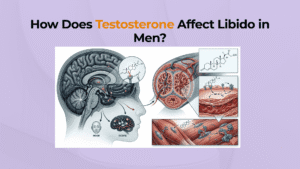
If you want to understand the broader hormone mechanism behind this recovery pattern, review how testosterone influences male libido.
Clinical assay data demonstrates that TRT transforms libido from a state of hypogonadal apathy to active pursuit within 3 to 6 months of achieving stable serum pharmacokinetics.
Exogenous testosterone restores the saturation of androgen receptors in the medial preoptic area (mPOA), reactivating the spontaneous desire centers of the brain.
The Impact of Metabolic Reversal and CYP19A1 Downregulation
Improving metabolic parameters naturally spikes libido by directly altering the body’s internal enzymatic hormone-processing pathways.
Lowering systemic hemoglobin A1c (HbA1c) restores microvascular endothelial function, making peripheral tissues highly responsive to central neurogenic sexual signals.
Visceral adipose tissue acts as a highly active endocrine organ, housing the Aromatase enzyme which actively converts circulating testosterone into estradiol ($E_2$).
Significant weight loss reduces the cellular volume and transcription of the Aromatase Enzyme, preventing the peripheral conversion of testosterone into estrogen and boosting bioavailable drive.
Because bioavailable androgens matter more than total levels alone, it helps to review what free testosterone means for male libido.
What Environmental Shifts Trigger a “Second Peak” in Desire?
Environmental and behavioral shifts trigger a “Second Peak” in desire by drastically reducing chronic systemic stress markers (hypercortisolemia) and optimizing sleep architecture to restore endogenous diurnal hormonal rhythms. For the exact impact of sleep stages on hormone synthesis, review the Male Libido Changes guide.
The Removal of the Glucocorticoid “Brake” (The Retirement Surge)
A significant, measurable increase in libido routinely occurs in later life when chronic professional or psychosocial stress levels subside, culminating in a clinical phenomenon termed the “Retirement Surge”.
The attenuation of survival-mode sympathetic nervous system activation allows the parasympathetic-driven reproductive drive to resurface safely.
Chronic stress elevates serum cortisol, which actively suppresses the Hypothalamic-Pituitary-Gonadal (HPG) axis via glucocorticoid receptor-mediated inhibition.
Lowered systemic Cortisol stops the inhibition of the Hypothalamic-Pituitary-Gonadal axis, allowing natural gonadotropin and dopamine levels to recover.
Once cortisol becomes a chronic suppressor rather than a short-term stress signal, the next step is understanding how chronic stress lowers male libido over time.
Polysomnographic Optimization of REM and Circadian Rhythms
Prioritizing uninterrupted, high-efficiency sleep architecture in later years yields a laboratory-measurable spike in morning serum testosterone and daily desire by normalizing the body’s circadian rhythm.
Men who therapeutically resolve obstructive sleep apnea (OSA) or fragmented sleep patterns report a rapid return of “Spontaneous Libido” that had remained clinically absent for years.
When fragmented sleep is driven by airway obstruction rather than simple poor sleep hygiene, it becomes important to understand the connection between sleep apnea and male libido.
Proper progression through NREM and REM sleep stages is strictly required for the nocturnal neuroendocrine synthesis of androgens.
Extended REM sleep cycles facilitate the pulsatile release of Luteinizing Hormone, driving the testes to produce their maximum biological potential of testosterone.
When Is a Sudden Libido Increase a Medical Pathology?
A sudden libido increase becomes an urgent neuro-psychiatric concern when it presents as uncontrollable Hypersexual Disorder (HD), signaling severe neurodegenerative changes or iatrogenic effects rather than systemic health optimization.
Distinguishing Optimization from Pathological Disinhibition
A healthy physiological increase in libido operates through conscious choice and relational connection, whereas a pathological increase manifests as uncontrollable, compulsive, and “driven” behavior.
Sudden behavioral shifts frequently indicate a deterioration of inhibitory control originating in the prefrontal cortex, heavily correlated with neurodegenerative diseases (like Frontotemporal Dementia) or the initiation of dopamine agonist medications.
Clinical assessments require a neurologist to rule out “frontal disinhibition syndrome” when patients exhibit sudden, personality-altering hypersexuality in their geriatric years.
Sudden behavioral hypersexuality indicates the loss of impulse control in the prefrontal cortex, signaling potential neurological decline or adverse medication reactions.
| Feature | Healthy Libido Spike | Pathological Hypersexuality |
|---|---|---|
| Onset | Gradual (Tracks with health improvements) | Rapid / Sudden / Out of character |
| Control | Retains social filters and conscious choice | Lacks social filters; obsessive focus |
| Driver | Metabolic reversal, TRT, or HPA-axis regulation | Frontal disinhibition or dopaminergic agents |
| Impact | Enhances intimacy and relationships | Causes distress, conflict, or legal risk |
[Diagnostic Audit] How to Evaluate Your Late-Life Libido Recovery
Utilize this clinical self-audit to isolate the precise biological biomarkers responsible for your increased drive and to identify indications where neuropsychiatric evaluation remains strictly necessary.
The Biomarker and Optimization Audit
-
✓
Review your serum Total Testosterone, Free Testosterone, and SHBG levels via LC-MS/MS assays to objectively measure endocrine recovery.
-
✓
Measure your waist circumference and HbA1c levels to confirm the successful downregulation of Aromatase (CYP19A1) activity.
-
✓
Track your sleep architecture to ensure you achieve sufficient deep and REM sleep phases without the hypoxemic interference of obstructive sleep apnea.
-
✓
Audit your pharmacological profile to identify if you recently discontinued an iatrogenic suppressor of drive (e.g., SSRI discontinuation syndrome).
-
✓
Assess your executive function and impulse control to guarantee your increased drive remains physiologically congruent rather than presenting as a compulsive urge.
If the increase in drive feels repetitive, intrusive, or hard to control, compare it against the warning signs of compulsive sexual behavior in men.
-
!
Schedule an immediate neuropsychiatric consult to rule out Frontotemporal Dementia or manic episodes if the libido spike is sudden, uncontrollable, and fundamentally alters core personality traits.