Does Hyperthyroidism Affect Male Libido in Men? Understanding Why Desire Can Become Mixed or Unpredictable
Important Medical/Safety Disclaimer:
This article is for informational purposes only and does not constitute medical advice. Persistent changes in libido, especially when accompanied by palpitations, weight loss, tremor, sleep disruption, or other systemic symptoms, require evaluation by a qualified healthcare professional.
Hyperthyroidism can affect male libido in mixed ways. Excess thyroid hormone may increase general physiologic activation, but anxiety, insomnia, palpitations, weight loss, fatigue, and changes in sex-hormone balance often make sexual desire feel unstable or reduced rather than predictably higher. 1,4,5
Hyperthyroidism: A State of Overactive Thyroid Hormone Signaling
Hyperthyroidism is a condition in which the thyroid gland produces excessive thyroid hormone. Because thyroid hormones influence metabolism, cardiovascular function, thermogenesis, and energy use across multiple organ systems, an overactive thyroid can produce whole-body effects that also influence sexual well-being. 1,2,4
What is the thyroid gland and its normal function?
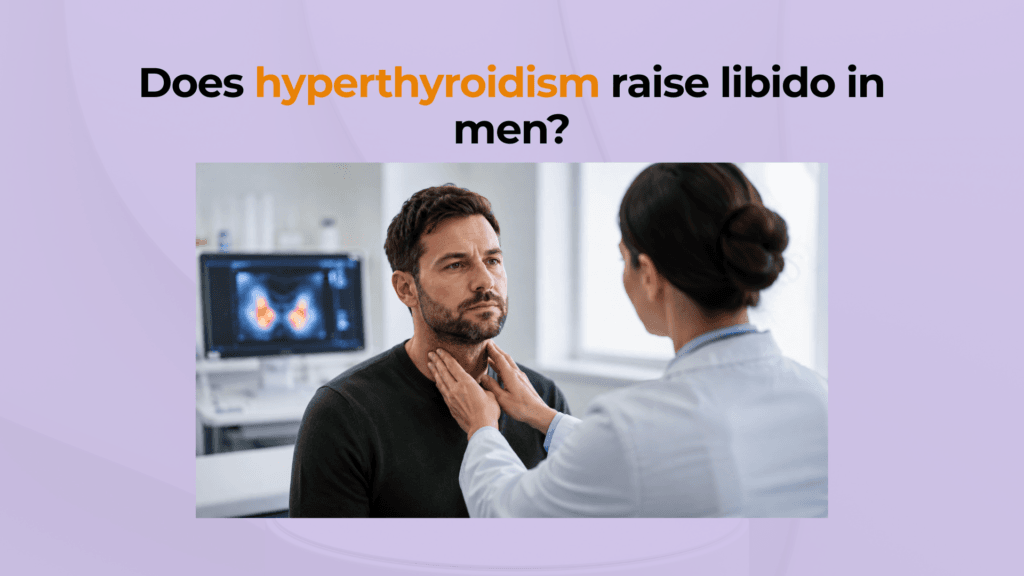
The thyroid gland is a butterfly-shaped endocrine gland in the neck that produces thyroxine (T4) and triiodothyronine (T3). In a healthy state, thyroid signaling helps regulate metabolism, heart rate, temperature handling, and broader physiologic homeostasis. 1,4
How hyperthyroidism occurs: excess thyroid hormones (T3 and T4)
Hyperthyroidism occurs when thyroid tissue produces excessive T3 and T4. Common causes include Graves’ disease, toxic multinodular goiter, toxic adenoma, and the thyrotoxic phase of thyroiditis. 1,2
How hyperthyroidism differs from hypothyroidism and euthyroidism
Hyperthyroidism is the opposite of hypothyroidism, where thyroid hormone signaling is reduced, while euthyroidism describes balanced thyroid function. In practice, hyperthyroidism tends to produce an accelerated metabolic state, whereas hypothyroidism slows metabolic activity. 1,3,4
| Feature | Hyperthyroidism (Overactive) | Euthyroidism (Normal) | Hypothyroidism (Underactive) |
|---|---|---|---|
| Typical Lab Pattern | Low TSH, elevated free T4 and/or T3 | Normal TSH and thyroid hormones | Often elevated TSH with low free T4 in primary disease |
| Metabolic State | Accelerated | Balanced | Slowed |
| Common Symptom Pattern | Palpitations, tremor, anxiety, weight loss, heat intolerance | No thyroid syndrome | Fatigue, slowed energy, weight gain, cold intolerance |
| Possible Libido Effect | Mixed or variable | Stable baseline | Often reduced |
How Hyperthyroidism Can Influence Male Libido
Hyperthyroidism can influence libido through several overlapping pathways. Some men may experience generalized activation or restlessness, while others experience anxiety, exhaustion, sleep disruption, cardiovascular strain, or hormone-binding changes that lower or destabilize sexual desire. Reviews of thyroid-related sexual function consistently describe the effect as real but variable rather than uniformly “pro-libido.” 5,6,7
Possible influence on motivation and reward signaling
One proposed explanation is that excess thyroid hormone can change central nervous system activity and alter motivational states. However, even when activation rises, that does not reliably translate into higher libido. In real-world patients, anxiety, palpitations, poor sleep, and overall physiologic strain often dominate the lived experience. 1,5 This is why a topic like the dopamine pathway may be relevant conceptually without proving that hyperthyroidism predictably raises sexual desire.
How T3 and T4 can heighten general activation without creating reliable sexual desire
High T3 and T4 levels accelerate metabolism and can produce faster heart rate, sweating, tremor, heat intolerance, and a sense of being physically “revved up.” That heightened activation may sometimes be confused with arousal, but it is not the same as sustained, healthy sexual desire. 1,4
Why the thyroid-libido connection is not predictably positive
The thyroid-libido connection is not predictably positive because any theoretical activating effect is frequently offset by systemic symptoms and sexual dysfunction. In a review of thyroid hormone derangements and sexual function, thyroid disorders were repeatedly linked to problems with libido and erectile function rather than a simple improvement in desire. 5,6
Indirect Systemic Impacts: How Hyperthyroidism Can Reduce or Destabilize Libido
In practice, the indirect systemic effects of hyperthyroidism often matter more than any possible activating effect. When the body is dealing with persistent anxiety, insomnia, tachycardia, weight loss, or fatigue, sexual interest often becomes less stable or declines. 1,4,5
Anxiety and agitation can interfere with desire
Anxiety and agitation are common manifestations of hyperthyroidism and can disrupt the relaxation, attention, and emotional comfort needed for satisfying sexual desire and response. 1,4
Metabolic overdrive can still lead to fatigue
Even though metabolism is accelerated, hyperthyroidism can still leave patients profoundly tired, especially when poor sleep and increased energy expenditure are present together. 1,4 That makes fatigue-related low libido an important related concept.
Cardiovascular strain can make sexual activity feel uncomfortable or unsafe
Palpitations, tachycardia, and other adrenergic symptoms can make sexual activity feel more physically demanding. In some men, that physical discomfort feeds back into avoidance, reduced confidence, or lower desire. 1,4
Weight and body-composition changes can affect confidence
Unintended weight loss and muscle weakness can change body image and overall well-being, which may further suppress sexual interest even when the primary problem began as an endocrine disorder. 1,5
Distinguishing Hyperthyroidism-Related Libido Changes from Other Sexual Problems
To distinguish thyroid-related libido changes from other sexual complaints, it helps to look for a systemic symptom pattern rather than focusing on desire alone. Thyroid disease usually affects multiple body systems at once. 1,3
Desire changes versus performance problems
Libido refers to sexual interest, while problems such as erectile dysfunction involve the body’s physical response. Hyperthyroidism can contribute to both, but the mechanisms are not identical. In thyroid disease, anxiety, altered hormone balance, and systemic stress can reduce desire and also worsen performance. 5,6
The role of SHBG and androgen availability
Hyperthyroidism can change sex-hormone balance. Multiple studies and reviews report higher sex hormone-binding globulin (SHBG) in hyperthyroid states, which can reduce the fraction of testosterone that remains freely available to tissues. 7,8 That is one reason why the related concept of free testosterone matters more than total testosterone alone in some men.
Identifying the Signals: Common Symptoms That Make a Thyroid Cause More Plausible
A thyroid explanation becomes more plausible when libido changes appear alongside a wider pattern of systemic symptoms. Common hyperthyroid symptoms include palpitations, tremor, anxiety, weight loss, heat intolerance, insomnia, sweating, diarrhea or more frequent bowel movements, and muscle weakness or fatigue. 1,4
Symptom Checklist for Hyperthyroidism
- ☐Unexplained weight loss: Are you losing weight despite a normal or increased appetite?
- ☐Rapid or irregular heartbeat: Do you experience palpitations or a racing heart, even at rest?
- ☐Anxiety, nervousness, or irritability: Have these become noticeably worse?
- ☐Tremor: Do you notice fine shaking in the hands or fingers?
- ☐Heat intolerance or sweating: Do you feel hot when others feel comfortable?
- ☐Bowel change: Are bowel movements becoming more frequent or looser?
- ☐Fatigue or weakness: Do you feel “wired but tired”?
- ☐Difficulty sleeping: Has insomnia become new or worse?
- ☐Change in libido: Has sexual desire changed in a way you cannot otherwise explain?
When to Seek Medical Evaluation for Libido Changes
A persistent change in libido, especially when combined with the symptom pattern above, is a reasonable signal to seek medical evaluation. Clinical workup for suspected hyperthyroidism typically includes thyroid-stimulating hormone (TSH), free thyroxine (free T4), and often triiodothyronine (T3) testing, with additional workup used to determine the cause. 2,3
Persistent libido changes coupled with other unexplained symptoms
The practical threshold for seeking help is persistence plus pattern. If libido changes recur and several hyperthyroid symptoms appear at the same time, thyroid evaluation becomes much more relevant than guessing at a single sexual cause. 3,4
Diagnostic pathways: blood tests and clinical interpretation
Low serum TSH is a sensitive screening test for thyroid dysfunction, and free T4 and T3 measurements help establish the degree and pattern of thyrotoxicosis. Treatment choices are based on etiology, symptom severity, and patient context rather than libido changes alone. 1,2,3
Synthesis: Why Hyperthyroidism Can Make Libido Feel Unstable
Hyperthyroidism does not create one simple libido outcome. It can increase physiologic activation, but it can also create anxiety, poor sleep, cardiovascular strain, fatigue, and changes in hormone binding that weaken desire or make it erratic. 1,5,7
That is why the most useful clinical question is not “Does hyperthyroidism always raise libido?” but “What symptom pattern is present, and does thyroid dysfunction help explain it?” Treating the underlying thyroid disorder is the central step when thyroid disease is driving the sexual complaint. 1,2,3
References
- Lee SY, Pearce EN. Hyperthyroidism: A Review. JAMA. 2023;330(15):1472–1483. doi:10.1001/jama.2023.19052.
- Ross DS, Burch HB, Cooper DS, et al. 2016 American Thyroid Association Guidelines for Diagnosis and Management of Hyperthyroidism and Other Causes of Thyrotoxicosis. Thyroid. 2016;26(10):1343–1421. doi:10.1089/thy.2016.0229.
- Kravets I. Hyperthyroidism: Diagnosis and Treatment. American Family Physician. 2016;93(5):363–370.
- Cleveland Clinic. Hyperthyroidism (Overactive Thyroid): Symptoms & Treatment. Updated October 31, 2024.
- Bates JN, Kohn TP, Pastuszak AW. Effect of Thyroid Hormone Derangements on Sexual Function in Men and Women. Sex Med Rev. 2020;8(2):217–230. doi:10.1016/j.sxmr.2018.09.005.
- Krassas GE, Tziomalos K, Papadopoulou F, Pontikides N, Perros P. Erectile Dysfunction in Patients with Hyper- and Hypothyroidism: How Common and Should We Treat? J Clin Endocrinol Metab. 2008;93(5):1815–1819. doi:10.1210/jc.2007-2259.
- Kjaergaard AD, Marouli E, Papadopoulou A, et al. Thyroid Function, Sex Hormones and Sexual Function: a Mendelian Randomization Study. Eur J Epidemiol. 2021;36:335–344. doi:10.1007/s10654-021-00721-z.
- Kumar A, Shekhar S, Dhole B. Thyroid and Male Reproduction. Indian J Endocrinol Metab. 2014;18(1):23–31. doi:10.4103/2230-8210.126523.