
How Does the Prostate Contribute to Ejaculation? Fluid Secretion and Ejaculatory Function
Neurophysiology · Emission · Expulsion Ejaculation is not a single squeeze by one organ. It is a coordinated sequence involving the epididymides, vas deferens, seminal vesicles, prostate, bladder neck, urethra and pelvic-floor muscles. The prostate contributes secretion, a conduit through its urethra, and smooth-muscle contraction—but it does not initiate erection or provide most of the […]
How Does the Prostate Support Fertility? Prostatic Fluid, Sperm Function and Semen
Answer first: The prostate supports fertility by adding enzyme-rich fluid to semen and contracting during emission. Its secretions contain PSA/KLK3, citrate, zinc and other molecules that shape semen’s biochemical environment and help it liquefy after ejaculation. The prostate does not produce sperm—the testes do—and prostate function is only one part of fertility. The clearest model […]
How Does the Prostate Change With Age? Growth, Volume and BPH Risk
AGE–ANATOMY EVIDENCE MAP The prostate does not simply become “large” at a fixed age. Later-life change is concentrated mainly around the urethra, while total volume, outlet shape, symptoms and obstruction can follow different trajectories. Direct answer: The prostate commonly enlarges with age because benign stromal and epithelial nodules expand mainly in transition and periurethral tissue. […]
What Is a Normal Prostate Size? Volume, Age and Measurement Ranges

REFERENCE-RANGE LAB “Normal prostate size” is not one number. It is a reference distribution shaped by age, population, gland zone and measurement method. Direct answer: A healthy young-adult prostate is commonly described as approximately 20–25 mL, with dimensions near 3.75–4.0 cm wide, 2.5–3.0 cm high and 3.1–3.8 cm long. These are approximate reference values—not diagnostic […]
BPH vs Benign Prostatic Obstruction: Tissue Growth vs Urinary Blockage
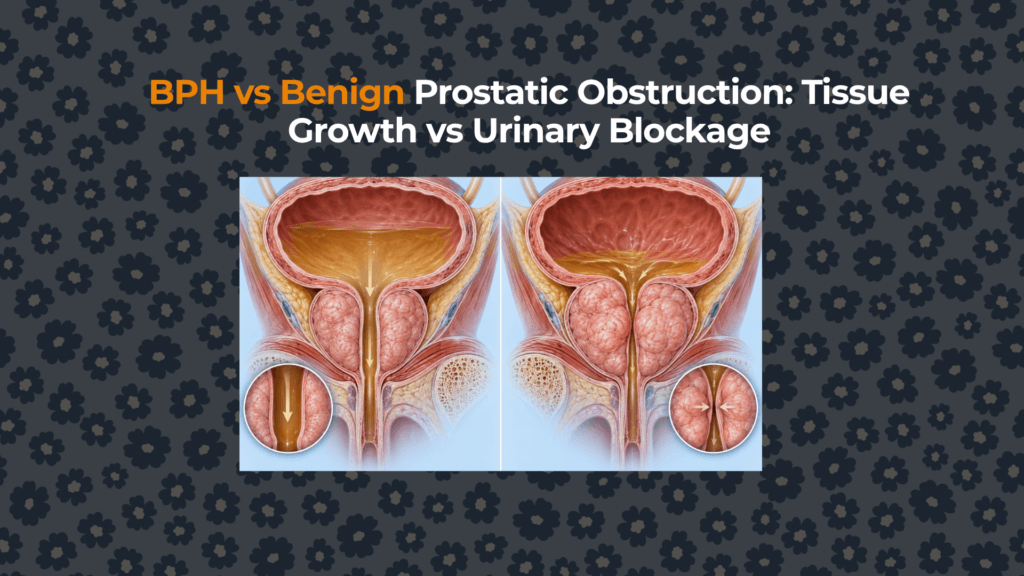
PRESSURE–FLOW LAB · TISSUE ≠ BLOCKAGE BPH describes what prostate tissue is doing. Benign prostatic obstruction describes what the bladder outlet is doing. Direct answer: Benign prostatic hyperplasia (BPH) is benign stromal and epithelial cell proliferation, usually in the transition zone. Benign prostatic obstruction (BPO) is resistance to urine flow at the bladder outlet attributed […]
How Is Prostate Volume Measured? Ultrasound, MRI and Volume Calculation
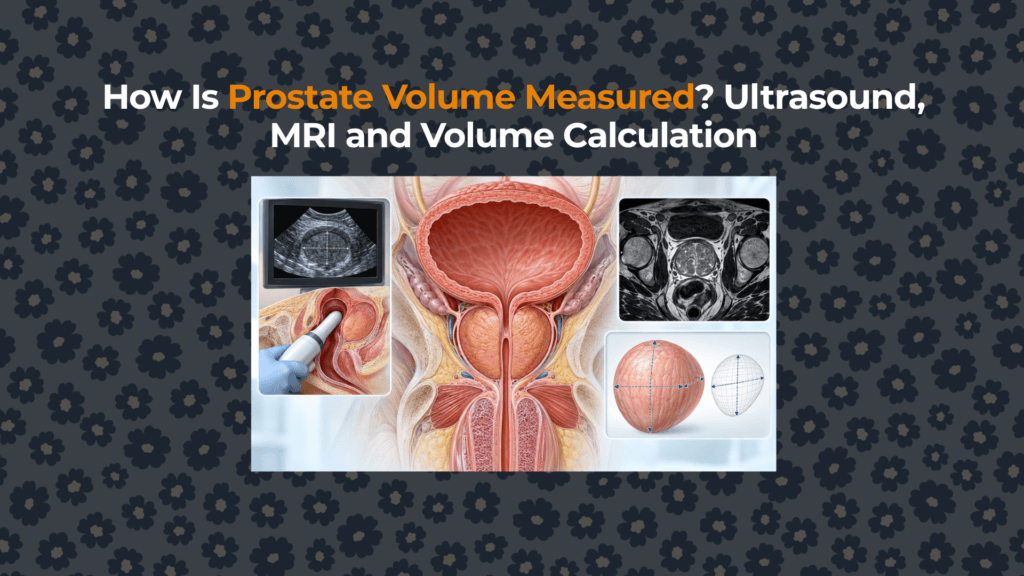
MEASUREMENT LAB · METHOD BEFORE NUMBER Prostate volume is not read directly from a scan. It is estimated from a boundary drawn around a three-dimensional gland. Direct answer: Clinicians usually measure prostate width, height and length on ultrasound or MRI, then apply the prolate-ellipsoid formula: width × height × length × 0.52. MRI or ultrasound […]
Why Does the Prostate Enlarge With Age? BPH Growth and Hormonal Mechanisms

AGEING–GROWTH CONTROL BOARD Age does not activate one prostate-growth switch. It creates years in which several local signals can change the balance among cell production, cell loss and tissue remodeling. Direct answer: The prostate may enlarge with age because androgen-responsive stromal and epithelial cells continue receiving local growth signals—especially dihydrotestosterone (DHT)—while altered cell turnover, stromal–epithelial […]
Does Prostate Size Predict BPH Symptoms? Volume, Obstruction and LUTS
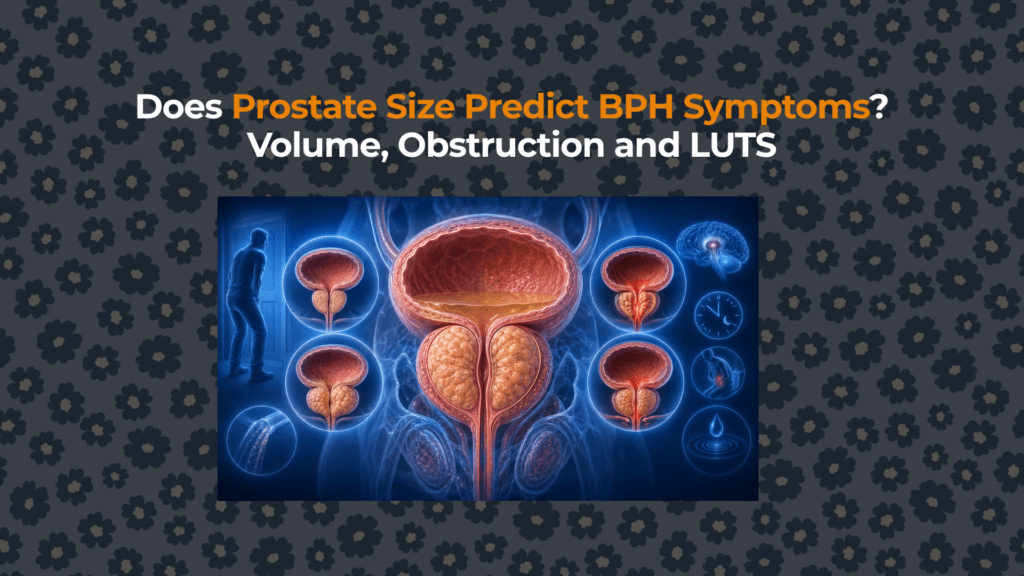
SIZE–SYMPTOM DISCORDANCE OBSERVATORY A prostate-volume number and a symptom score describe different dimensions. They can move together across populations while diverging sharply in one person. Direct answer: Prostate size does not reliably predict how severe BPH-associated urinary symptoms will be. A large gland may cause few symptoms, while a modestly enlarged gland may produce marked […]
What Is Median Lobe Prostate Enlargement? Anatomy, Obstruction and Treatment Relevance

BLADDER-NECK GEOMETRY STUDIO A median lobe can be clinically important because of where it grows, not merely how much tissue it adds. Direct answer: Median-lobe prostate enlargement is benign tissue growth at the prostate base that projects upward toward or into the bladder. This projection can elevate and deform the bladder neck, sometimes acting like […]
What Is Intravesical Prostatic Protrusion (IPP)? Median Lobe Growth and Bladder Outlet Obstruction
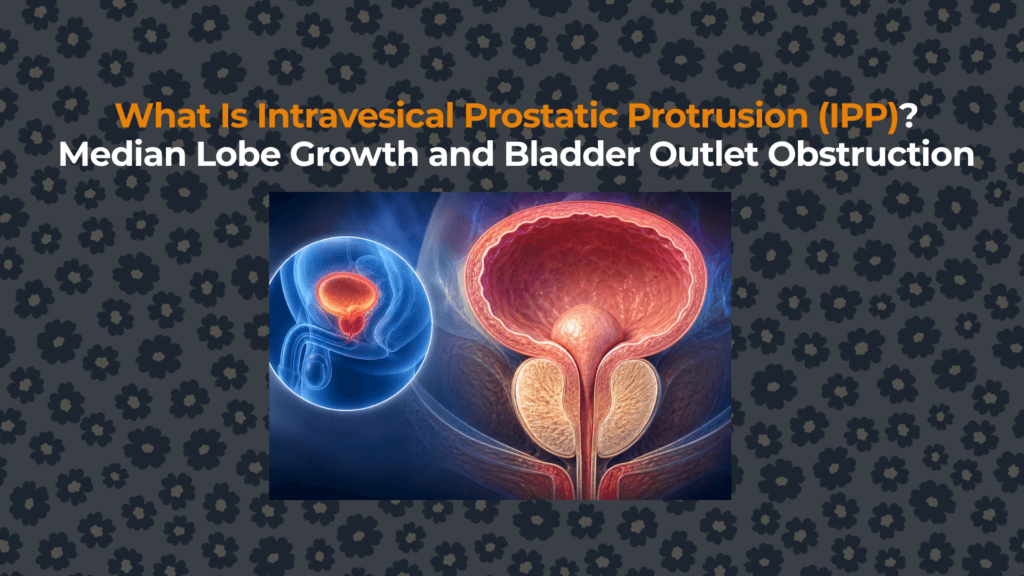
ULTRASOUND METROLOGY LAB IPP turns outlet geometry into a millimetre measurement. Its value comes from adding anatomical probability—not from replacing symptoms, flow or pressure–flow evidence. Direct answer: Intravesical prostatic protrusion is the perpendicular distance that prostate tissue projects into the bladder lumen above the bladder base, usually measured on a mid-sagittal transabdominal ultrasound. Common grades […]