Why Does the Prostate Enlarge With Age? BPH Growth and Hormonal Mechanisms
Age does not activate one prostate-growth switch. It creates years in which several local signals can change the balance among cell production, cell loss and tissue remodeling.
01. Aging Creates the Time Context, Not a Single Molecular Cause
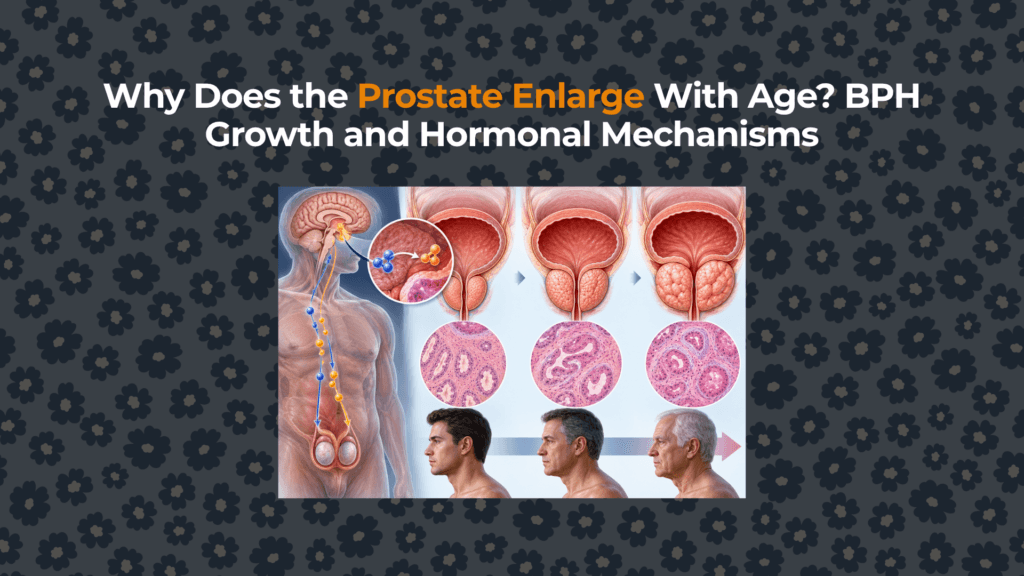
Benign prostatic hyperplasia is a tissue process: benign stromal and epithelial cell-number increase. Its probability rises with age, but age is not a molecule and does not prove why one person develops enlargement while another does not. The most defensible model treats aging as accumulated exposure to endocrine signaling, tissue repair, cellular senescence and changing local communication.
The separate age-trajectory analysis owns prevalence and longitudinal size patterns. Here, age is the time axis on which mechanisms operate.
02. DHT Is a Required Growth Signal, Not a Complete Explanation
Inside prostate tissue, 5-alpha-reductase converts testosterone to DHT. DHT binds the androgen receptor more avidly than testosterone, and the receptor regulates transcription in epithelial and stromal cells. This pathway supports prostate survival, secretion and growth. It does not, by itself, explain the location, rate or clinical consequences of every benign nodule.
03. Local Hormone Signaling Can Persist While Blood Testosterone Falls
The apparent paradox is that circulating testosterone commonly declines with age while BPH becomes more common. Blood concentration and tissue signaling are not interchangeable. Prostate exposure depends on hormone delivery, local 5-alpha-reductase activity, androgen-receptor biology and interactions with growth factors. Therefore “more testosterone in the blood causes BPH” is medically inadequate.
04. Enlargement Reflects Net Cell and Matrix Accumulation Over Years
Hyperplasia means increased cell number, not simply larger cells. Tissue expands when production and survival exceed cell loss over time; extracellular matrix can also accumulate and stiffen the gland. A small annual imbalance, repeated for years, can create measurable nodules without requiring rapid growth.
05. Stromal–Epithelial Signaling Organizes Transition-Zone Nodules
BPH is multicellular. Stromal smooth-muscle cells and fibroblasts communicate with glandular epithelium through growth factors, extracellular matrix and androgen-receptor-dependent signals. This “conversation” helps explain why the process is nodular and why gland-rich and stroma-rich nodules differ. The transition-zone anatomy guide locates the principal growth compartment around the proximal urethra.
06. Inflammation and Fibrosis Are Plausible Modifiers With Uneven Causal Evidence
Human BPH tissue frequently contains immune cells and inflammatory mediators. Chronic signaling may promote proliferation, wound-repair pathways and matrix deposition; fibrosis may increase stiffness even without proportionate volume change. However, cross-sectional tissue associations cannot establish whether inflammation initiated growth, resulted from it, or both.
07. Metabolic Factors Track Risk but Do Not Diagnose an Individual Cause
Obesity, insulin resistance, diabetes and metabolic syndrome are associated in many studies with BPH, prostate enlargement or male LUTS. Possible pathways include insulin/IGF signaling, autonomic tone, sex-hormone metabolism and systemic inflammation. Definitions and outcomes vary across studies, so these associations should not be converted into “your diet caused your enlarged prostate.”
| Candidate mechanism | Human evidence | Supported inference | Not proven |
|---|---|---|---|
| DHT–androgen receptor signaling | Biology plus consistent 5-ARI effects | Androgen signaling is permissive and therapeutically modifiable | DHT alone initiates every BPH case |
| Altered cell turnover | Human tissue and treatment-response evidence | Net accumulation can enlarge tissue over time | A universal individual growth rate |
| Stromal–epithelial communication | Human tissue, experimental and translational studies | Multiple cell compartments coordinate growth | One dominant growth factor in all patients |
| Inflammation/fibrosis | Frequent tissue association; mechanistic studies | May modify remodeling, stiffness and progression | Inflammation is always the initiating cause |
| Metabolic syndrome traits | Observational associations and plausible pathways | Systemic health may modify probability | An individual causal diagnosis |
08. 5-Alpha-Reductase Inhibitors Provide a Human Mechanistic Test
Finasteride and dutasteride reduce DHT production. In men with LUTS and prostate enlargement, the EAU guideline reports that after 2–4 years, 5-alpha-reductase inhibitors decrease prostate volume by about 18–28%, improve IPSS by about 15–30%, and increase maximum flow by about 1.5–2.0 mL/s. Their clinical effects relative to placebo generally require at least six months.
This is intervention evidence that androgen signaling helps maintain benign prostate tissue. It is not evidence that DHT is the only initiating cause, that every gland will shrink equally or that treatment is appropriate without clinical assessment.
09. Growth, Size, Symptoms and Obstruction Remain Separate Variables
Cellular BPH can exist before obvious enlargement. Enlargement can occur without troublesome symptoms. Symptoms can arise from the bladder or other urinary conditions, and obstruction depends on outlet geometry, smooth-muscle tone and bladder pressure—not volume alone. The BPH-versus-BPO analysis protects that tissue-to-function boundary.
Continue to prostate size versus BPH symptoms for the next mapped question. The broader urinary-health hub covers non-prostate causes of urinary symptoms.
10. The Most Accurate Model Is Multi-Causal and Patient-Specific
The strongest conclusion is narrower than a universal cause: age creates time and a permissive biological setting; local androgen signaling is required; altered cell turnover and stromal–epithelial interactions build nodules; inflammatory, fibrotic and metabolic pathways may modify the process. The histologic BPH definition explains exactly what the accumulated tissue is.