
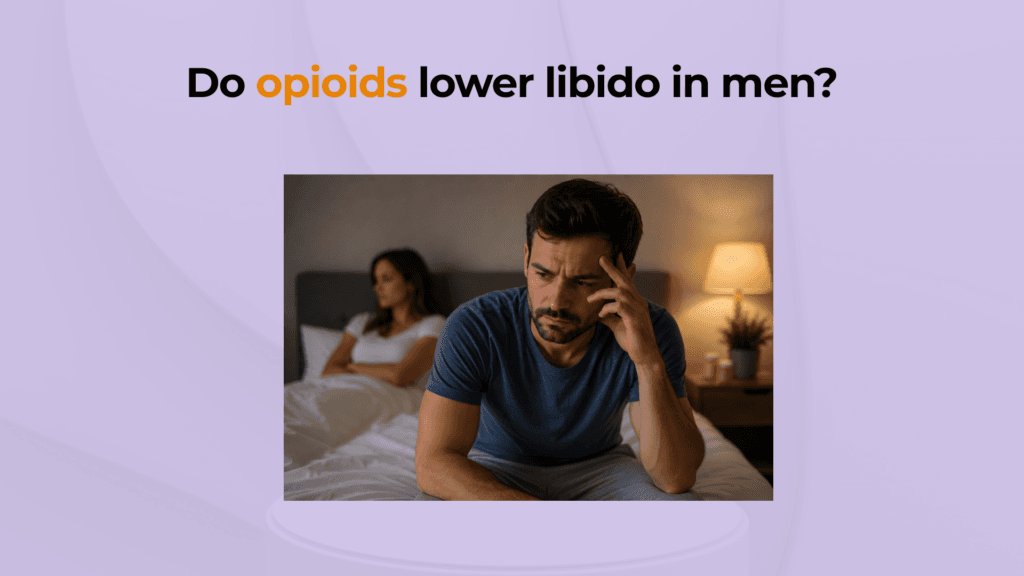
Do opioids lower libido in men?

Do opioids lower libido in men? | FactBasedUrology

Do opioids lower libido in men?

Yes, chronic opioid use significantly lowers libido in men by suppressing the Hypothalamic-Pituitary-Gonadal (HPG) axis, leading to Opioid-Induced Androgen Deficiency (OPIAD) and reduced testosterone production .

Important Medical/Safety Disclaimer:

Do not stop or change opioid dosage without consulting a prescribing physician. Abrupt cessation can cause severe withdrawal.

The Direct Clinical Answer: Prevalence and Risk

Opioids lower libido in men through a well-documented clinical phenomenon known as Opioid-Induced Androgen Deficiency (OPIAD). This condition validates the experiences of many men who notice a decline in sexual desire while on pain medication, fitting within the broader pattern of low libido in men caused by pharmacological suppression.

How Common Is Libido Loss Among Opioid Users?

Libido loss among opioid users occurs in approximately 50% to 80% of men on chronic maintenance therapy . This high prevalence helps normalize the symptom, indicating it is a common side effect rather than an isolated incident.

The risk is often dose-dependent. Increased morphine milligram equivalents (MME) correlate with decreased free testosterone, resulting in higher sexual dysfunction rates. It is important to contrast chronic use risks with acute or short-term use, where these effects are typically less pronounced.

However, individual genetic metabolism and specific opioid types create variance in side effect profiles; not every single user will experience this.

Mechanism of Opioid-Induced Androgen Deficiency

The mechanism of Opioid-Induced Androgen Deficiency involves direct suppression of the Hypothalamic-Pituitary-Gonadal (HPG) axis. Understanding this biological pathway clarifies why the medication affects sexual function.

How Opioids Suppress Testosterone Production

Opioids suppress testosterone production by inhibiting Gonadotropin-Releasing Hormone (GnRH) secretion in the hypothalamus . This interruption in hormonal signaling leads to a reduction in Luteinizing Hormone (LH) and Follicle-Stimulating Hormone (FSH), creating a profile similar to low testosterone-related libido decline.

Reduced LH signaling decreases Leydig cell stimulation, lowering serum testosterone concentrations. It is crucial to contrast this central suppression (brain) with primary testicular failure; the origin is neurological and hormonal, not structural organ damage.

Consequently, OPIAD is typically functional and reversible upon cessation or treatment, rather than causing permanent sterilization.

HPG Axis Suppression Mechanism Diagram showing opioids blocking GnRH secretion in the hypothalamus, leading to reduced LH and Testosterone. Hypothalamus Pituitary Testes GnRH LH/FSH OPIOID factbasedurology
Figure 1: HPG Axis Suppression. Opioids bind to receptors in the hypothalamus, blocking GnRH pulses and downstream testosterone production.

Management and Medical Intervention

Management of opioid-related libido loss requires medical intervention to balance pain control with hormonal health. Patients should not attempt to manage this alone due to the complexity of pain and hormone regulation, particularly when chronic pain itself affects libido.

Treatment Options for Opioid-Induced Sexual Dysfunction

Treatment options for opioid-induced sexual dysfunction include dosage adjustment, opioid rotation, or testosterone replacement therapy. Switching to buprenorphine, a partial agonist, might help reduce HPG axis suppression compared to full agonists.

Testosterone replacement therapy (TRT) restores serum levels and improves libido scores without necessarily altering pain management, following protocols outlined in low testosterone treatment for libido. However, the benefits of TRT must be contrasted with the risks of increasing opioid dosage to manage pain alongside low T.

Prescribing authority lies solely with the treating physician based on individual bloodwork.

Treatment Hierarchy Infographic showing the hierarchy of intervention: Dose reduction, Switching meds, TRT. 1. Dosage Adjustment 2. Opioid Rotation 3. TRT (Testosterone)factbasedurology
Figure 2: Treatment Hierarchy. Clinical management typically proceeds from dose adjustment to opioid rotation, and finally to TRT if needed.
Opioid TypeRisk LevelMechanism Impact
MethadoneHighStrong HPG Axis Suppression
OxycodoneModerateDose-Dependent Suppression
BuprenorphineLowerPartial Agonist Effect
TramadolVariableMixed Serotonin/Opioid Effect

Patient Action Checklist

  • Document Symptoms: Track libido changes relative to dosage increases.
  • Request Labs: Ask for Total Testosterone, Free Testosterone, LH, and FSH, following testosterone testing guidelines for libido [OP6].
  • Discuss Rotation: Inquire about buprenorphine or lower-risk alternatives.
  • Verify Credentials: Ensure the reviewer is a Board-Certified Endocrinologist [YMYL Governance].

Conclusion

Opioid-induced libido loss is a significant, dose-dependent, and biologically explainable condition. By understanding the suppression of the HPG axis, patients can engage in informed discussions with their healthcare providers about managing pain while preserving hormonal health, recognizing that this form of opioid-related sexual dysfunction requires coordinated medical management.

Related articles

Facebook
Twitter
LinkedIn
WhatsApp
X

Leave a Reply

Your email address will not be published. Required fields are marked *

Written by factbasedurology.

This guide was created by factbasedurology, an educational platform committed to publishing evidence-based insights on men’s sexual wellness. All content is built from credible medical literature and scientific sources, with a focus on synthesizing complex topics into accessible information. We are dedicated to helping men understand their bodies, build confidence, and take informed action

⚠️ This content is for informational purposes only and does not substitute professional medical advice. Always consult a licensed urologist for personal health concerns.

Our goal is to turn clinical knowledge into confidence — with facts you can trust.