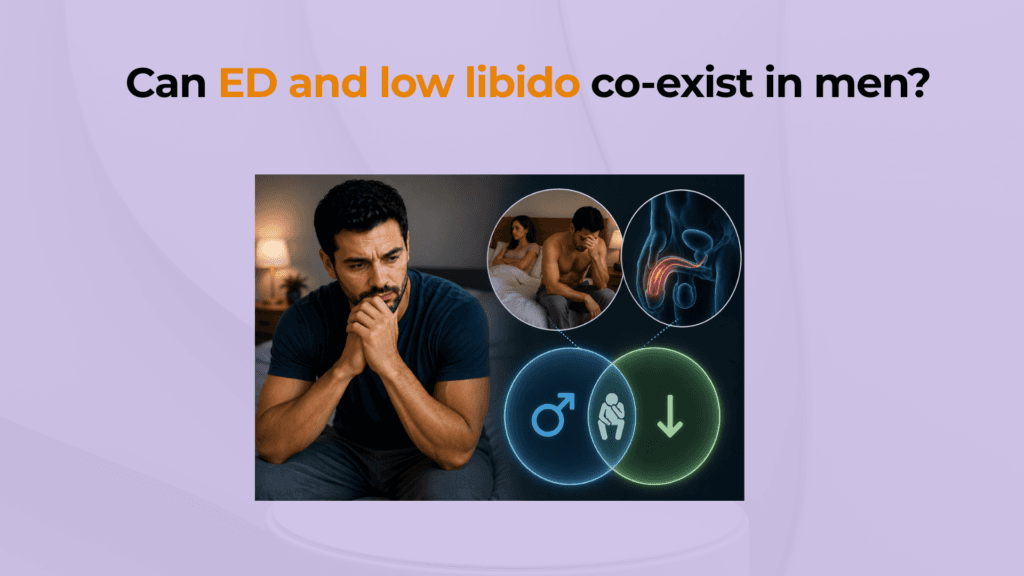
Can ED and Low Libido Co-Exist in Men?
Erectile dysfunction and low libido can happen at the same time because male sexual function has two linked but separate layers: desire and erection response. Desire depends heavily on brain, hormone, mood, sleep, relationship, and reward systems. Erection depends heavily on nerves, blood vessels, smooth muscle relaxation, penile tissue, and sexual stimulation. When a shared driver affects both layers, a man may lose interest and also struggle to get or keep an erection.
Yes. ED and low libido can co-exist in men, but they are not the same problem. ED means the erection response is unreliable; low libido means sexual desire is reduced. They overlap most often when low testosterone, vascular disease, diabetes, hypertension, depression, anxiety, medication effects, sleep problems, relationship stress, or performance pressure affects both sexual motivation and physical response.
What is the difference between ED and low libido?
ED is mainly a problem of arousal execution: the body does not reliably create or maintain an erection firm enough for sex. Low libido is mainly a problem of sexual motivation: the mind and body do not generate enough sexual interest, urge, or anticipation. This distinction matters because a man can have low desire with normal erections, strong desire with poor erections, or both symptoms together.
Clinically, this is why libido and erectile function should be evaluated separately before treatment. A pill that improves blood flow may help erection mechanics, but it does not automatically create desire. Likewise, improving mood, sleep, hormones, or relationship safety may improve desire, but a vascular erection problem may still need direct ED treatment.
Why do ED and low libido often appear together?
ED and low libido often appear together because several body systems are upstream of both desire and erection quality. Testosterone deficiency can lower sexual thoughts and reduce erectile responsiveness. Endothelial dysfunction can reduce penile blood flow and make sex feel unreliable. Depression and anxiety can reduce desire while activating stress pathways that interfere with erections. Diabetes, hypertension, obesity, sleep apnea, alcohol, smoking, medications, and chronic stress can affect multiple sexual systems at once.
This is why a man should not assume that ED automatically means “no attraction,” and he should not assume low libido is purely psychological. A mixed presentation needs a differential diagnosis that includes hormones, vascular health, metabolic health, nervous-system function, medication review, sleep, mood, and relationship context.
Confirmed testosterone deficiency can affect both sexual desire and erectile response. Symptoms plus repeated low morning testosterone matter more than one isolated result.
Endothelial dysfunction, diabetes, hypertension, smoking, and cardiovascular disease can reduce penile blood flow and sexual confidence.
Depression, anxiety, shame, conflict, and performance pressure can reduce desire while increasing sympathetic tension that makes erections harder.
SSRIs, beta blockers, opioids, alcohol, poor sleep, inactivity, and obesity can affect both libido and erectile function through different pathways.
How should ED and low libido be evaluated together?
Evaluation should start by separating the pattern. Does the man want sex but cannot get or keep an erection? Does he have reliable erections but little desire? Or are both desire and erection response reduced? This first separation prevents the common mistake of treating every sexual complaint as a blood-flow problem or every erectile problem as a relationship problem.
The American Urological Association recommends that men with ED receive a medical, sexual, and psychosocial history, physical examination, selective lab testing, and morning serum total testosterone measurement. If testosterone deficiency is suspected, diagnosis should not be made from one random result. Testosterone deficiency requires symptoms plus consistently low levels on properly timed testosterone testing.
| Symptom pattern | What it suggests | Useful evaluation route |
|---|---|---|
| High desire, poor erections | Often points toward vascular, neurologic, medication, pelvic injury, anxiety, or erection-specific causes. | ED history, cardiovascular risk review, medication review, diabetes/A1C, lipids, blood pressure, and ED-focused treatment assessment. |
| Low desire, reliable erections | Often points toward depression, stress, relationship context, low testosterone, sleep problems, medication effects, or low sexual motivation. | Libido assessment, mood/sleep review, medication review, morning testosterone if symptoms suggest deficiency, and relationship context. |
| Low desire and poor erections | Mixed presentation. Shared drivers such as testosterone deficiency, diabetes, cardiovascular risk, depression, anxiety, obesity, and sleep apnea become more likely. | Integrated workup: ED evaluation, testosterone testing, metabolic labs, cardiovascular risk review, mental health screen, and medication review. |
Important clinical boundary
Morning erections, masturbation erections, partner-specific erections, sudden onset, gradual worsening, medication timing, mood changes, and relationship context all matter. A man with strong desire but poor erections should not be told he simply has low libido. A man with low desire and normal erections should not be treated as if blood flow is the only issue.
How are ED and low libido treated when they co-exist?
Treatment should match the dominant driver. PDE5 inhibitors such as sildenafil or tadalafil improve erection mechanics by supporting blood-flow response, but they do not directly create sexual desire. Testosterone therapy is only appropriate when testosterone deficiency is confirmed and the benefits, fertility issues, prostate monitoring, red blood cell effects, and cardiovascular context are reviewed. Therapy, anxiety treatment, depression treatment, sleep restoration, exercise, alcohol reduction, and relationship work may be necessary when desire and confidence are the main barriers.
For mixed ED-low libido, the best clinical framing is not “one pill fixes both.” The better framing is: identify which system is failing first, then layer treatment. A man may need ED treatment plus testosterone evaluation. Another may need performance anxiety treatment plus gradual sexual confidence rebuilding. Another may need cardiovascular risk reduction before sexual treatment is safe or effective.
| Dominant driver | What treatment usually targets |
|---|---|
| Blood-flow/erection mechanics | PDE5 inhibitors, cardiovascular risk reduction, diabetes control, smoking cessation, physical activity, and ED-specific medical review are usually considered when the main problem is erection firmness or maintenance. In that pattern, treatment targets blood-flow response first, while libido is reassessed after confidence and erection reliability improve. |
| Confirmed low testosterone | When symptoms and repeat morning labs confirm deficiency, treatment focuses on identifying the cause, reviewing fertility goals, checking LH/FSH when appropriate, and discussing therapy only when criteria are met. In this context, low testosterone can affect both sexual thoughts and erection responsiveness. |
| Performance anxiety | Treatment targets self-monitoring, fear of failure, avoidance, sympathetic arousal, and pressure-based sex patterns. When desire is present but sexual situations trigger threat and checking, performance anxiety can turn an erection problem into repeated libido avoidance. |
| Cardiometabolic risk | Evaluation should include blood pressure, A1C, lipids, waist weight, activity level, smoking, and cardiovascular risk before assuming a purely sexual cause. Poor cardiovascular health can reduce penile blood flow and make sex feel less reliable, which may lower desire over time. |
When should ED with low libido be checked urgently?
Persistent ED with low libido should be checked when it is sudden, worsening, associated with diabetes or cardiovascular risk, linked to new medication, accompanied by chest pain or reduced exercise tolerance, or paired with loss of morning erections and severe fatigue. ED can be an early signal of vascular disease because penile arteries may show blood-flow problems before larger arteries produce symptoms.
- Seek medical review if ED is persistent, worsening, or paired with diabetes, hypertension, high cholesterol, obesity, smoking, or heart symptoms.
- Check testosterone properly when low desire appears with weak morning erections, fatigue, reduced muscle, infertility concerns, or low sexual thoughts.
- Review medications if symptoms started after antidepressants, opioids, beta blockers, prostate drugs, or other new prescriptions.
- Assess mood and anxiety if desire drops with depression, fear of failure, avoidance, shame, relationship conflict, or constant stress.
- Do not self-start testosterone without diagnosis, because treatment can affect fertility, red blood cell levels, prostate monitoring, and cardiovascular risk context.
FAQ: ED and low libido in men
Can ED and low libido happen at the same time?
Yes. They can happen together when one condition affects both sexual desire and erection response. Common shared drivers include low testosterone, diabetes, cardiovascular disease, depression, anxiety, poor sleep, medication effects, and relationship stress.
Does ED always mean a man has low desire?
No. A man can want sex but still have ED because of blood-flow, nerve, medication, anxiety, or hormonal issues. Desire and erection quality should be separated during evaluation.
Can low libido cause ED?
Low libido can reduce arousal intensity and make erections less reliable, but it does not explain every case of ED. A man with low desire and erection problems still needs evaluation for vascular, hormonal, metabolic, neurologic, medication, and psychological causes.
Should testosterone be tested when ED and low libido occur together?
Yes, morning total testosterone is commonly part of ED evaluation. However, testosterone deficiency should be diagnosed only when symptoms are present and testosterone is consistently low on properly timed testing.
Will ED pills increase libido?
ED pills can improve erection response, but they do not directly increase libido. Desire may improve indirectly if sexual confidence returns, but persistent low desire needs its own evaluation.
References
- American Urological Association. Erectile Dysfunction: AUA Guideline. 2018.
- American Urological Association. Testosterone Deficiency Guideline. 2018.
- Endocrine Society. Testosterone Therapy for Hypogonadism Guideline Resources. 2018.
- Mayo Clinic. Erectile dysfunction: Symptoms and causes. Updated 2024.
- Mayo Clinic. Erectile dysfunction: A sign of heart disease? Updated 2026.