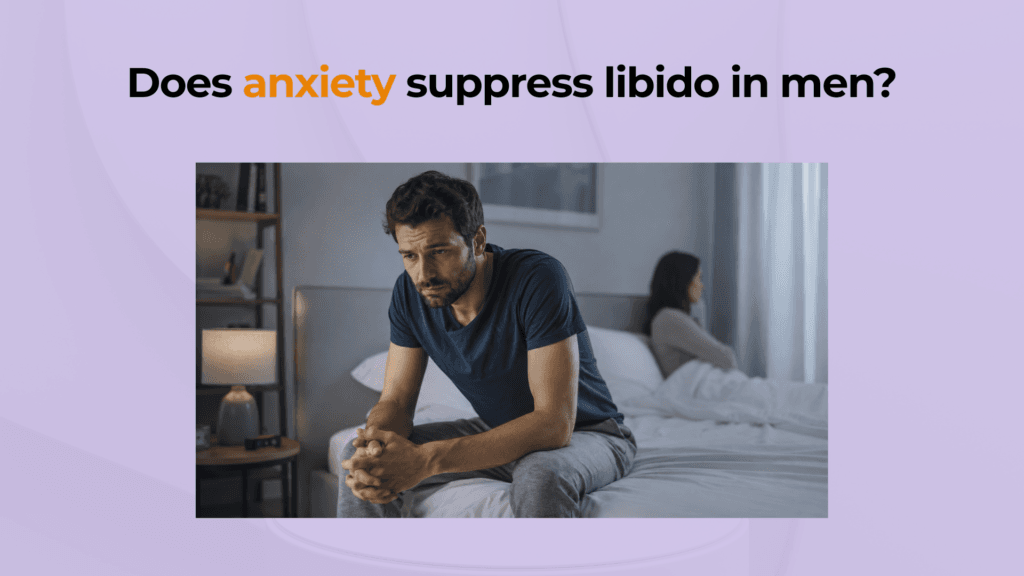
Does Anxiety Suppress Libido in Men? Yes—Anxiety Can Lower Male Libido
Yes. Anxiety can suppress libido in men by keeping the nervous system in threat mode, increasing worry and vigilance, reducing sexual focus, worsening performance confidence, and making erection readiness more difficult.
Direct answer: Anxiety can reduce male sexual desire when the brain treats sex as pressure instead of pleasure. Libido depends on safety, attention, reward, energy, confidence, and arousal readiness. Persistent anxiety can interfere with all of these, especially when worry, body monitoring, stress hormones, or fear of erection failure take over.
Anxiety disorders involve more than occasional worry; NIMH describes anxiety disorders as worry or fear that does not go away, is felt in many situations, can worsen over time, and can interfere with daily life and relationships.[1] That same persistent threat state can also interfere with sexual interest and sexual performance.
Medical disclaimer: This article is educational and does not replace care from a licensed clinician. Seek urgent help for thoughts of self-harm, suicide, panic symptoms that feel medically dangerous, chest pain, fainting, severe agitation, mania symptoms, or sudden unsafe behavior.
What does this mean for you?
If libido dropped during anxiety, the key question is whether the main driver is generalized anxiety, sexual performance anxiety, erectile dysfunction, medication effects, or another medical issue. These patterns overlap, but they need different solutions.
The most common patterns
- General anxiety pattern: low libido appears with constant worry, restlessness, poor sleep, fatigue, muscle tension, and reduced emotional bandwidth.
- Performance anxiety pattern: desire may exist, but sexual situations trigger fear, self-monitoring, erection checking, or fear of disappointing a partner.
- Erectile-confidence pattern: one erection problem creates fear of the next encounter, and that fear makes the next erection harder.
- Medical overlap pattern: low libido appears with loss of morning erections, persistent erectile dysfunction, medication changes, heavy alcohol use, low testosterone symptoms, or sleep apnea symptoms.
How anxiety affects stress physiology and sexual arousal
Anxiety can suppress libido by increasing sympathetic nervous system activation and stress-axis signaling. During stress, the sympathetic nervous system and adrenal glands help prepare the body for threat; StatPearls describes catecholamine release during stress and notes that stress affects multiple body systems, including endocrine and reproductive systems.[2]
For sexual function, this matters because arousal requires a shift away from threat monitoring and toward relaxed attention, blood-flow readiness, and sensory engagement. When the body is locked into “fight-or-flight,” sex can feel irrelevant, risky, pressured, or physically difficult.
The original draft used a “pregnenolone competition” explanation. That is too strong for a reader-facing medical page. A safer explanation is that stress-axis activation can interact with reproductive-axis function. A review on stress and the reproductive axis describes cross-talk between the HPA stress axis and the HPG reproductive axis, including the idea that stress-axis activation can affect reproductive function.[3]
Careful wording matters
Use “anxiety can contribute to lower libido”, not “anxiety always suppresses testosterone.” Some men lose desire mainly from worry and fatigue. Others struggle more with erection confidence. Others have a separate medical problem that anxiety makes worse.
Men who feel chronically wired, stressed, or unable to relax often need to consider cortisol as part of the stress-libido pathway. When the problem is long-term stress load rather than sex-specific fear, chronic stress can keep recovery, sleep, and sexual desire in conflict.
Performance anxiety vs. generalized anxiety
Performance anxiety is specific fear about sexual performance, while generalized anxiety is broader worry that drains desire and energy across life. Both can lower libido, but the experience is different.
Performance anxiety
Performance anxiety often starts after one distressing sexual event: a weaker erection, premature ejaculation, delayed ejaculation, or feeling unable to satisfy a partner. The next time sex becomes possible, the brain remembers the earlier failure. The man begins monitoring his erection, arousal, or timing instead of experiencing pleasure. That monitoring increases anxiety, and the cycle repeats.
Systematic-review evidence identifies men with anxiety disorders as a high-risk group for erectile dysfunction, and the AUA guideline states that psychological factors such as depression, anxiety, stress, and relationship conflict may be primary or secondary contributors to erectile dysfunction.[4][5]
If desire is present but sexual situations trigger fear of failure, performance anxiety can turn one difficult sexual experience into repeated self-monitoring, pressure, and arousal loss.
Generalized anxiety
Generalized anxiety can suppress libido more indirectly. The problem may not be fear of sex itself. It may be exhaustion from constant worry, poor sleep, inability to relax, low emotional availability, muscle tension, and feeling mentally overloaded.
When anxiety is broad and persistent rather than sex-specific, anxiety treatment should target constant threat signaling, avoidance, sleep disruption, and mental overload before treating low libido as a stand-alone sexual problem. In men whose desire drops mainly after prolonged deadlines, relationship strain, or poor recovery, stress management becomes part of the libido plan rather than a generic wellness step.
What should you do if anxiety is lowering libido?
Start by identifying whether anxiety is lowering desire, disrupting erections, or creating fear around sexual performance. The treatment path depends on which part of the sexual response is affected.
1. Track the timing
Write down when low libido began, when anxiety worsened, whether the problem occurs only with a partner or also alone, and whether morning erections are normal. Timing helps separate anxiety-driven patterns from vascular, hormonal, medication, or sleep-related patterns.
2. Treat the anxiety pattern
Cognitive behavioral therapy is a well-studied treatment approach for anxiety disorders, typically focused on changing maladaptive thoughts and behaviors that maintain anxiety.[6] For sexual performance anxiety, therapy may also include attention-shifting, sensate focus, communication skills, and reducing erection-checking behavior.
3. Evaluate erectile dysfunction if erections are unreliable
If erections are repeatedly weak, short-lived, or absent in multiple contexts, do not assume anxiety is the only cause. The AUA guideline emphasizes thoughtful evaluation because psychological factors can be primary or secondary, and ED can also involve vascular, neurological, hormonal, medication-related, or relationship factors.[5]
4. Check other libido factors if symptoms persist
If libido remains low after anxiety improves, evaluate sleep, alcohol, depression, medications, metabolic risk, and hormone symptoms. Low energy, reduced morning erections, loss of muscle, or persistent low motivation can make testosterone part of the evaluation rather than assuming anxiety is the only cause.
What not to do
- Do not assume anxiety is the only cause. Persistent low libido or ED may involve hormones, blood flow, sleep, medications, alcohol, depression, or relationship strain.
- Do not force sex to “test” yourself repeatedly. Repeated testing can worsen the performance-anxiety loop.
- Do not self-medicate with testosterone or online erection drugs. Proper evaluation is safer, especially if chest symptoms, blood-pressure medication, or cardiovascular risk is present.
- Do not hide anxiety, panic, or sexual fear from the clinician. Clear reporting helps separate mental-health and urological contributors.
- Do not ignore urgent mental health symptoms. Severe panic, suicidal thoughts, or unsafe behavior needs immediate support.
When should you seek medical help?
Seek medical help when anxiety-related libido loss is persistent, distressing, linked with erectile dysfunction, or interfering with relationships and daily life. Anxiety-related sexual problems are common enough to discuss openly, and they are often treatable.
- Low libido lasts several weeks and causes distress or relationship strain.
- Erectile dysfunction, loss of morning erections, premature ejaculation, delayed ejaculation, or avoidance of sex appears.
- Panic symptoms, severe insomnia, appetite change, depression symptoms, or work impairment are present.
- Symptoms began after starting or changing medication.
- There are thoughts of self-harm, suicide, mania, dangerous impulses, or sudden unsafe behavior.
FAQs about anxiety and male libido
Does anxiety suppress libido in men?
Yes. Anxiety can suppress libido in men by increasing worry, threat vigilance, fatigue, performance monitoring, and sympathetic arousal that makes sexual desire and arousal harder.
Can anxiety cause erectile dysfunction?
Anxiety can contribute to erectile dysfunction, especially when performance worry, sympathetic arousal, relationship stress, or repeated fear of failure interferes with arousal. Persistent ED still deserves medical evaluation.
Is anxiety-related low libido permanent?
Usually it does not have to be permanent. Libido may improve when anxiety is treated, performance pressure is reduced, sleep and stress recover, and other causes are evaluated.
Should I test testosterone if anxiety lowers libido?
Consider medical evaluation if low libido persists after anxiety improves or appears with reduced morning erections, persistent fatigue, loss of muscle, infertility concerns, or erectile dysfunction.
Evidence sources
- National Institute of Mental Health. Anxiety Disorders. Last reviewed December 2024. View source
- Chu B, Marwaha K, Sanvictores T, Awosika AO, Ayers D. Physiology, Stress Reaction. StatPearls. NCBI Bookshelf. Updated 2024. View source
- Toufexis D, Rivarola MA, Lara H, Viau V. Stress and the Reproductive Axis. Journal review, PMC. View source
- Velurajah R, Brunckhorst O, Waqar M, McMullen I, Ahmed K. Erectile dysfunction in patients with anxiety disorders: a systematic review. International Journal of Impotence Research. 2022. View source
- Burnett AL, Nehra A, Breau RH, et al. Erectile Dysfunction: AUA Guideline. Journal of Urology. 2018. View source
- Kaczkurkin AN, Foa EB. Cognitive-behavioral therapy for anxiety disorders: an update on the empirical evidence. Dialogues Clin Neurosci. 2015. View source