Does Hyperthyroidism Raise Libido in Men? Understanding Hormonal Influences on Sexual Desire
Important Medical/Safety Disclaimer:
This article is for informational purposes only and does not constitute medical advice. Persistent changes in libido, especially when accompanied by other physical or mood symptoms, require evaluation by a qualified healthcare professional.
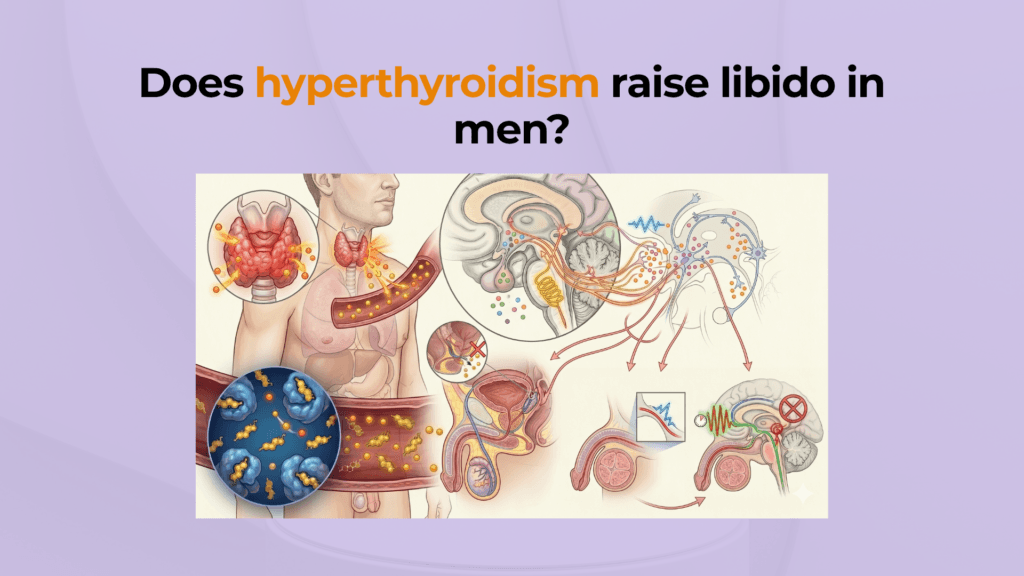
Hyperthyroidism in men creates a paradoxical effect on libido; while excess thyroid hormones can heighten metabolic and neurological arousal signals, systemic symptoms like anxiety and fatigue often override these effects, leading to a complex and unpredictable impact on sexual desire.
Hyperthyroidism: A State of Overactive Thyroid Glands
Hyperthyroidism is a medical condition characterized by an overactive thyroid gland that produces an excess of thyroid hormones. These hormones act as a primary regulator for the body’s vast network of metabolic processes, and when their levels are imbalanced, the effects can be felt system-wide, including on sexual health.
What is the thyroid gland and its normal function?
The thyroid gland is a butterfly-shaped endocrine gland in the neck responsible for producing hormones that regulate the body’s metabolism. It achieves this by releasing a steady, controlled amount of its key hormones—thyroxine (T4) and triiodothyronine (T3)—into the bloodstream. In a healthy state, the thyroid gland helps regulate metabolism, heart rate, and energy use, thereby maintaining systemic homeostasis.
How hyperthyroidism occurs: excess thyroid hormones (T3 and T4)
Hyperthyroidism occurs when the thyroid gland releases excessive amounts of the hormones T3 and T4, accelerating the body’s metabolic processes. It’s as if the body’s internal thermostat is set too high, causing all systems to run in overdrive. This state can be triggered by several conditions, most commonly Graves’ disease (an autoimmune disorder), but also by thyroid nodules that produce excess hormones.
How hyperthyroidism differs from hypothyroidism and euthyroidism
Hyperthyroidism is the direct opposite of hypothyroidism, where the thyroid is underactive, while euthyroidism represents a normal, balanced thyroid function. These three states exist on a spectrum determined by the levels of thyroid hormones and Thyroid-Stimulating Hormone (TSH). Using an analogy, hyperthyroidism is like a car engine idling too fast, leading to anxiety and weight loss, while hypothyroidism is an engine idling too slow, causing fatigue and weight gain. Euthyroidism is the engine running correctly.
| Feature | Hyperthyroidism (Overactive) | Euthyroidism (Normal) | Hypothyroidism (Underactive) |
|---|---|---|---|
| Hormone Levels | High T3/T4, Low TSH | Normal T3/T4 & TSH | Low T3/T4, High TSH |
| Metabolism | Accelerated | Balanced | Slowed |
| Common Symptom | Anxiety, Weight Loss | None | Fatigue, Weight Gain |
| Impact on Libido | Complex / Variable | Normal | Typically Decreased |
The Paradox: How Overactive Thyroid Hormones Can Impact Male Libido
The impact of overactive thyroid hormones on male libido is paradoxical, as direct biochemical effects can potentially increase arousal signals while systemic symptoms often suppress overall sexual desire. To understand this contradiction, we must first look at the direct hormonal pathways that could, in theory, enhance libido.
Direct influence of thyroid hormones on neurotransmitters (e.g., dopamine)
Excess thyroid hormones can directly influence libido by increasing the sensitivity of neurotransmitter systems, such as the dopamine pathway, which is critical for motivation and sexual arousal. Thyroid hormone T3 can modulate dopamine receptor sensitivity, effectively “turning up the volume” on reward-seeking signals in the brain. This creates a plausible biochemical explanation for a potential increase in sexual motivation. However, it’s crucial to recognize this is a theoretical effect that is often not the experienced reality due to other overriding symptoms.
How T3 and T4 can increase metabolic rate and potentially sexual arousal signals
Increased levels of T3 and T4 hormones accelerate the body’s overall metabolic rate, which can lead to heightened physiological arousal that may be misinterpreted as or contribute to sexual desire. Symptoms like a faster heart rate and a feeling of increased energy can, in some cases, lower the threshold for sexual arousal. This is a state of general activation, not targeted sexual activation, and it is the same mechanism that leads to negative symptoms like anxiety and palpitations.
The thyroid-libido connection: is it always positive?
The connection between the thyroid and libido is not always positive, as the potential increase in arousal is frequently overshadowed by debilitating systemic symptoms. The clinical picture is a battle between a direct, but often weak, “pro-libido” signal and several strong, indirect “anti-libido” signals. The net effect is highly variable and depends on the severity of the condition and the individual’s overall health.
Indirect Systemic Impacts: How Hyperthyroidism Affects Libido Through Other Symptoms
The indirect systemic impacts of hyperthyroidism, such as anxiety, fatigue, and cardiovascular strain, often exert a more powerful, negative influence on libido than any direct hormonal effect. While the engine may be revving high, the rest of the vehicle—the body and mind—is under immense stress, making sexual activity a low priority.
Increased anxiety and agitation: a double-edged sword for desire
The increased anxiety and agitation common in hyperthyroidism act as a double-edged sword, where initial restlessness might mimic arousal but quickly becomes a powerful inhibitor of true sexual desire and intimacy. Constant nervousness and an inability to relax are fundamentally incompatible with the psychological state required for a healthy sexual response.
Chronic fatigue and metabolic stress: reducing energy for sexual activity
Despite a high metabolic rate, hyperthyroidism often causes profound chronic fatigue and metabolic stress, leaving insufficient physical and mental energy for sexual activity. The body is burning through its energy reserves so quickly that it leads to a state of exhaustion, even while feeling “wired.”
Cardiovascular strain and its impact on sexual response
Cardiovascular strain from hyperthyroidism, including rapid heart rate (tachycardia) and palpitations, can create physical discomfort and anxiety that directly interferes with the normal physiological sexual response. The physical exertion of sexual activity can feel daunting or even unsafe when the heart is already racing at rest.
Weight loss and body image concerns: psychological factors affecting libido
Unintended and rapid weight loss associated with hyperthyroidism can lead to negative body image and psychological distress, further reducing libido. While weight loss might be desired by some, the muscle wasting and gaunt appearance that can accompany the condition often have a negative psychological impact.
Distinguishing Hyperthyroidism’s Libido Effects from General Sexual Dysfunction
Distinguishing libido changes caused by hyperthyroidism from other forms of sexual dysfunction requires examining the full constellation of symptoms, not just the sexual ones. Thyroid-related issues are systemic, impacting the entire body, whereas other sexual dysfunctions can be more isolated.
Hyperthyroidism-related libido changes vs. age-related decline
Libido changes from hyperthyroidism are typically more abrupt and accompanied by symptoms of a sped-up metabolism, unlike the more gradual decline sometimes associated with aging. The sudden onset of anxiety, weight loss, and palpitations alongside a libido shift is a key distinguishing feature.
Distinguishing thyroid-driven desire issues from performance-focused problems (e.g., erectile dysfunction)
Thyroid-driven issues primarily affect sexual desire (libido), whereas performance problems like erectile dysfunction (ED) relate to physiological response, though the two can be linked. In hyperthyroidism, the primary complaint is often a lack of interest or mental energy for sex, even if physical function remains intact. However, the anxiety and cardiovascular strain from the condition can also contribute to performance issues.
The role of other hormones (e.g., testosterone, prolactin) in hyperthyroidism-related libido changes
Hyperthyroidism can alter the balance of other critical sex hormones, such as by increasing Sex Hormone-Binding Globulin (SHBG), which reduces free testosterone and can negatively impact libido.
SHBG acts like a sponge, binding to testosterone in the blood and making it unavailable for the body’s tissues to use. Even if total testosterone levels are normal, a high SHBG level means less “active” testosterone, which is a powerful blow to libido.
Identifying the Signals: Common Symptoms of Hyperthyroidism Linked to Libido Changes
Identifying a potential link between hyperthyroidism and libido changes involves recognizing a pattern of overt systemic symptoms that coincide with altered sexual desire. The key is the *combination* of symptoms; a change in libido alone can have many causes, but when it appears alongside the following signs, a thyroid issue becomes a primary suspect.
Symptom Checklist for Hyperthyroidism
-
☐Unexplained Weight Loss: Are you losing weight despite a normal or increased appetite?
-
☐Rapid or Irregular Heartbeat: Do you experience palpitations or a racing heart, even at rest?
-
☐Anxiety, Irritability, or Nervousness: Have you noticed a significant increase in anxiety or mood swings?
-
☐Tremors: Do you have a fine trembling in your hands or fingers?
-
☐Increased Sensitivity to Heat: Do you feel hot when others feel comfortable?
-
☐Changes in Bowel Patterns: Are you experiencing more frequent bowel movements?
-
☐Fatigue or Muscle Weakness: Do you feel tired or weak despite being “wired”?
-
☐Difficulty Sleeping: Is insomnia a new or worsening problem?
-
☐Changes in Libido: Have you noticed a persistent, unexplained change in your sexual desire (increase or decrease)?
When to Seek Medical Evaluation for Libido Changes
A persistent change in libido in men, especially when coupled with any of the systemic symptoms of hyperthyroidism, signals a clear need for medical evaluation. Self-diagnosing is unreliable and can delay treatment for a manageable condition.
Persistent libido changes coupled with other unexplained symptoms
The critical threshold for seeking medical advice is when libido changes are not temporary and occur alongside other unexplained physical or mood symptoms. If you check several boxes on the symptom list above, it is important to schedule a consultation with a healthcare professional.
Diagnostic pathways: blood tests and medical consultation
The primary diagnostic pathway for suspected hyperthyroidism involves a medical consultation and a simple blood test to measure levels of TSH, T3, and T4. This test provides a definitive biochemical snapshot of thyroid function and is the gold standard for diagnosis.
Synthesizing the Impact: Hyperthyroidism’s Complex Relationship with Male Libido
Ultimately, hyperthyroidism’s relationship with male libido is deeply complex, where the condition’s systemic strain on the body is the most significant factor influencing sexual health. While a direct hormonal link to increased arousal exists in theory, the practical experience for most men is that the overwhelming fatigue, anxiety, and metabolic stress suppress sexual desire far more powerfully.
Treating the underlying thyroid condition is the only effective way to address any related libido issues. Therefore, a comprehensive medical diagnosis is the essential first step toward restoring both metabolic and sexual well-being.