How Does Testosterone Affect Libido in Men?
Testosterone supports male sexual desire, and treatment improves libido in some men with confirmed deficiency; low desire alone does not diagnose low testosterone, and higher levels do not guarantee greater interest in sex.
Libido means sexual interest. Hypogonadism means inadequate testosterone production with compatible symptoms and consistently low laboratory measurements. These concepts overlap, but they are not interchangeable. [1]
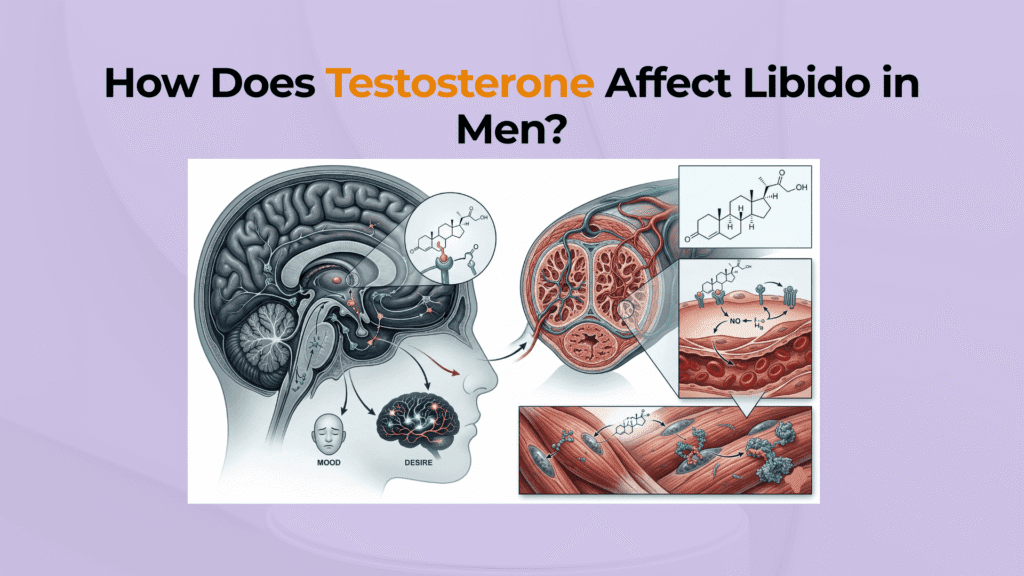
How Does the HPG Axis Control Testosterone Relevant to Male Libido?
The hypothalamic–pituitary–gonadal (HPG) axis regulates testicular testosterone through brain and pituitary signals; disruption of this system is one explanation for testosterone deficiency in men with reduced libido.
- Releases GnRH: The hypothalamus sends pulses of gonadotropin-releasing hormone to the anterior pituitary.
- Releases LH and FSH: The pituitary secretes luteinizing hormone and follicle-stimulating hormone into the circulation.
- Produces testosterone: LH stimulates Leydig cells in the testes. FSH acts on Sertoli cells and supports sperm production.
- Regulates feedback: Testosterone and estradiol feed back to the hypothalamus and pituitary. Inhibin B from the testes helps regulate FSH.
This hormonal circuit supports testicular function; a libido rating does not directly measure GnRH pulses, LH secretion or sperm production. Endotext: Endocrinology of the Testis and Spermatogenesis
Which Tests Distinguish HPG-Axis Causes of Low Testosterone?
Testosterone-related low libido requires assessment of symptoms and consistently low testosterone; LH and FSH help distinguish a testicular cause from a hypothalamic or pituitary cause after deficiency is established.
Primary hypogonadism concerns the testes. Secondary hypogonadism concerns hypothalamic or pituitary signaling. The Endocrine Society recommends repeated morning fasting testosterone measurements and additional evaluation of the cause. One low result or reduced desire alone does not locate a problem within the HPG axis. Endocrine Society guideline, recommendations 1.1–1.4
Does Testosterone Replacement Restore Every HPG-Axis Function?
Testosterone replacement and fertility treatment have different goals; replacing circulating testosterone does not establish restored sperm production or resolve every cause of low libido.
The Endocrine Society recommends against starting testosterone therapy in men planning fertility in the near term. Discuss reproductive plans before treatment. Read the low-testosterone and libido guide for symptom assessment and the treatment evidence below for measured desire outcomes.
What evidence shows that testosterone affects sexual desire?
Testosterone treatment improved desire in a randomized trial of men with hypogonadism and low libido, supporting a treatment effect in that selected population.
The TRAVERSE Sexual Function Study enrolled 1,161 men with low libido from the larger trial: 587 received testosterone gel and 574 received placebo. Participants were aged 45–80, had two testosterone measurements below 300 ng/dL, and had cardiovascular disease or increased cardiovascular risk. [2]
Testosterone treatment improved sexual desire, sexual activity and hypogonadal symptoms over two years. It did not improve erectile function. The study therefore supports a distinction between hormonal effects on desire and effects on erections. [2]
The findings do not establish a libido benefit for men with normal testosterone, younger men without deficiency or people using supraphysiologic doses. A trial’s eligibility threshold is not a universal point at which desire suddenly disappears.
Does low libido prove that testosterone is low?
Low libido does not prove testosterone deficiency; diagnosis requires compatible symptoms and consistently low measurements interpreted by a clinician.
The Endocrine Society’s July 2026 statement emphasizes assessment of reversible contributors, including obesity and medicines such as opioids or corticosteroids. Low energy, low mood and low desire also occur for reasons other than hypogonadism. [1]
For example, a man whose desire declines after starting an antidepressant needs a medication review alongside any indicated hormone assessment. A normal testosterone result does not invalidate his symptoms. Read the related guide to low libido in men for broader causes.
Which testosterone tests help assess reduced libido?
Assessment of testosterone-related low libido starts with appropriately timed measurements; one random test does not establish a diagnosis.
The Endocrine Society’s 2026 statement recommends at least two early-morning fasting testosterone tests and accurate assays. Results need interpretation alongside symptoms and the laboratory method. A value close to a threshold warrants careful assessment rather than an automatic prescription. [1]
Total testosterone measures circulating bound and unbound hormone together. Free testosterone measures the unbound fraction. Sex hormone-binding globulin, or SHBG, influences the relationship between them. The guide to free testosterone and libido explains when that distinction matters.
| Finding | What it establishes |
|---|---|
| Low desire alone | A symptom requiring assessment; not a hormone diagnosis. |
| One low testosterone result | A result that requires clinical interpretation and confirmation. |
| Symptoms with repeatedly low testosterone | Evidence supporting evaluation for hypogonadism and its cause. |
| Normal testosterone with low desire | A reason to assess other contributors rather than escalate testosterone blindly. |
Does estradiol also contribute to testosterone-related libido?
Estradiol contributes to male sexual function alongside testosterone; suppressing estrogen is not an established general treatment for low libido.
Finkelstein and colleagues studied hormone suppression and replacement for 16 weeks in healthy men aged 20–50. One cohort contained 198 men; another contained 202 men and received anastrozole to suppress testosterone conversion to estradiol. The experiment found that both androgen and estrogen deficiency contributed to reduced sexual function. [3]
This induced-hormone-deprivation experiment does not define an ideal testosterone-to-estradiol ratio for every man. It also does not show that every elevated estradiol result causes reduced desire. Do not use an aromatase inhibitor as a self-directed libido treatment.
Does more testosterone always produce more libido?
More testosterone does not reliably produce more libido; evidence of benefit in deficient men does not establish a benefit from increasing levels beyond physiological needs.
The TRAVERSE sexual-function trial studied replacement in symptomatic men with repeatedly low testosterone. It did not test bodybuilding doses or prove that sexual interest rises indefinitely with the hormone concentration. [2]
A receptor “saturation” diagram is not a validated dose-response curve for individual desire. Treatment aims to address confirmed deficiency and assess symptoms, rather than pursue the highest laboratory number. Persistent low desire requires reassessment of the original explanation.
When is testosterone treatment appropriate for low libido?
Testosterone treatment is an option for selected men with properly diagnosed hypogonadism after assessment of the cause, expected benefit, fertility plans and safety.
Low testosterone sometimes reflects a testicular disorder or impaired signaling from the hypothalamus or pituitary. Other contributors include medicines, chronic illness and obesity. Some reversible causes are addressed without testosterone replacement. [4]
Different treatment formulations have different practical constraints. Testosterone gel requires precautions against transfer through skin contact. Tell the prescriber about plans to conceive before treatment; testosterone therapy is unsuitable for men planning fertility. [4]
What safety information matters when testosterone is used for libido?
Testosterone treatment for low libido requires individualized monitoring; cardiovascular trial reassurance does not establish that treatment is risk-free.
FDA required blood-pressure warnings after reviewing ambulatory blood-pressure studies in 2025. The agency also removed boxed-warning language about increased major cardiovascular outcomes following TRAVERSE. These are specific regulatory findings, not a guarantee of safety for every patient. [5]
In June 2026, FDA requested further labeling updates concerning the age-related limitation of use and prostate information. HHS stated that long-term prostate uncertainty remains and that assessment and monitoring still matter. A requested label update is distinct from an individual treatment decision. [6]
Discuss blood pressure, blood counts, prostate assessment, sleep apnea, clotting history and fertility with the clinician. Follow-up should assess symptom response and adverse effects. The exact product’s current prescribing information informs its use. [4] [5]
What should men record before assuming testosterone causes low libido?
Men should record changes in sexual desire and relevant health history before attributing low libido to testosterone.
- Describe sexual interest separately from erection reliability.
- Record when symptoms began and whether they persist.
- List prescriptions, supplements and anabolic-steroid use.
- Report sleep problems, mood changes, illness and weight changes.
- Explain fertility goals before discussing hormone treatment.
Morning erections provide symptom context but do not replace laboratory evaluation. Seek assessment for persistent, distressing low desire or associated infertility, testicular changes or other symptoms. The guide to low testosterone and libido addresses that clinical pattern.
Which sources support this testosterone and libido guide?
This testosterone guide uses randomized human evidence and current official guidance, and separates desire improvement from erection outcomes and safety claims.
- Endocrine Society. July 2026 statement on diagnosis and testosterone replacement.
- TRAVERSE Sexual Function Study. Testosterone treatment, desire and erectile outcomes.
- Finkelstein et al. (2013). Gonadal steroids and sexual function in men.
- Endocrine Society. Hypogonadism in men.
- FDA. February 2025 testosterone labeling changes.
- HHS/FDA. June 2026 requested testosterone label updates.