What Is Spontaneous Libido in Men? What It Looks Like and Why
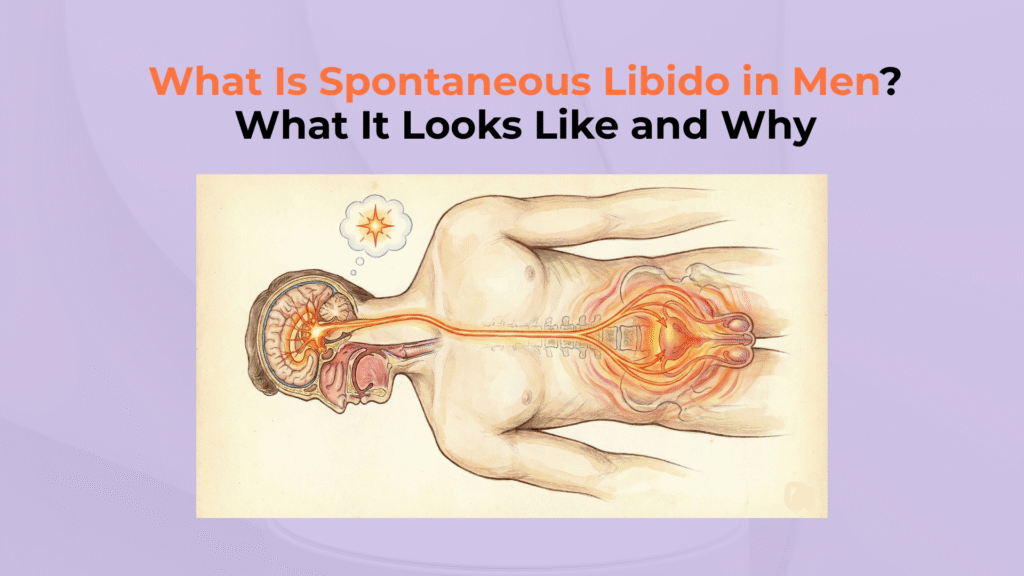
Spontaneous libido in men is defined as an internally generated motivational state where sexual desire arises from neuro-hormonal priming rather than immediate external stimulation, serving as a distinct primary engine within the broader Male Sex Drive.
To truly understand this drive, we must look beyond simple attraction and examine the neurochemistry of Dopamine and Libido (the “wanting” layer), distinguishing it from the cue-triggered pathway of Responsive Libido in Men.
Important Medical Disclaimer
This guide is for educational purposes only. A sudden, total loss of spontaneous desire (including morning erections) can be associated with hormonal issues, medication effects, depression, sleep disorders, or vascular health problems. Consult a qualified healthcare provider for evaluation [SL3] [SL9] [SL10].
What Is the Biological Definition of Spontaneous Libido?
The biological definition of spontaneous libido frames it as a state of high internal excitatory tone, where the brain’s desire centers are active independent of environmental cues [SL2].
Defining Spontaneous vs. Responsive Desire
Spontaneous libido is an innate, internally generated urge for sexual activity that arises without an immediate external stimulus, contrasting with Responsive Desire which follows arousal [SL2].
The Dual Control Model explains this variability as a balance between sexual excitation and inhibition.
Bancroft & Janssen note that individuals vary significantly in how easily their excitation system is triggered versus how easily their inhibition system suppresses desire [SL2].
High circulating testosterone supports permissive readiness in desire circuits, making spontaneous sexual thoughts more likely without external cues [SL3].
The Role of the Medial Preoptic Area (MPOA)
The Medial Preoptic Area (MPOA) acts as a command hub within the HPG Axis and Testosterone Signaling system, helping translate hormonal signals into motivated pursuit states [SL4].
In higher spontaneous libido states, androgen signaling can prime hypothalamic and reward pathways, keeping desire “readily accessible” [SL4].
Evidence from Hull suggests that dopamine activity in this region contributes specifically to pursuit (“wanting”) rather than merely the consummatory pleasure (“liking”) [SL5].
Androgen-sensitive hypothalamic circuits integrate testosterone-linked signals, increasing readiness to seek sexual opportunity [SL4].
What Does Spontaneous Libido Look Like in Daily Life?
In daily life, spontaneous libido manifests as unprompted sexual ideation and physiological readiness, often occurring during non-sexual contexts [SL1].
The Phenomenological Experience (The “Internal Itch”)
The phenomenological experience is characterized by unsolicited sexual thoughts or fantasies that occur during neutral activities, such as working or exercising [SL1].
This includes spontaneous erections and Nocturnal Penile Tumescence (morning wood), which serves as a critical biomarker for vascular health [SL9].
Levine notes that “Drive” has cognitive components that feel like an internal biological imperative [SL1].
Baseline dopamine tone amplifies incentive salience for sexual reward, increasing the frequency of unsolicited sexual ideation [SL5].
The Frequency and Variability Factor
Spontaneous libido often tracks the Testosterone Circadian Rhythm, which explains why desire is often highest in the morning.
Conversely, Sleep Deprivation can flatten this rhythm, reducing daytime testosterone and desire-related energy [SL8].
Harman et al. in the Baltimore Longitudinal Study of Aging note that testosterone trends downward with age, but health status varies significantly between individuals [SL6].
Stress and Cortisol can raise inhibition and suppress spontaneous desire on some days [SL2] [SL7].
Why Do Men Experience Spontaneous Libido? (The Biological Drivers)
Men experience spontaneous libido because testosterone-linked permissive readiness and brain motivation systems maintain a baseline of reproductive “wanting,” even without immediate cues [SL3] [SL5].
The Testosterone Threshold
Testosterone drives Libido through a permissive threshold—acting more like a key that unlocks a door rather than a volume knob [SL3].
Once above the personal threshold, spontaneous desire becomes more likely as a “default readiness” [SL3].
The Endocrine Society notes that raising T levels far above this threshold does not necessarily yield “super-desire,” but falling below it drastically reduces spontaneous thoughts [SL3].
Circulating testosterone activates androgen signaling in the CNS, enabling spontaneous sexual thoughts and motivation [SL3].
Evolutionary Biology: The “Search” Mode
Spontaneous libido can be understood as a “search mode” where Incentive Salience makes sexual rewards feel motivationally relevant even before stimulation occurs [SL5].
Berridge distinguishes “Wanting” (motivation) from “Liking” (pleasure); spontaneous libido is primarily “Wanting” [SL5].
Incentive salience recruits dopamine-linked motivation, increasing pursuit readiness in the absence of immediate cues [SL5].
How Does Spontaneous Libido Change with Age and Health?
Spontaneous libido commonly becomes less frequent with age and health stressors, and many men experience a relative shift toward Responsive Desire rather than a “loss of sexuality” [SL2] [SL6].
The Shift to Responsive Desire
With age or health stressors, many men shift from “spontaneous” to more cue-dependent desire, a pattern typical of Responsive Libido in Men.
With aging, total and free testosterone often decline on average, and spontaneous desire may become less frequent, while Responsive Desire remains intact [SL6] [SL2].
Many men interpret this as “low libido,” but it can be a shift in context-dependence [SL2].
The Dual Control Model suggests that as excitation sensitivity lowers, stronger cues (intimacy, touch) are required to trigger arousal [SL2].
The Impact of Cortisol and Burnout
Chronic stress raises inhibition and can suppress spontaneous desire via elevated Cortisol, which signals the body to prioritize vigilance over reproduction [SL7].
Chronic stress can suppress spontaneous libido because elevated Cortisol and stress physiology increase inhibitory control and can disrupt the Hypothalamic-Pituitary-Gonadal Axis [SL7] [SL11].
In this state, the body prioritizes vigilance over reproduction (inhibition up, excitation down) [SL2] [SL7].
Chronic stress increases inhibitory mechanisms and reduces hormonal readiness, reducing spontaneous sexual thoughts [SL2] [SL7].
[Checklist] Auditing Your Spontaneous Libido
Use this functional and health audit to evaluate signals related to spontaneous desire, inhibition, and hormonal readiness [SL1] [SL2].
Functional and Health Audit
- ✓ Thought Frequency: Do you notice sexual thoughts at least once every 24–48 hours? [SL1]
- ✓ Nocturnal Penile Tumescence: Are sleep-related erections present (signal of physiological function)? [SL9]
- ✓ Desire Type Check: If spontaneous urges are low, does desire appear after touch/intimacy (Responsive Desire)? [SL2]
- ✓ Stress Load: Experiencing sustained stress or burnout symptoms? [SL7]
- ✓ Sleep Status: Getting adequate sleep quality for testosterone regulation? [SL8]
- ✓ HPG Flags: Major weight change, opioid use, or persistent fatigue? (Consider clinical eval) [SL3] [SL11]
- ! Safety Rule: Sudden, total loss of spontaneous desire + morning erections justifies medical evaluation [SL3] [SL9] [SL10]
If spontaneous libido is low, start by confirming you’re not simply describing responsive desire by auditing your Male Sex Drive type. Then review the top modifiable drivers: sleep quality, stress/cortisol levels, and your testosterone threshold status.