Long & Thin Penis: Is Girth or Length More Important? (A Biomechanical Guide)
This morphology is organized inside the Penis Types & Morphologies hub.
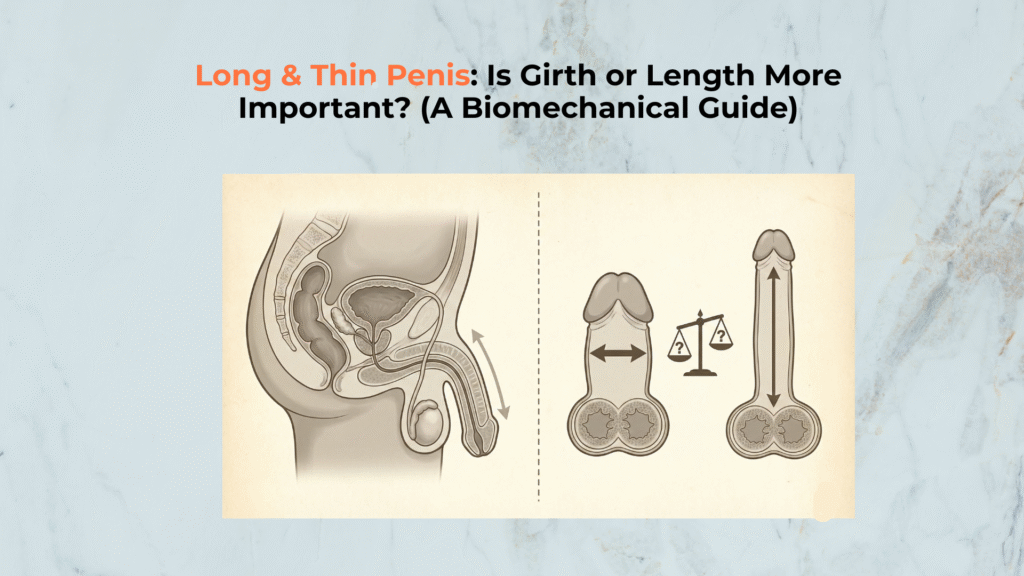
Axial Length is the primary biomechanical driver of the Long & Thin Penis because it dictates the potential for deep targeting and stimulation of posterior structures, which is why this profile is classified under Long & Thin.
This guide explicitly deconstructs the functional trade-offs of this morphology, moving beyond arbitrary “Length-to-Girth” ratios to focus on functional mechanics. We define the Long & Thin Penis through the divergence of anthropometric percentiles, analyze its specialized capacity for Axial Length targeting, and provide precise Depth Control strategies to mitigate the specific risk of cervical collision—using anatomy reference points like the glans and the coronal friction boundary at the corona + frenulum region.
Why Is Axial Length the Primary Biomechanical Driver of the Long & Thin Penis?
Axial Length is the primary biomechanical driver of the Long & Thin Penis because it dictates the potential for deep targeting and stimulation of the posterior vaginal structures. While radial girth provides circumferential stretch, Axial Length (erectile reach) determines the capacity for deep targeting, and your baseline framework for interpreting “coverage state” across morphologies sits in the Penis Types & Morphologies hub.
How Is the Long & Thin Penis Defined Clinicaly?
Clinically, a “Long & Thin” morphology is defined not by a fixed ratio, but by the divergence between length and circumference percentiles on standard anthropometric nomograms [C1], and the canonical reference page for this morphology is Long & Thin.
A Long & Thin morphology corresponds to an upper-percentile erect length (e.g., >75th percentile) combined with a lower-percentile erect circumference (e.g., <25th percentile). This divergence creates a distinct biomechanical profile where the physics of insertion relies more on reach than on radial displacement. Using a nomogram provides a realistic anatomical baseline, unlike arbitrary internet ratios.
| Morphology Type | Anthropometric Profile | Biomechanical Implication |
|---|---|---|
| Long & Thin | High Length Percentile + Low Circumference Percentile | Specialized for deep reach; lower radial stretch. |
| Short & Thick | Low Length Percentile + High Circumference Percentile | Maximize introitus contact; limited depth. |
| Proportional | Consistent Percentiles (e.g., 50th/50th) | Balanced mechanics. |
How Does the Long & Thin Penis Influence Positional Versatility?
The Long & Thin Penis influences positional versatility by maximizing depth capability, which simultaneously requires precise Depth Control to mitigate the risk of deep dyspareunia (collision pain) [C3, C6].
The increased Axial Length allows contact with the posterior fornix, requiring careful management of collision dyspareunia risks. The practical rule is to treat “depth limitation” as a mechanical constraint (not a performance issue), similar to how tissue state changes movement mechanics in your circumcision difference (mechanics) model.
How Does Reduced Radial Girth Influence the Anatomical Function?
Reduced Radial Girth influences anatomical function by shifting the friction source from peripheral Radial Compression (circumferential stretch/pressure) to targeted Axial Thrusting, which concentrates sensation around the corona + frenulum region rather than uniform shaft-wall stretch.
Which Anatomical Structures Govern the Long & Thin Penis Profile?
The penile profile is governed by the structural interaction between the Corpora Cavernosa and the Tunica Albuginea, which determine rigidity and expansion limits [C10].
The Tunica Albuginea acts as a load-bearing sheath that constrains circumferential expansion, channeling hydraulic pressure into axial rigidity. The penile profile is governed by structural interaction inside the erectile bodies, but the externally measurable reference points you use for functional “contact zones” begin at the glans and extend to the foreskin interface described in foreskin (prepuce) anatomy.
How Does the Friction Profile Compare to Short & Thick Types?
The Long & Thin Penis friction profile relies on deep, focused pressure targeting specific internal zones, contrasting with the generalized stretch provided by thicker anatomies. Axial thrusting bypasses the anterior vaginal wall, prioritizing pressure on the posterior fornix.
| Mechanical Feature | Long & Thin Penis | Short & Thick Penis |
|---|---|---|
| Primary Friction | Axial Thrusting (Targeting) | Radial Compression (Stretch) |
| Optimal Depth | Maximum Penetration | Shallow to Mid-Canal |
| Sensation Focus | Deep Fornix / Cervix [C7], where “deep contact risk” is mechanically different from the shallow friction emphasis described in your short & thick framework. | Introitus / Mid-Shaft |
Which Sexual Scenarios Best Leverage Axial Length?
Sexual scenarios best leverage Axial Length when they utilize angles that naturally facilitate deep insertion while allowing for partner-controlled depth.
Why Does the Long & Thin Penis Excel in Rear-Entry Positions?
Rear-entry positions excel because MRI imaging demonstrates that these angles alter contact geometry, facilitating deeper access to the fornices [C8, C9].
Rear-entry geometry aligns the vaginal canal, facilitating maximum depth capability, which is why this scenario is treated as a “best leverage case” in the Long & Thin morphology profile.
Which Positional Modifications Mitigate Cervical Impact?
Positional modifications mitigate Cervical Impact by using leg placement and pelvic tilt to mechanically limit insertion depth. Leg placement modifies the depth of penetration, preventing involuntary cervical collision.
| Positional Strategy | Functional Goal | Risk Management Rationale |
|---|---|---|
| Legs Down | Reduced Depth | Limits penetration depth to prevents collision [C12]. |
| Legs Up | Maximum Depth | Increases risk of collision; demands extreme control. |
| Lateral (Spooning) | Moderate Depth | Naturally limits insertion depth via gluteal contact. |
How Do Advanced Techniques Mitigate Cervical Risk?
Advanced techniques mitigate cervical risk by prioritizing partner-controlled insertion and slow, deliberate movement to avoid high-velocity collision. If your user’s anatomy has a mixed skin coverage outcome, depth control becomes even more important—compare the mechanical variability described in a partially circumcised penis with the stable exposure baseline in a circumcised penis.
How to Execute “The Slow, Deliberate Thrust”
Executing the “Slow, Deliberate Thrust” ensures that deep targets are reached without the momentum that causes collision dyspareunia [C4, C6].
Execution of the Deep Targeting Stroke
- Enter slowly, pausing before maximum depth.
- Communicate with partner to identify the “collision point.”
- Use short, rhythmic movements in the deep zone, avoiding full withdrawal-and-reentry.
Safety Protocol: The “Stop and Adjust” Rule
The primary safety protocol is the immediate cessation of thrusting if deep pain occurs, followed by a positional adjustment to reduce depth [C4, C5].
Safety Checklist for Deep Penetration
Conclusion: What Final Action Protocol Ensures Optimal Use?
The final action protocol establishes Axial Length as a specialized tool for deep targeting, provided that depth is managed to prevent collision pain. For readers comparing morphologies, keep this page connected inside the Penis Types & Morphologies hub and treat Long & Thin as the canonical reference node.
Final Optimization Checklist
References
- [C1] Veale D, et al. (2015) “Am I normal?” (BJU Int) — PubMed: https://pubmed.ncbi.nlm.nih.gov/25487360/
- [C3] Tayyeb M, et al. “Dyspareunia” (StatPearls / NCBI Bookshelf): https://www.ncbi.nlm.nih.gov/books/NBK562159/
- [C4] Mayo Clinic “Painful intercourse (dyspareunia)”: https://www.mayoclinic.org/diseases-conditions/painful-intercourse/symptoms-causes/syc-20375967 | https://www.mayoclinic.org/diseases-conditions/painful-intercourse/diagnosis-treatment/drc-20375973
- [C5] Cleveland Clinic “Dyspareunia (Painful Intercourse)”: https://my.clevelandclinic.org/health/diseases/12325-dyspareunia-painful-intercourse
- [C6] The OB/G Project “Deep Pain with Intercourse”: https://www.obgproject.com/2016/07/20/diagnosing-treating-collision-dyspareunia/
- [C7] Kenhub “Vaginal fornix: Anatomy and structure”: https://www.kenhub.com/en/library/anatomy/vaginal-fornix
- [C8] Faix A, et al. (2002) “MRI of sexual intercourse” — PubMed: https://pubmed.ncbi.nlm.nih.gov/11898711/
- [C9] Schultz WW, et al. (1999) BMJ “MRI… during coitus”: https://www.bmj.com/content/319/7225/1596 | https://pubmed.ncbi.nlm.nih.gov/10600954/
- [C10] Udelson D, et al. (2007) “Biomechanics of male erectile function” — PMC: https://pmc.ncbi.nlm.nih.gov/articles/PMC2396202/
- [C12] NHS Leaflet (Leicestershire Partnership NHS Trust) “Dyspareunia” (PDF): https://www.leicspart.nhs.uk/wp-content/uploads/2022/07/493-Dyspareunia-2.pdf
FBU Clinical AI
Context-AwareHi! I’m reading the “Long & Thin” guide right now. Select a question below or ask me anything about biomechanics, depth control, or risk management!