
Large Glans Penis: Sexual Function and Sensitivity Impact
Anatomical Guide | FactBasedUrology
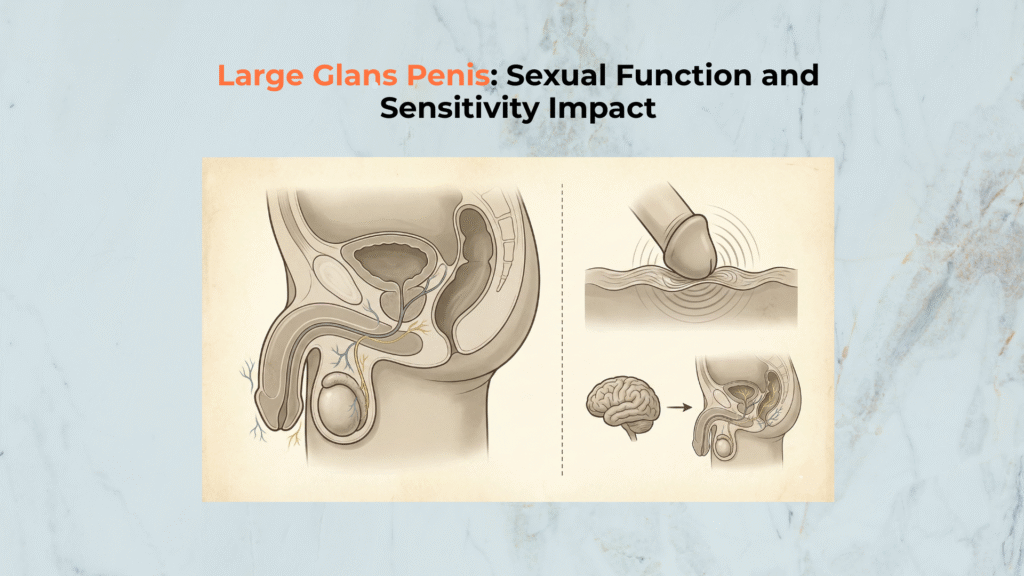
The Large Glans Penis is characterized by a glans that significantly exceeds the diameter of the shaft, providing a focal point for increased friction and tactile sensation during intromission. This anatomy is often specialized for focal friction and terminal stimulation, which suggests a unique set of potentially optimized techniques.
The Large Glans Penis represents a distinct distal morphology within the broader penis types classification , where the coronal diameter exceeds the mid-shaft, creating a friction profile unlike uniformly shaped variants.
Important Medical Disclaimer
This guide discusses anatomical variation and lubrication techniques. If entry causes persistent pain, tearing, or bleeding, stop immediately and seek evaluation from a urologist or gynecologist, as this may indicate insufficient arousal, infection, or structural incompatibility.
Large Glans Profile: At a Glance
-
1Is it usually normal or serious? Normal. It is a size variation defined by the Glans-to-Shaft Ratio.
-
2When should I see a doctor? If initial intromission causes recurrent pain/tearing or if you notice changes in glans sensitivity (e.g., loss of sensation).
-
3Can this usually be managed or adapted? Yes, through controlled entry (lubrication) and focused, shallow technique (Shallow Pulse).
Why Is the Large Glans Penis Biomechanically Significant for Friction?
The Large Glans Penis is biomechanically significant for friction because its size increases and concentrates contact against the nerve-rich vaginal entrance during entry and exit.
How Is the Large Glans Penis Defined by Glans-to-Shaft Ratio?
In this guide, the Large Glans Penis is classified based on a Glans-to-Shaft Ratio greater than 1.0, which establishes the necessary mechanical differential for focal friction. For this classification, the ratio compares the erect coronal rim circumference (maximum glans flare) to the erect mid-shaft circumference. Anatomical principles confirm that a ratio >1.0 can increase the radial force exerted against the Vaginal Introitus during insertion.
This flared profile is often compared to the mushroom-shaped penis , though the defining metric in clinical assessment remains the glans-to-shaft ratio rather than visual appearance alone. For patients seeking a neutral biomechanical reference, the average-proportional penis serves as the comparative baseline against which focal friction and entry resistance are evaluated.
| Glans Type | Glans-to-Shaft Ratio | Biomechanical Implication |
|---|---|---|
| Large Glans Penis | > 1.0 (Flared) | Focal Friction on entry/withdrawal. |
| Cylindrical Glans | ≈ 1.0 (Uniform) | Distributed friction throughout the shaft. |
| Tapered Glans | < 1.0 (Narrowing) | Friction focused at the shaft/base. |
In contrast to a cylindrical penis , which distributes contact evenly along the shaft, a large glans concentrates mechanical load at the entrance, increasing focal stimulation and entry resistance. Men with a Large Glans Penis may experience stimulation patterns opposite to those seen in a tapered penis , where friction is biased toward the shaft and base rather than the coronal rim.
How Does the Large Glans Penis Influence Partner Stimulation?
The Large Glans Penis influences partner stimulation by increasing and concentrating friction in the most sensitive, nerve-dense areas near the vaginal entrance. This diameter focuses the Coronal Ridge precisely on the external tissue adjacent to the Vaginal Introitus and vulvar vestibule.
Surface interaction at the coronal ridge can be further influenced by tissue texture, particularly when comparing a pronounced corona to a smooth-corona penis , which typically produces lower drag during intromission.
- Focal Pressure: Direct engagement with the entrance.
- Clitoral Drag: Increased indirect stimulation via tissue traction.
- Ridge Drag: The coronal rim acts as a textured anchor during withdrawal.
Which Anatomical Structures Define the Large Glans Penis Profile?
Anatomical structures define the Large Glans Penis profile through the specific development of the Corpus Spongiosum and the resulting tactile sensory features.
How Does the Corpus Spongiosum Create the Large Glans Penis Profile?
The Corpus Spongiosum creates the Large Glans Penis profile by forming the entire structure of the head, which is hyper-developed relative to the shaft. The Corpus Spongiosum expands distally beyond the sheaths of the Corpora Cavernosa to form the glans.
How Does Keratinization Impact Sensitivity?
Keratinization impacts sensitivity in a Large Glans Penis by forming a protective layer that varies in thickness depending on circumcision status. Evidence is mixed; some studies report increased keratinization following consistent glans exposure, while others report no significant difference.
Which Sexual Scenarios Best Leverage the Large Glans Penis?
Sexual scenarios and friction profiles that best leverage the Large Glans Penis prioritize shallow, controlled movements that keep the glans engaged at the entrance.
Technique adaptation is especially important when compared with thrust-dominant morphologies like the short & thick penis , where deep piston mechanics are often better tolerated than in flared-glans anatomy.
Why Does the Large Glans Penis Excel in Shallow Thrusting Positions?
The Large Glans Penis often favors shallow thrusting positions because the repetitive motion concentrates friction near the entrance. The goal is to maximize the repeated contact of the Coronal Ridge across the sensitive Vaginal Introitus, where the highest density of sensory nerve endings are often located.
| Position Strategy | Effectiveness | Mechanical Rationale |
|---|---|---|
| Shallow Entry (Pulsing) | Often Favored | Focuses intense friction on the entrance (where flare is effective). |
| Deep Pounding | Varies | Glans passes beyond the most sensitive area quickly; comfort is key. |
| Reverse Cowgirl (Grinding) | Highly Adaptable | Partner controls depth, facilitating precise Corona engagement. |
When Should You Seek Evaluation for Pain and Discomfort?
You should seek evaluation for pain and discomfort whenever initial sexual difficulty persists or if structural changes, bleeding, or acute pain occur. Specific red flags require immediate consultation with a urologist or gynecologist.
When entry discomfort persists despite lubrication, clinicians must rule out inflammatory conditions such as tight foreskin (phimosis type) , which can amplify coronal compression and exacerbate pain during penetration.
Clinical Red Flags
- Intromission Pain: Sharp pain, burning, or tearing at the entrance that persists despite lubrication.
- Bleeding or Lesions: Any visible tearing or bleeding in either partner’s tissues.
- New Sensory Loss: Sudden or progressive loss of glans sensitivity.
- Suspected Infection: Symptoms of Balanitis, discharge, or recurrent local inflammation.
How Do Advanced Techniques Optimize the Large Glans Penis?
Advanced techniques optimize the Large Glans Penis by using specific motions to leverage the glans diameter for friction and stimulation.
How to Execute “The Shallow Pulse” Technique
“The Shallow Pulse” technique utilizes short-range thrusts to ensure the Corona repeatedly stimulates the nerve-dense vaginal entrance.
- Enter only a short distance past the glans.
- Maintain rapid, short thrusts.
- Focus on withdrawal friction to maximize the glans’ diameter against the ridges.
How to Mitigate Entry Discomfort
Mitigating entry discomfort caused by the Large Glans Penis requires using Intromission Lubrication to manage friction at the entrance. Applying high-viscosity lubrication can substantially reduce surface drag.
- Partner Lead: Partner controls initial entry rate.
- Lubrication: Use lubrication focused exclusively on the Introitus.
- Pre-Stretching: Gentle manual dilation before full insertion.
- STOP RULE: Stop immediately if pain is sharp, burning, or causes tearing.
Final Checklist for Maximizing Intimacy
The Large Glans Penis checklist ensures owners maximize pleasure by adhering to the specialized techniques required by the flared anatomy.
Optimization Protocol
- ✓ Motion Shift: Prioritize Shallow Pulsing and Withdrawal friction.
- ✓ Targeting: Focus stimulation on the Vaginal Entrance (Introitus).
- ✓ Lubrication Plan: Always use high-quality lubrication at the Vaginal Opening.
- ✓ Sensitivity Check: Communicate about Entry Discomfort during initial intromission.
Frequently Asked Questions About the Large Glans Penis
Is a Large Glans Penis (or “mushroom head”) normal or a medical problem? ▼
In most cases, a Large Glans Penis is a normal anatomical variation, not a disease. It simply means the glans diameter or circumference is greater than the mid-shaft (Glans-to-Shaft Ratio > 1.0), creating a “flared” or “mushroom” profile. This shape does not automatically indicate any problem with fertility, hormones, or erectile function. Medical review becomes important only if you also notice pain, bleeding, new curvature, or sudden changes in sensitivity.
Does a Large Glans Penis give more pleasure to my partner? ▼
It can increase pleasure for some partners because the flared glans focuses friction at the vaginal entrance (introitus), where sensory nerve endings are often dense. The Coronal Ridge may create more “drag” and traction when you use shallow, controlled motions such as the Shallow Pulse. However, comfort is highly individual. For some partners the same friction can feel too intense or uncomfortable without adequate lubrication and gradual entry.
Can a Large Glans Penis cause pain or tearing for my partner? ▼
Yes, it can cause discomfort if entry is fast, dry, or forced. The wider glans and Coronal Ridge increase the drag at the entrance, especially if arousal and natural lubrication are still low. To reduce risk of pain or tearing:
- Use high-quality lubrication focused on the introitus.
- Let your partner control the initial entry and depth whenever possible.
- Start with shallow, slow motions before deeper thrusting.
If pain, tearing, or bleeding keeps happening despite these strategies, both partners should discuss this with a urologist or gynecologist to rule out infections, skin conditions, or structural causes of dyspareunia.
Do I need special condoms if my glans is much wider than my shaft? ▼
Sometimes, yes. With a pronounced flare, standard condoms may fit the shaft but feel tight or constricting at the corona. This can cause discomfort, ring-marks, or a tendency for the condom to roll or pinch at the ridge.
Many brands offer “flared,” “bulb-shaped,” or “anatomically contoured” condoms that provide extra space around the glans while still gripping the shaft securely. Choosing a barrier with adequate glans room improves comfort without reducing protection, as long as the condom still fits snugly at the base and is used correctly.
Does having a Large Glans Penis always mean higher sensitivity? ▼
Not always. The larger surface area exposes more tissue to touch, so many people with a large glans describe the corona as highly sensitive, especially with direct or dry friction. At the same time, factors like keratinization, circumcision status, chronic friction, and individual nerve distribution can increase or decrease sensitivity over time.
If you notice a sudden loss of sensitivity, numb patches, burning, or persistent soreness, that is no longer just “variation” and should be evaluated by a clinician to rule out infection, dermatologic conditions, or nerve injury.
Can I change the shape of my glans or do I need surgery to “fix” it? ▼
For a typical Large Glans Penis with no pain, scarring, or functional problem, surgery is not recommended and usually unnecessary. The shape is created by how the Corpus Spongiosum developed and expanded during growth; there is no safe, evidence-based exercise or device that specifically “shrinks” only the glans without risk.
Surgical alteration is generally reserved for clear medical indications (for example, severe scarring, significant deformity, or conditions that clearly impair function). If you are distressed by the appearance, it is better to discuss your concerns with a urologist and, if needed, a mental health professional, rather than attempting unsafe self-modification.
Does a Large Glans Penis affect fertility or cause erectile dysfunction? ▼
By itself, a Large Glans Penis does not cause infertility or erectile dysfunction (ED). Fertility is driven by sperm production, hormone balance, and ejaculatory function, not by whether the glans is slightly wider than the shaft. ED is usually connected to vascular, neurologic, hormonal, or psychological factors.
If you experience persistent erection difficulties, rapid loss of rigidity, or cannot maintain penetration, you should be evaluated for ED just like anyone else, regardless of penis shape. The glans profile alone is almost never the root cause.
When should I stop experimenting and see a doctor about my Large Glans Penis? ▼
Seek medical evaluation if you notice any of the following:
- Recurrent sharp pain, burning, or tearing during entry despite good lubrication.
- Bleeding, sores, or lesions on the glans, shaft, or partner’s tissues.
- Sudden loss of sensitivity or new numb areas on the glans.
- Persistent inflammation, swelling, or discharge suggesting infection (e.g., balanitis).
- New, rigid curvature or plaques that were not there before.
These signs go beyond normal anatomical variation. A urologist or gynecologist can evaluate both partners, rule out treatable conditions, and help you adapt technique safely.
Conclusion
In conclusion, the Large Glans Penis is an anatomical variant whose size creates Focal Friction and concentrated contact at the vaginal entrance, requiring specific techniques to optimize pleasure and comfort. By leveraging Shallow Pulse motions and ensuring adequate lubrication, individuals can transform potential entry challenges into specialized sensory advantages.
The Large Glans Penis should be interpreted as a normal anatomical variant within the Penis Types Hub , where morphology, function, and technique are assessed independently rather than judged cosmetically.
Talking to Your Partner: Key Sentences
“Because my glans is wide, let’s try a lot of lube just at the opening before we start.”
“Let me know when the contact feels good right at the entrance, and I’ll focus on the ‘shallow pulse’ motion.”
At FactBasedUrology, we believe anatomical awareness is the foundation of intimate confidence. Master your mechanics to maximize the power of your flare.
One Response