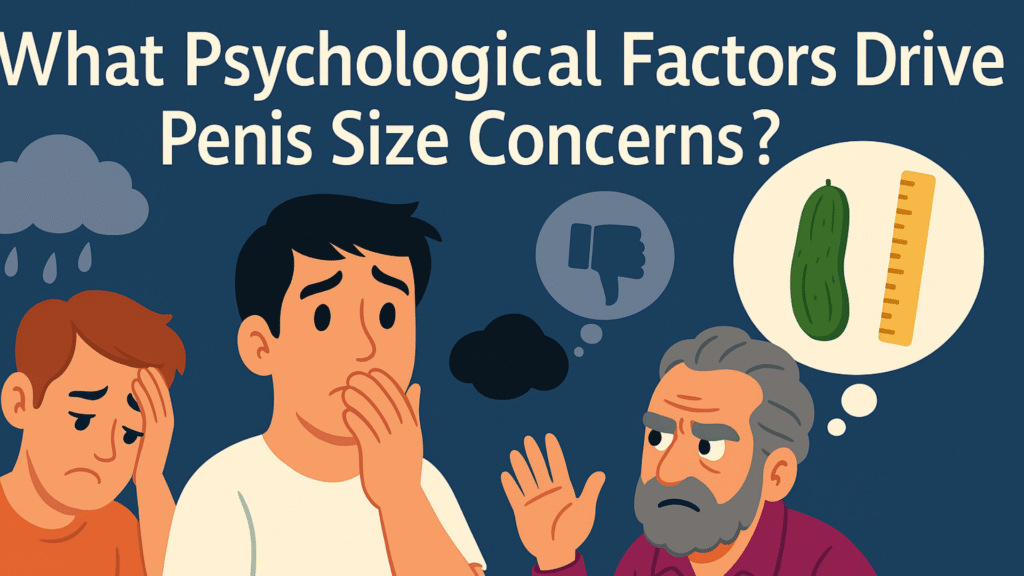
The psychological factors that drive penis size concerns are rooted not in anatomical reality but in cognitive biases like social comparison, deep-seated fears of inadequacy, and self-reinforcing loops of performance anxiety.
A percentile is a statistical position, not a score of masculinity, function or worth: interpret your measurement with the percentile calculator.
For most men experiencing anxiety about their penis size, the issue is not anatomical but psychological, driven by internal thought patterns that distort the perception of penis size and affect their sexual satisfaction.
This guide dissects the core psychological factors of penis size concerns. We will examine the cognitive biases, underlying fears, and specific mental frameworks that create and amplify this anxiety.
Understanding the psychological factors of penis size concerns, including the impact on sexual function and satisfaction, is the first step toward dismantling them and building genuine sexual confidence.
Why Do Psychological Factors Override Physical Reality in Penis Size Concerns?
Psychological factors override physical reality in penis size concerns because body image is a mental and emotional construct, not an objective photograph; cognitive distortions can warp perception, and a single anxious thought can trigger a powerful negative feedback loop.
The mind’s interpretation of the body, including how one perceives their penis, holds more power than the body itself, especially in discussions about enlargement.
The Concept of Body Image Perception
The concept of body image perception explains that your body image is not what you physically see in the mirror, but rather how you feel and think about what you see, making it highly susceptible to psychological factors.
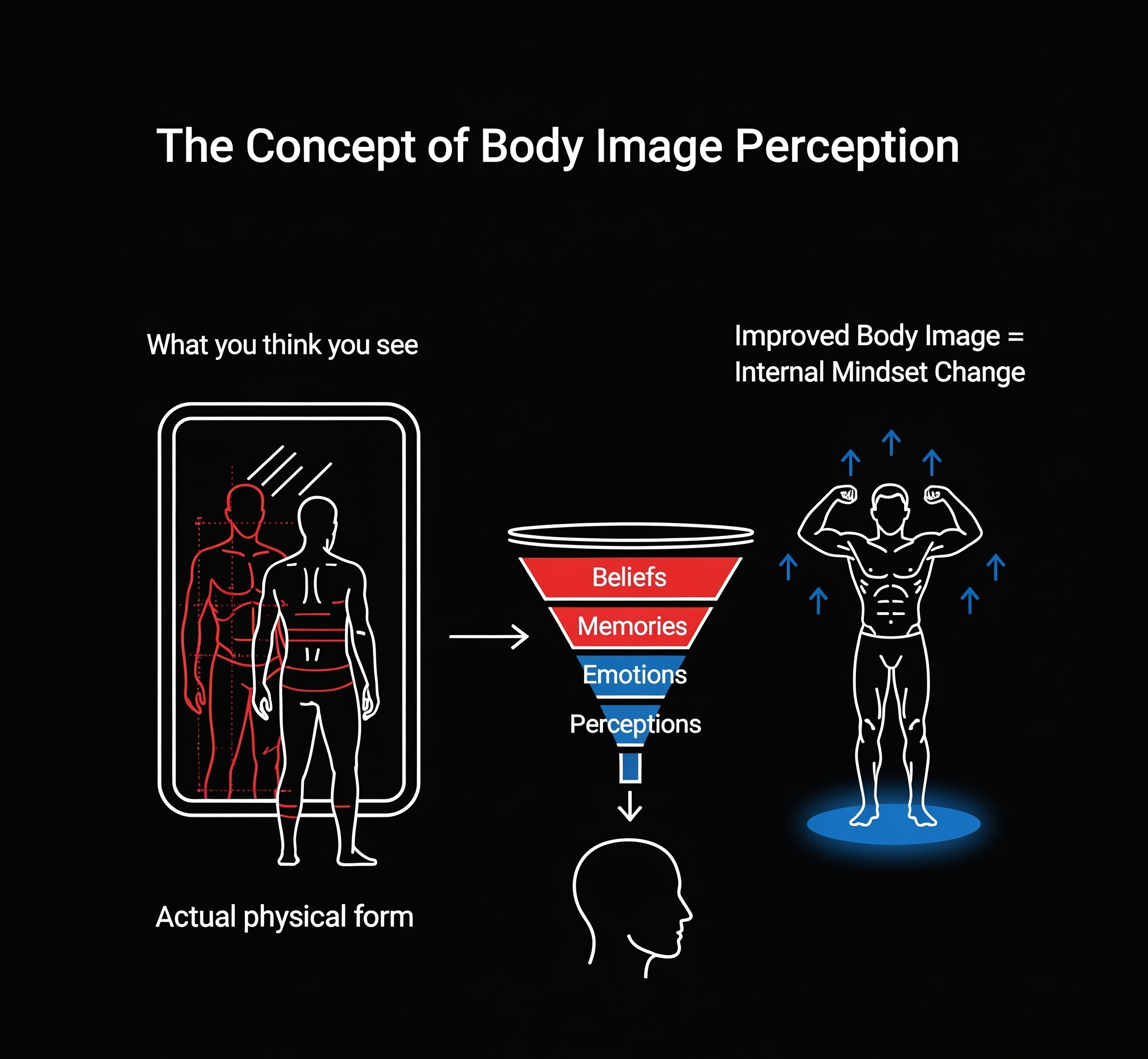
This internal experience is a combination of your beliefs, memories, emotions, and perceptions. This subjective nature allows negative thoughts and feelings to distort your self-perception, making your penis seem inadequate regardless of its actual size.
Improving your body image is therefore an internal process of changing your thoughts and feelings about your body, not just observing its physical form.
Cognitive Distortions: When Your Mind Lies to You
Cognitive distortions are flawed patterns of thinking that cause your mind to perceive reality inaccurately; in the context of penis size concerns, distortions like catastrophizing or mental filtering can create a reality that feels true but isn’t based on objective fact.
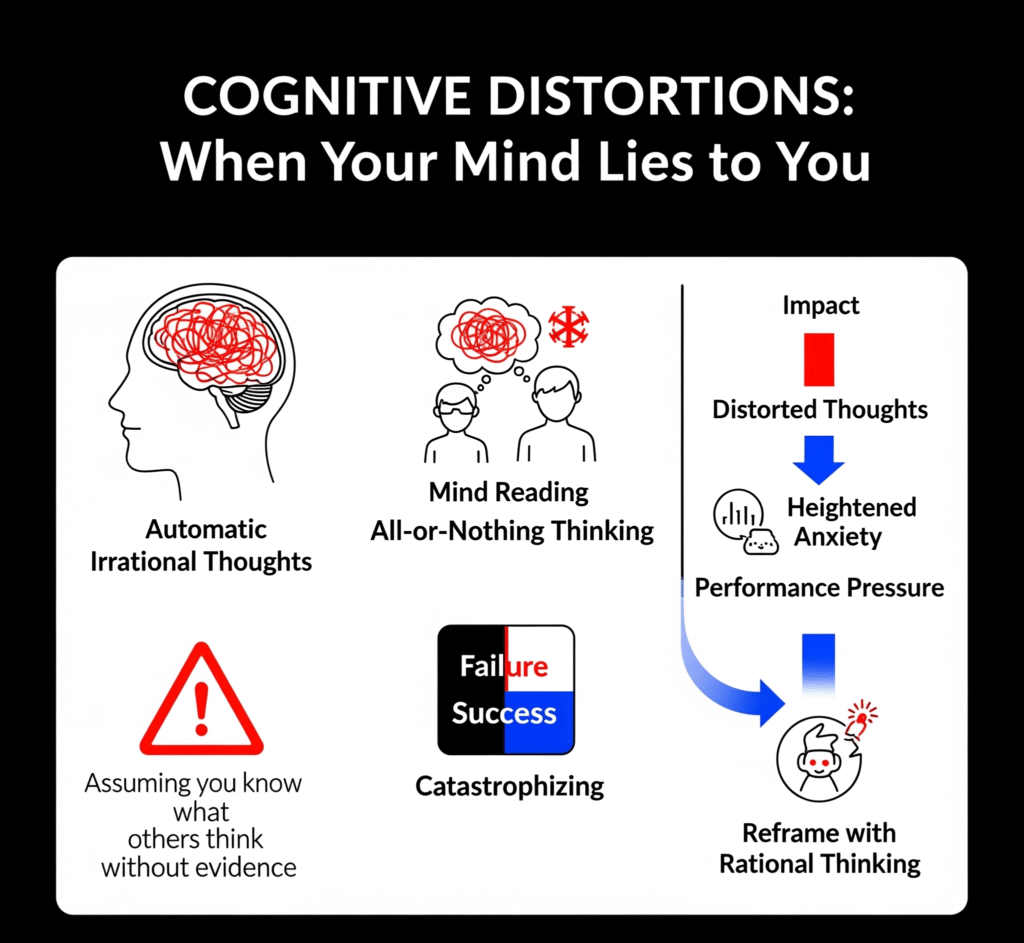
These are the irrational, automatic thoughts that fuel anxiety about the impact of penis size on sexual performance, leading some to consider enlargement surgery.
Specific cognitive distortions that magnify penis size concerns include worries about penis length and perceived inadequacies, which are significant concerns among different populations.
- Mind Reading: Assuming you know what your partner is thinking about the size of the penis without evidence can lead to misunderstandings. For example: “My partner is quiet after sex because she’s disappointed with my size.”
- All-or-Nothing Thinking may lead to misconceptions about penis growth and its significance in male sex. Seeing things in black and white. For example: “Because my penis isn’t huge, I am a complete failure as a lover.”
- Catastrophizing about penis size can lead to heightened anxiety and worry about penis size, rather than focusing on the role in how individuals perceive their sexuality and intimacy. Expecting the worst-case scenario to happen. For example: “If my partner ever saw my penis when it’s fully flaccid, she would be so repulsed that she would leave me immediately.”
These distortions are the mental “lies” that build a prison of anxiety, creating a false reality where penis size is the sole determinant of sexual worth.
The Role of the “Anxious Thought”
The role of the “anxious thought” is to act as the initial trigger in a negative psychological cascade; a single thought like “Am I big enough?” can be influenced by social and cultural standards regarding penis size.
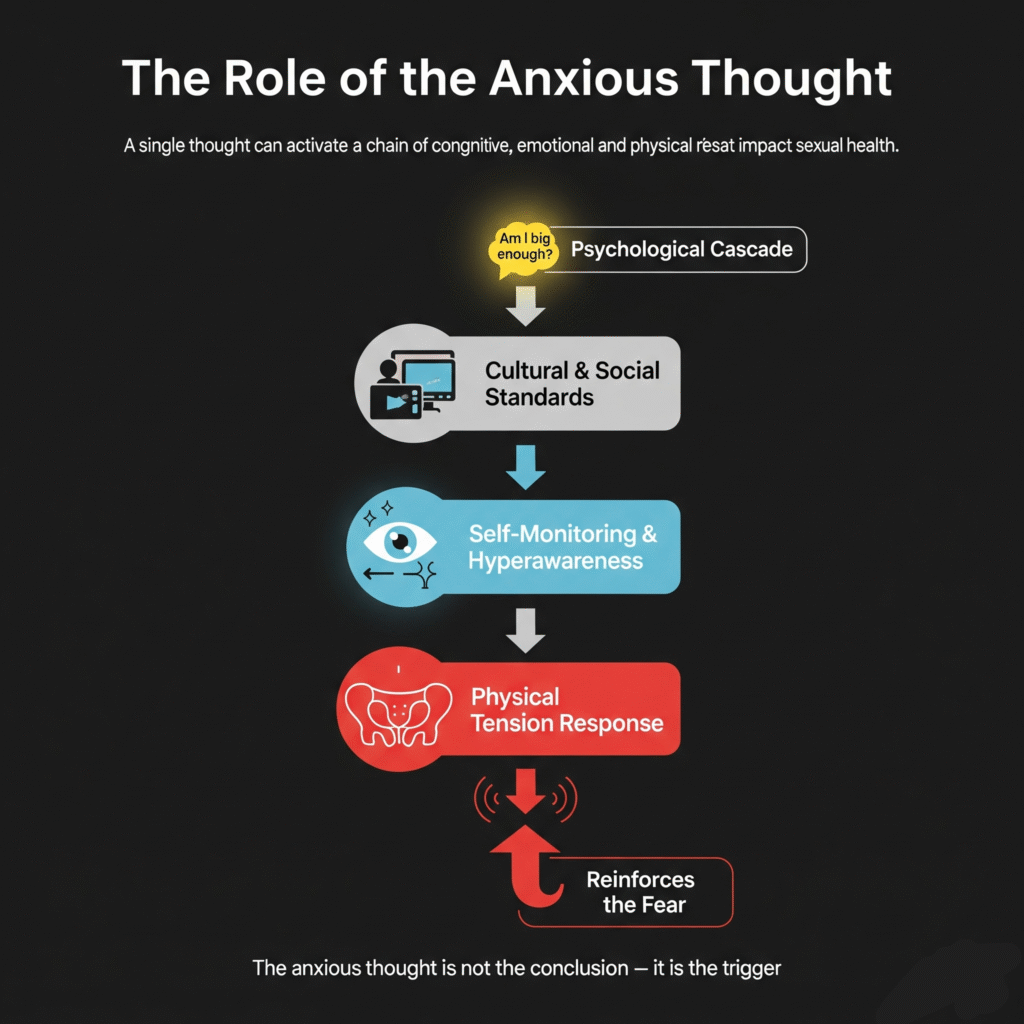
can initiate a powerful sequence of physical and emotional responses that reinforce the initial fear. This thought is the seed from which the broader and more debilitating concerns about the size of their penis grow, starting a chain reaction of anxiety, self-monitoring, and physical tension related to sexual health.
Examining the psychological factors behind penis size concerns naturally leads to exploring how these perceptions affect overall sexual function and satisfaction, particularly for heterosexual men who may feel that size matters. how penis size affects self-esteem and sexual confidence.
What Are the Core Psychological Factors Driving Penis Size Concerns?
The core psychological factors driving penis size concerns include specific conditions like Penile Dysmorphic Disorder (PDD), the cognitive bias of social comparison, a fundamental fear of sexual inadequacy, and the externalization of pre-existing generalized anxiety.
Factor 1: Penile Dysmorphic Disorder (PDD)
Penile Dysmorphic Disorder (PDD) is a specific psychological factor defined as a form of Body Dysmorphic Disorder (BDD) characterized by a debilitating, obsessive, and often irrational preoccupation with a perceived flaw in penis size or shape. PDD is not a distinct diagnosis in the DSM-5 but is considered a specifier of Body Dysmorphic Disorder, where the preoccupation centers on the penis.
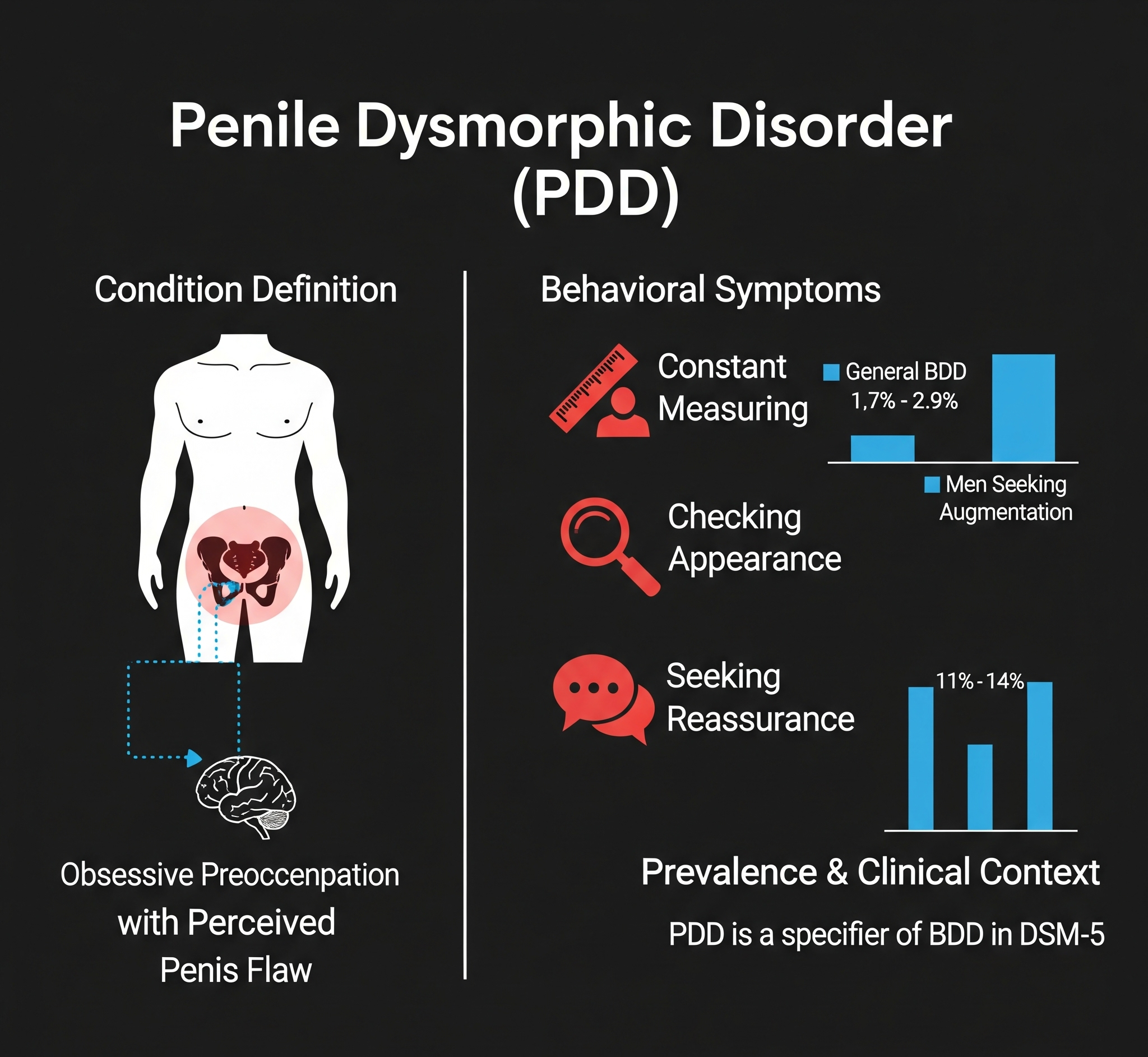
Men with PDD often engage in compulsive behaviors like constant measuring, checking, and seeking reassurance, yet remain unconvinced by evidence that their size is normal, despite studies showing that many women reported that penis size varies in importance.
While BDD affects an estimated 1.7% to 2.9% of the general population, its prevalence is much higher among specific groups concerned about the size of the penis and its impact on masculinity, particularly among female undergraduate students.
Some studies find BDD in as many as 11-14% of men seeking penile augmentation procedures, showing how this psychological concern is concentrated among those seeking physical solutions for a mental issue. Source: https://www.ncbi.nlm.nih.gov/pmc/articles/PMC3181960/
Factor 2: The Cognitive Bias of Social Comparison
The cognitive bias of social comparison is a key psychological factor where individuals determine their own self-worth by unfavorably comparing themselves to others, often based on the unrealistic and skewed standards for penis size presented in media and Pornography.
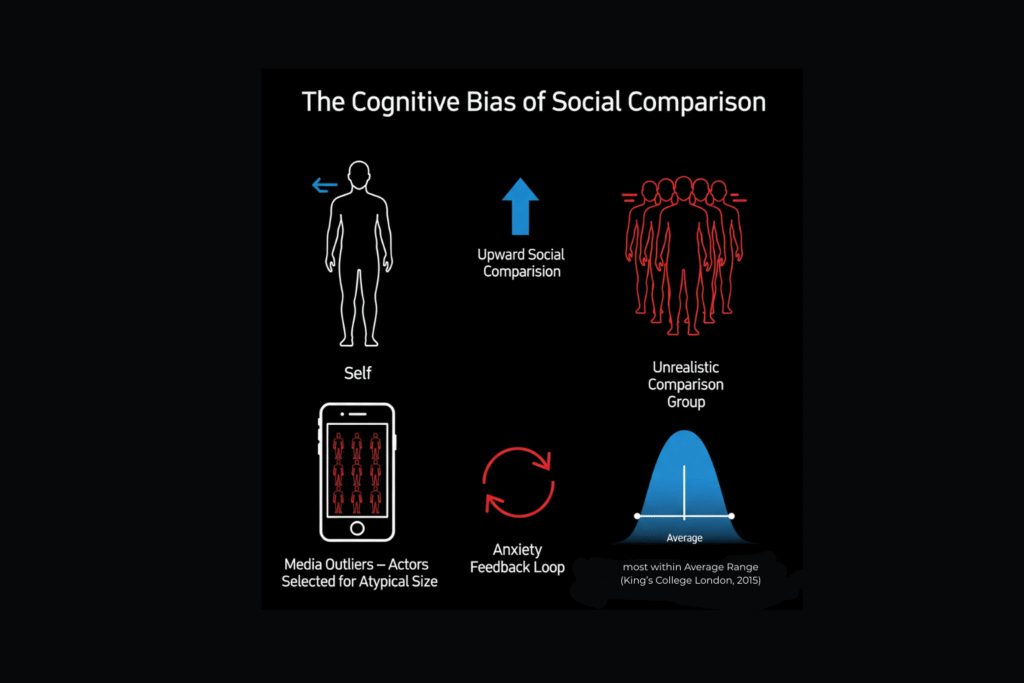
Based on Leon Festinger’s Social Comparison Theory, this is a natural human tendency, but it becomes destructive when the comparison group is unrealistic, especially regarding large penises.
This process of “upward social comparison” against actors in Pornography—who are selected specifically for their atypical size—creates a distorted view of the diversity in penis sizes and what is “normal” or “desirable.”
This stands in stark contrast to clinical data, such as the landmark 2015 study that reveals insights into the relationship between penis size and sexual satisfaction, particularly in cases of micropenis. King’s College London is conducting studies on how the impact of penis size can affect psychological well-being.
published in the journal associated with penis size. BJU International, a journal that often discusses topics related to penis growth and male sexual health., which analyzed measurements from over 15,000 men and established average sizes that are far more modest than those depicted in entertainment.
Understanding the psychological factors behind penis size concerns also invites a closer look at penile enlargement and its implications on mental health. Understanding how social desirability bias affects self-reported penis size is crucial for addressing dissatisfaction with penis size.
Factor 3: The Fear of Sexual Inadequacy
The fear of sexual inadequacy is a deep-seated psychological factor where penis size concerns become the tangible, focused proxy for a broader, more abstract anxiety about being unable to satisfy a partner.
The obsession with size is rarely about the penis itself; it’s about what the individual believes it represents: virility, competence, and the ability to provide pleasure, often influenced by social and cultural narratives.
This core fear drives much of the anxiety and can lead to misconceptions about the importance of having a larger penis for perceived masculinity, making men believe that size, whether length or girth, matters.
Depression linked to Penis Size. This fear can be effectively addressed by shifting the focus from anatomy to controllable elements like technique, communication, and emotional intimacy, which contribute to sexual satisfaction and overall health. Intimacy with a Partner.
Factor 4: Generalized Anxiety and Externalization
Generalized anxiety can be a contributing psychological factor, where men with pre-existing, free-floating anxiety may unconsciously “externalize” or latch onto their penis size as a specific, concrete “container” for their broader fears and insecurities.
Externalization is a psychological defense mechanism where internal anxieties are projected onto an external object or a specific body part, a process also known as somatization.
The penis becomes a convenient but misplaced focus for a mind struggling with general self-esteem and the importance of penis size in sexual relationships. Anxiety or low Self-Esteem. In these cases, addressing the underlying anxiety disorder is essential to alleviating the specific concern about penis size. Exploring the psychological factors behind penis size concerns naturally leads to asking Research shows how penis size dissatisfaction is linked to mental health issues among different ethnic groups..
| Attribute | Mindset driven by psychological factors related to the worry about their penis size can lead to a distorted view of the importance of penis enlargement, rather than recognizing the value of emotional connection with sexual partners. | Healthy, Confident Mindset regarding one’s genital size is essential for overall well-being, as many men may feel insecure about their penis size. |
| Understanding penis size and its impact on perception of reality. | Distorted by cognitive biases and fear. | Based on objective reality and function, including the size of the male body. |
| Source of Anxiety | Internal obsession with a perceived flaw, such as the girth of their penis, can exacerbate anxiety regarding sexual activity. | External stressors or relationship issues can also affect penis size perceptions, causing individuals to feel insecure. |
| Focus During Sex is crucial for enhancing sexual experiences, especially when concerns about an erect penis arise. | “Am I good enough for sexual health and performance?” (Internal monitoring of perceptions related to male sex). | “Is my partner enjoying this, or is she dissatisfied with my penis length?” (External focus) rather than penis size |
| Goal, particularly in the context of research on penis size among different populations. | To avoid judgment and “prove” adequacy. | To create connection and mutual Pleasure can be enhanced by understanding penis size and its implications for sexual partners.. |
How Do These Psychological Factors Reinforce Penis Size Concerns?
These psychological factors reinforce penis size concerns by creating the initial “anxious thought,” which then fuels the negative feedback loop of performance anxiety and leads to avoidance behaviors that prevent any positive, confidence-building experiences.
The Creation of the “Anxious Thought”
Each psychological factor, whether it’s social comparison, a deep-seated fear of inadequacy, or dysmorphic preoccupation, serves as the origin point for the specific “anxious thought” that kicks off the negative cycle of performance anxiety.
Social comparison can generate the thought “I’m probably smaller than average,” influencing how individuals perceive their penis size. Fear of inadequacy can generate “I won’t be able to please her.”
This thought is the spark that ignites the entire self-perpetuating loop of anxiety surrounding penis enlargement. Mental Health struggles related to Sexual Confidence is closely tied to one’s genital self-image..
Fueling the Negative Feedback Loop
These psychological factors fuel the negative feedback loop when the poor erection caused by the initial anxiety is misinterpreted as a physical failure, which then “confirms” the validity of the original concern (e.g., “I knew I wasn’t good enough”), making the obsession stronger.
The initial anxiety triggers the body’s “fight-or-flight” response, diverting blood away from the penis and leading to pressure on men regarding their size. Psychogenic Erectile Dysfunction and the impact of penis size on sexual performance, particularly for heterosexual men and women..
This physical manifestation of anxiety about the size of the male body is then seen as “proof” that the underlying belief about being inadequate is correct, creating a vicious cycle where Performance Anxiety: A common issue linked to perceptions of penis size and its effect on sexual health. and body image concerns feed each other.
Understanding the psychological factors behind worry about their penis size also helps explain how penis size influences sexual confidence and myths about penis size.
The Development of Avoidance Behaviors
The development of avoidance behaviors is a key way these psychological factors are reinforced, as individuals may start to avoid intimacy altogether to prevent feeling anxious, which in turn prevents them from ever having a positive sexual experience that could break the cycle.
Avoiding sexual situations is a common but destructive coping mechanism for Performance Anxiety and Small Penis Anxiety (SPA). This avoidance ensures that the negative belief about one’s genital size is addressed.
Penis Size is never challenged or disproven by real-world evidence of a successful, pleasurable intimate encounter, solidifying the anxiety. Understanding the psychological factors behind penis size concerns can also shed light on Why men are obsessed with penis size and how it affects sexual confidence..
What Are the Key Takeaways for Managing These Psychological Factors?
The key takeaways for managing the psychological factors of penis size concerns are to first identify the issue as a thought pattern, actively challenge the flawed comparisons that fuel it, shift focus to controllable elements like skill, and seek professional help when concerns are obsessive.
A Checklist for Managing Penis Size Anxiety
- ☐ Identify the Thought Pattern: Focus on how thoughts about the size of the penis, whether flaccid or erect, can impact sexual function and overall confidence. Recognize that the concern is a psychological factor, not an anatomical fact. Your anxiety stems from your beliefs about your partner’s penis size and how it compares to societal standards related to sexual health. Perception, not your physical body, including the size of your flaccid penis, which can affect sexual performance.
- ☐ Challenge the Comparison: Consider how the average penis size relates to your perception of masculinity. Actively remind yourself that media and pornographic portrayals are not reality, as they often exaggerate the importance of penis size. Ground yourself in facts about average size and understand that many are satisfied with their partner’s penis regardless of size, as size varies among individuals. Partner Satisfaction, which consistently prioritizes factors other than size.
- ☐ Shift Focus to Controllables: Move your mental energy away from size (uncontrollable) and toward skill, communication, and partner Pleasure (controllable aspects of sexual health, including techniques to increase penis size, can improve confidence and sexual satisfaction). This is central to rebuilding Sexual Confidence.
- ☐ Seek Professional Help if Needed: For obsessive concerns like Penile Dysmorphic Disorder (PDD), seeking therapy like Cognitive Behavioral Therapy (CBT) is a sign of strength to Rebuild self-esteem by addressing concerns about the size of the male body..
Conclusion
In conclusion, the psychological factors of penis size concerns—such as cognitive biases, deep-seated fears of inadequacy, and flawed social comparison—are the true drivers of this widespread anxiety, not the physical anatomy itself.
This battle is not with one’s body, but with one’s thought patterns. Understanding these patterns is the essential first step to dismantling them and improving your genital self-image.
Relationship with both yourself and your partners regarding the importance of sexual performance and satisfaction during sexual intercourse. At factbasedurology, we are dedicated to helping individuals understand and overcome these psychological hurdles related to penis size to build genuine confidence.
By changing your mind, you can change your reality and build a foundation of confidence that is immune to physical comparison.