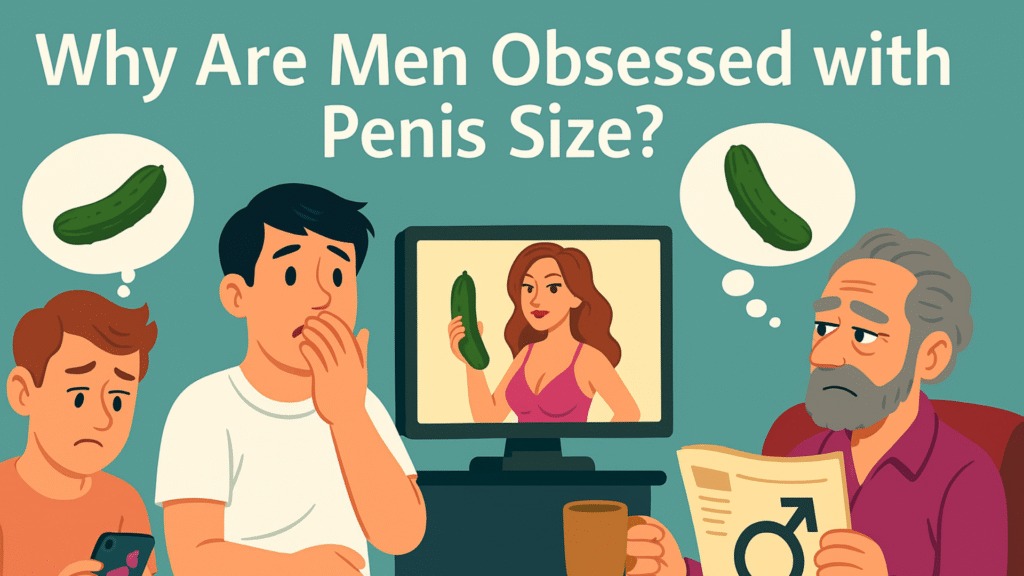
The “male obsession with penis size” is a complex phenomenon driven by a combination of deep-seated cultural symbols of power, unrealistic media portrayals, and powerful psychological fears about masculinity, performance, and self-worth.
This focus on penis size is a widespread and deeply ingrained aspect of male psychology, causing significant obsession and anxiety for millions of men who want to increase their penis size, often leading them to seek a stretched penis.
In its most severe form, this anxiety can manifest as Penile Dysmorphic Disorder (PDD), a clinical condition related to Body Dysmorphic Disorder (BDD) with a prevalence as high as 4.2% in some male populations.
This guide explores the deep-seated reasons behind the ‘male obsession with penis size,’ examining the cultural, evolutionary, and psychological factors that contribute to this powerful phenomenon, including the impact of porn.
Understanding these drivers is the first step toward dismantling the anxiety they create. The “male obsession with penis size” is not an inherent biological imperative but a learned psychological burden, and by deconstructing its origins, one can challenge its hold on mental health and self-perception.
What Are the Cultural Roots of the Male Obsession with Penis Size?
The cultural roots of the male obsession with penis size are deeply embedded in historical symbols of power and fertility, amplified by modern media’s unrealistic standards, and reinforced by the social dynamics of peer comparison.
Historical Symbols of Power and Fertility
Throughout history, prominent phallic symbols have been widely used across cultures to represent power, virility, fertility, and dominance, creating a deep and lasting cultural link between penis size and perceived masculine value.
From the Roman era, societal standards have often worried men about their sexual competence. fascinum, an amulet used to ward off evil and confer protection, to the Hindu perspective on size and sexual competence. lingam Worshipped as a representation of the Shiva’s divine generative energy, the phallus has long been an object of reverence and a symbol of life-giving force, often associated with the ideal of a big dick.
This historical symbolism has contributed to the modern, often subconscious, association between a larger penis and masculine worth, where the “power” has shifted from agricultural fertility to social and sexual dominance.
The ancient equation of phallus with power has been inherited by modern culture, providing a historical foundation for the male obsession with penis size, which often leads to feelings of inadequacy among men with a small penis.
The Influence of Modern Media and Pornography
The influence of modern media, and particularly the pornography industry, has dramatically amplified the “male obsession with penis size” by creating and promoting a highly skewed and unrealistic standard that many men adopt as their primary, albeit inaccurate, reference point.
The adult film industry operates on a clear “selection bias,” deliberately choosing male performers whose genital anatomy places them in the far upper percentiles, making them statistical outliers in terms of size of the penis.
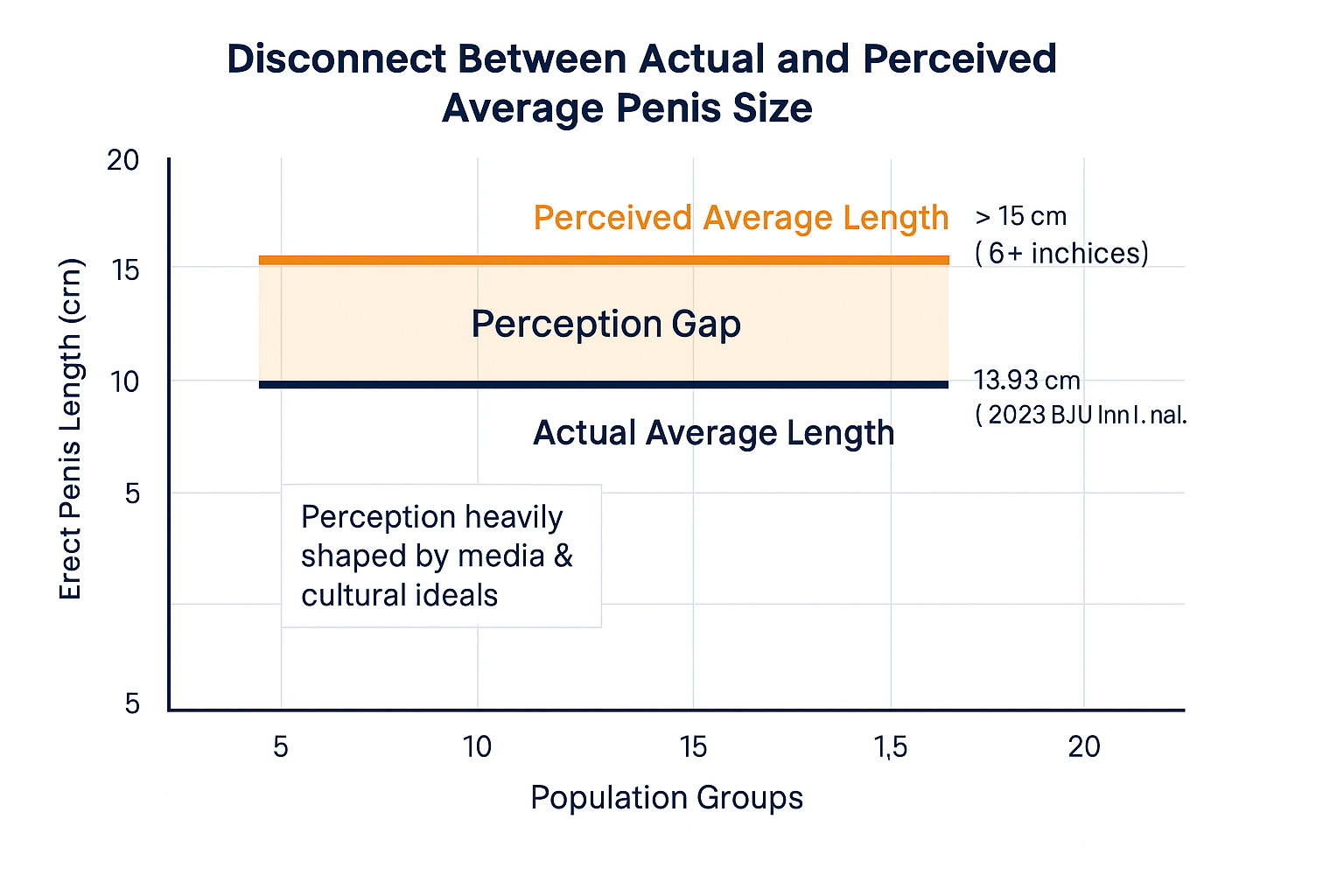
This practice creates a profound disconnect between perception and reality. A 2023 meta-analysis in BJU International publishes research that often touches on aspects of men’s health, including concerns about penis size. A study of over 55,000 men found the average erect penis length to be 13.93 cm (~5.5 inches), yet many men perceive the average to be over 6 inches—a distorted perception heavily shaped by media exposure and the desire for big dicks.
This link is not merely correlational. Research published in the context of body image issues has shed light on the societal pressures regarding penis size, revealing a common preoccupation that can lead to body dysmorphia. Journal of Sex & Marital Therapy found that higher pornography consumption was associated with lower genital self-image and increased penis size anxiety in men, further complicating their body image issues.
The constant exposure to a curated and unrepresentative sample size establishes an unrealistic baseline that fuels the modern male obsession with penis size and the desire for enlargement, as many men compare themselves to what they see in porn.
Social Comparison and “Locker Room” Culture
Social comparison and locker room culture instill anxieties about penis size from a young age, as peer-group dynamics, jokes, and a competitive environment can create a powerful, often subconscious, pressure to measure up to perceived norms.
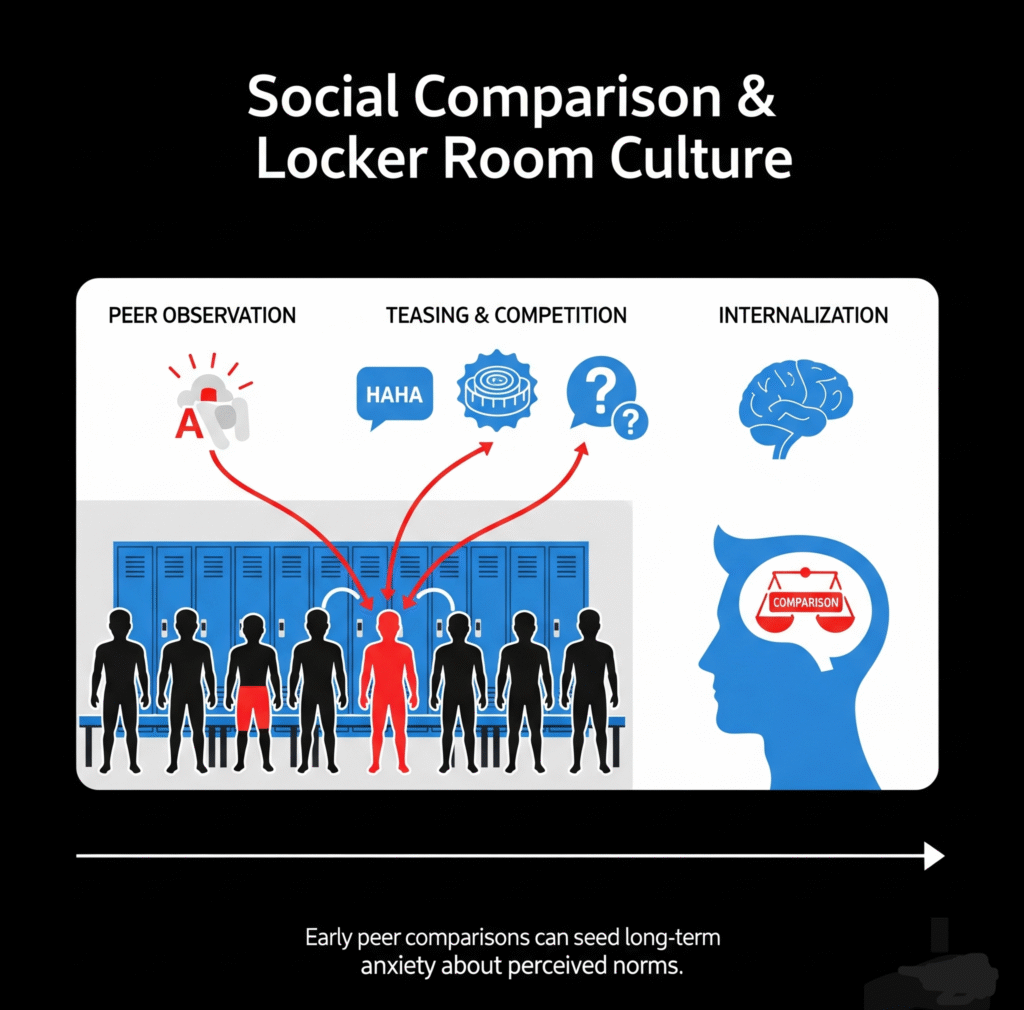
This behavior is explained by Social Comparison Theory, a concept developed by psychologist Leon Festinger in 1954, which posits that individuals determine their own social and personal worth based on how they stack up against others.
This phenomenon is quantified in a study published in the Proceedings of the National Academy of Sciences, which also discusses the impact of size on sexual performance.
Journal of Urology and Sexual MedicineA 2019 study found that 47% of university-aged men had witnessed teasing about penile appearance in locker rooms, with size being the most common reason for the ridicule, perpetuating penis envy among heterosexual men. These formative experiences can cement a deep-seated insecurity that contributes directly to the male obsession with penis size.
To really understand this obsession, it helps to explore the deeper psychological drivers behind penis size anxiety, which often leads men to seek methods such as the use of a penis pump to increase their penis size.
What Are the Psychological Drivers Behind the Male Obsession with Penis Size?
The psychological drivers behind the male obsession with penis size include the tendency to link a single physical trait to overall self-worth and masculinity, a deep-seated fear of sexual inadequacy, and a self-reinforcing negative feedback loop of performance anxiety.
Linking Penis Size to Masculinity and Self-Worth
A core psychological driver is the process where a single physical trait like penis size becomes an oversimplified proxy for a man’s entire sense of masculinity, sexual adequacy, and overall value as a partner. In psychology, a compulsive focus on size can lead to detrimental effects on mental health and sexual performance.
proxy is a substitute or a figure that represents the value of something else, often tied to the obsession with size that many men are obsessed with. In this context, the penis becomes a physical stand-in for the abstract concept of “manliness,” where the size of a man’s penis often symbolizes masculinity, and many men feel pressured to increase the size to meet the expectations of the majority of women.
This cognitive reductionism transforms “penis size” from a simple anatomical feature into a powerful symbol of one’s entire masculine identity, often leading men to experience penis envy and compulsively compare themselves to well-endowed portrayals in media.
The brain latches onto a measurable trait to answer an unmeasurable question: “Am I a good enough man?” often influenced by societal standards of what women would prefer. This linkage is a cognitive pattern, not a reflection of reality, but it is a primary driver of the “male obsession with penis size.”
The Fear of Inadequacy and Performance Anxiety
The male obsession with penis size is often rooted in a deeper, more fundamental fear of not being “enough” to sexually satisfy a partner, an anxiety which directly fuels performance-related stress in intimate situations.
The focus on “penis size” is often a tangible manifestation of this less tangible fear of inadequacy. It provides a specific, physical target for a free-floating anxiety about one’s value as a sexual being, often tied to the preoccupation with size.
This anxiety is predominantly a male self-perception issue, often rooted in body dysmorphia and societal expectations of manhood. A landmark study by Lever, Frederick, and Peplau (2006) published in the context of the obsession with size. Journal of Sex & Marital Therapy found that while 85% of women reported being satisfied with their partner’s penis size, only 55% of men were satisfied with their own.
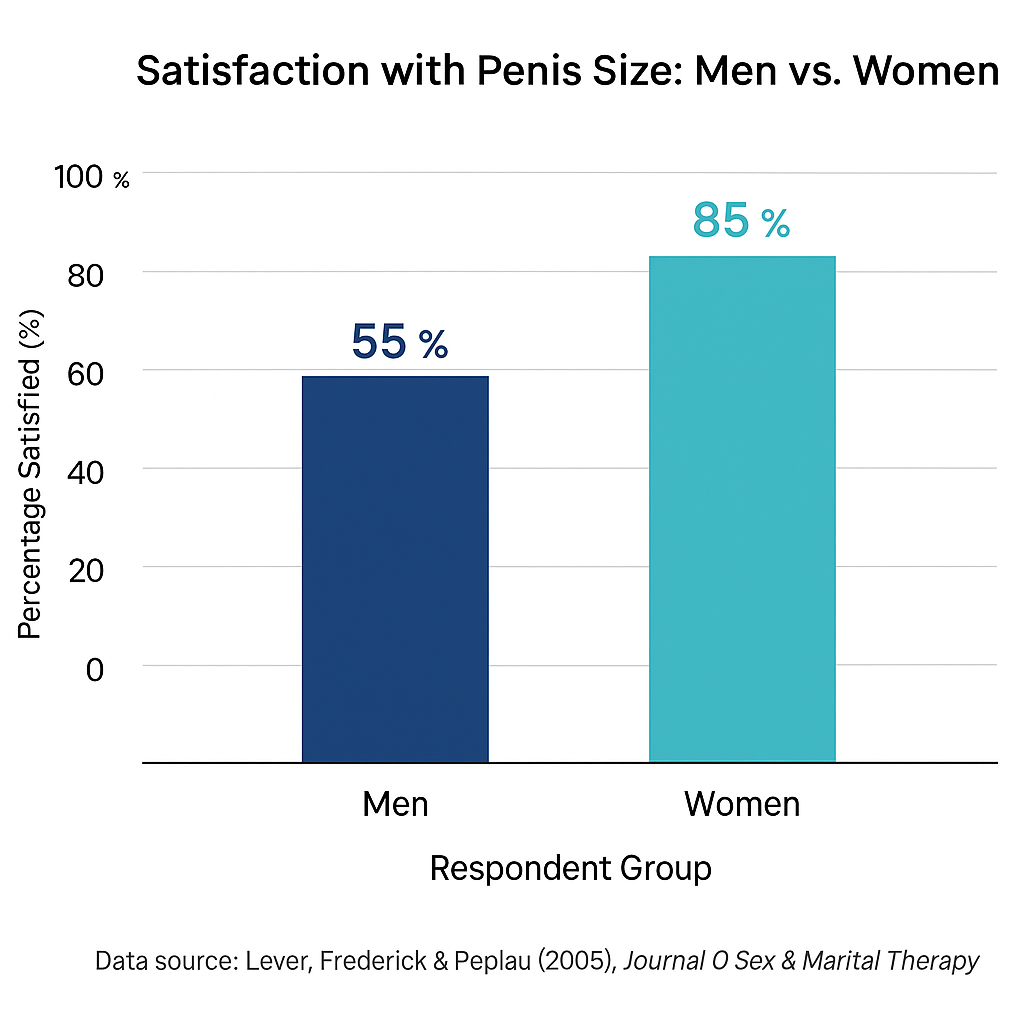
This stark gap highlights that the pressure and dissatisfaction stem primarily from men’s own minds, not from the expressed desires of their partners, often exacerbated by a preoccupation with size.
How the “Negative Feedback Loop” Reinforces the Obsession
The negative feedback loop reinforces the “male obsession with penis size” when anxiety about size causes a poor sexual experience (e.g., a weaker erection), which is then misinterpreted as “proof” of the initial fear, thereby intensifying the obsession for future encounters. This destructive cycle is both psychological and physiological, often fueled by the size obsession prevalent in porn and the societal pressure for enlargement treatments, leading to low self-esteem and anxiety.
The process unfolds in a clear sequence, often influenced by societal standards regarding the size of their penis.
- Anxious Thought: men may feel that their self-worth is tied to the size of their penis, particularly when comparing themselves to the average of 3.6 inches. The cycle begins with a fear-based thought (“My penis is too small,” or “My partner will be disappointed”), which reflects how men may feel about their size and their libido, often leading to body dysmorphia.
- Stress Response: The stress response can be exacerbated by the societal pressure surrounding size, affecting mental health and sexual performance. This thought triggers the body’s fight-or-flight response, releasing stress hormones like cortisol and catecholamines (adrenaline), especially in men who may feel insecure about their average penis size.
- Inhibited Physical Response: Anxiety can lead to a smaller perceived size of the penis during intimate moments. Catecholamines are vasoconstrictors, meaning they tighten blood vessels, which can affect the size of the penis during arousal. This directly counteracts the vasodilation (relaxation of blood vessels) required to achieve and maintain a firm erection, leading to weaker erections or erectile dysfunction, which can be linked to body dysmorphia.
- Perceived “Confirmation” of Fear: men may feel inadequate due to societal pressures surrounding the importance of size. The man experiences a weaker erection and misinterprets this physiological result of anxiety as “proof” that his penis is inadequate, contributing to his desire to increase the size through methods like penis enlargement surgery.
- Intensified Obsession: This “proof” strengthens the original anxious belief, making the fear and performance anxiety even greater for the next sexual encounter, thus perpetuating the cycle.
| Attribute: the perceived importance of size can often overshadow other attributes that contribute to sexual satisfaction. | Obsessive Mindset | Confident Mindset can help combat body dysmorphia related to perceptions of manhood. |
| Source of Value, particularly among men, often stems from societal pressures related to body image and perceived masculinity, contributing to body dysmorphia. | External (Perceived size, partner reaction, and the obsession with size that men are obsessed with) | Internal (Skill, health, connection, and the impact of size obsession) |
| Primary Fear | Fear of being judged as “small” or inadequate. | Fear of not connecting with a partner. |
| Mental Focus on the perceived size of their penis can influence confidence and may lead to compulsive behaviors regarding sexual performance. | Comparison and measurement of the size of a man’s penis can lead to unrealistic expectations. | Presence and partner’s pleasure. |
| Behavioral Result: men often respond to societal pressures with compulsively seeking validation through size enhancement, which can lead to low self-esteem. | Anxiety, avoidance, and a focus on risky “fixes” like penis pumps often plague men who struggle with penis size anxiety. | Confidence, engagement, and a focus on skill can help men overcome the pressure of the size obsession, rather than relying on superficial measures like penis pumps. |
Is There an Evolutionary Basis for the Male Obsession with Penis Size?
While some evolutionary psychology theories suggest visual cues of virility may have played a role in ancestral mate selection, the modern “male obsession with penis size” is overwhelmingly a product of cultural amplification rather than a direct biological necessity.
Theories on Visual Cues and Mate Selection
Some evolutionary psychology theories propose that in ancestral environments, visible signs of health and virility, which a larger penis size could be perceived to represent, may have acted as a visual cue in inter-sexual selection or male-to-male competition.
A 2013 study published in a reputable journal explored how the fixation on size affects men’s self-esteem and sexual satisfaction, revealing that many men feel inadequate due to societal standards, particularly regarding manhood.
PNAS, a journal that addresses various aspects of the obsession with size, particularly the importance of size in male sexual satisfaction and its relation to vaginal experiences. (Proceedings of the National Academy of Sciences and related studies on sexual medicine have examined the preoccupation with size and its impact on sexual function, particularly regarding erect circumference.) supports this idea.
Researchers used computer-generated male figures with varying heights, body shapes, and flaccid penis sizes, finding that women rated figures with larger dicks as more attractive, highlighting the size obsession.
However, the study also noted that this effect had diminishing returns and was secondary to other traits like a taller stature and a more masculine shoulder-to-hip ratio, which can overshadow concerns about the size of the penis.
This suggests that while size may be a factor, it is only one piece of a much larger puzzle in attractiveness, even from a purely theoretical evolutionary perspective regarding men’s health and the average flaccid penis.
The Reality of Human Biology vs. Other Primates
The reality of human biology shows that unlike in many other primates where penis size is directly linked to mating strategies and dominance hierarchies, human sexual dynamics are far more complex, revolving around factors like pair-bonding, emotional connection, skill, and long-term partnership.
Humans have the largest penis relative to body size of all primates, which some theorists suggest evolved due to our upright posture and face-to-face mating, contributing to the obsession and anxiety surrounding size.
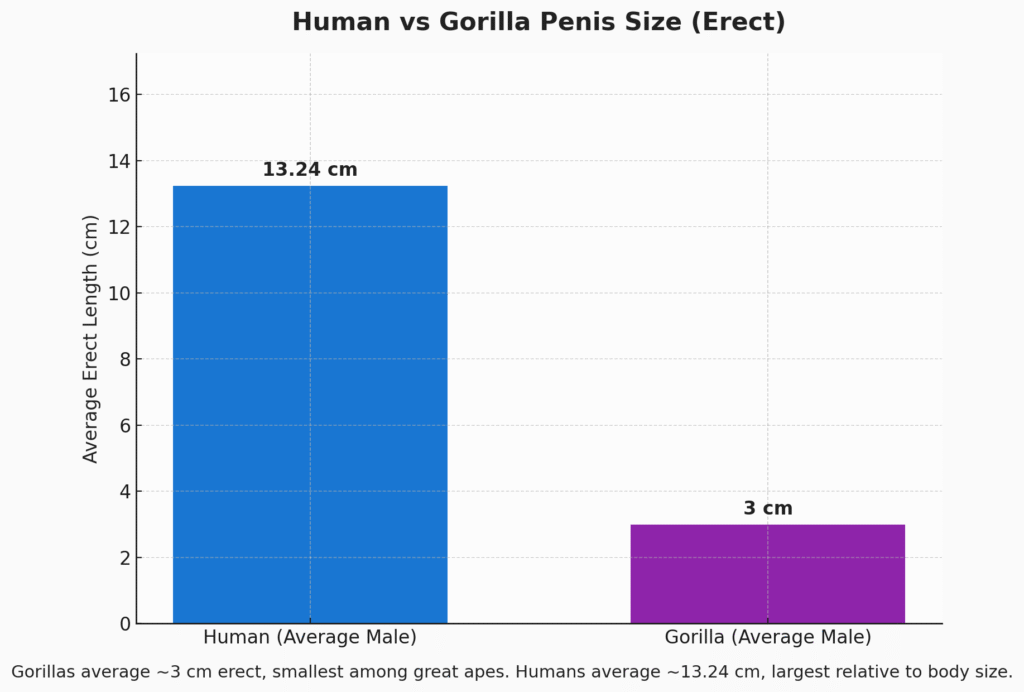
A stark contrast is the gorilla, which, despite its size, does not conform to the typical standards of penis size among men. Despite being a large and physically dominant primate living in a polygynous society, gorillas have the smallest penis of all great apes, averaging around 3 cm (1.2 inches) when erect, a stark contrast to the well-endowed expectations placed on men.
This demonstrates that in the primate world, size of a man’s penis is not a universal marker of power or reproductive success, challenging the notion that men want larger sizes or are preoccupied with inches long. Factors like emotional intelligence, communication, and partnership are far more significant in human sexual success than anatomy alone.
Distinguishing Between Biological Predisposition and Cultural Amplification
It is crucial to distinguish between a possible, slight biological predisposition for noticing physical traits and the immense cultural amplification that creates the modern male obsession with penis size, which is overwhelmingly a product of societal and psychological factors, not evolutionary necessity.
While Evolutionary Psychology may offer a partial, theoretical explanation for why penis size might be noticed, it cannot account for the intensity of the modern obsession, the associated anxiety, or the prevalence of Body Dysmorphic Disorder.
The scientifically balanced conclusion is that any minor evolutionary echo is drowned out by the roar of cultural and psychological amplification. The male obsession with penis size is fueled primarily by the media we consume, the social comparisons we make, and the psychological fears we internalize about the girth and length of their man’s penis.
What Are the Key Takeaways for Understanding the Male Obsession with Penis Size?
The key takeaways for understanding the male obsession with penis size are that it is primarily a learned cultural and psychological phenomenon, it often acts as a proxy for deeper fears about adequacy, it creates a self-reinforcing cycle of anxiety, and it can be overcome by shifting focus to controllable factors.
Understanding the Obsession: A Quick Summary of how men may feel pressured by societal standards regarding size, often worried about their perceived sexual competence.
☐ It’s Learned, Not Innate: The obsession with size is primarily driven by cultural messages and media, not biology, leading to body dysmorphia among men.
☐ It’s a Proxy for Deeper Fears: It often represents a deeper anxiety about masculinity and adequacy.
☐ It Creates a Vicious Cycle: Anxiety about size can cause the very sexual issues that are feared.
The Antidote is Shifting Focus: Overcoming the obsession involves moving focus from anatomy to controllable factors like skill, health, and connection, often with the help of professional help to endow men with the confidence they need.
Conclusion
In conclusion, the “male obsession with penis size” is a complex phenomenon woven from a tapestry of cultural history, modern media influence, and deep-seated psychological fears about self-worth and masculinity, which can be consciously understood and overcome.
The evidence clearly shows that this fixation stems not from an objective reality of partner dissatisfaction but from a subjective, internal sense of insecurity amplified by unrealistic cultural standards. The obsession with size is a learned burden, not a biological mandate, affecting a lot of men, often leading to low self-esteem.
While the obsession is common and its roots are deep, it is based on factors that can be deconstructed, understood, and consciously overcome through a shift in mindset from measurement to connection.
True sexual value lies not in a measurement, but in confidence, skill, and the ability to create a deep and meaningful connection with a partner, rather than merely focusing on size.