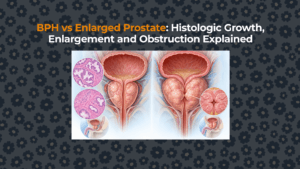
Transurethral resection of the prostate (TURP) is an operation that removes obstructing prostate tissue from around the prostatic urethra. A surgeon passes a resectoscope through the penis and urethra, removes prostate tissue in small pieces and creates a wider channel for urine to leave the bladder.
01. TURP: Indications, Technique and Treatment Role
What problem is TURP intended to treat?
TURP is designed to treat bladder-outlet obstruction caused by enlarged benign prostate tissue.
The prostate surrounds the first part of the urethra below the bladder. When tissue in the transition region enlarges, it can compress or distort the prostatic urethra and increase resistance to urinary flow.
This can contribute to:
- a weak urinary stream;
- difficulty starting urination;
- intermittent flow;
- straining;
- incomplete bladder emptying;
- increasing post-void residual urine;
- recurrent urinary retention;
- and other lower urinary tract symptoms.
TURP removes part of the obstructing adenomatous tissue rather than removing the entire prostate.
What happens before and during TURP?
Before TURP, clinicians confirm that prostate-related outlet obstruction is a reasonable explanation for the symptoms and that surgery is appropriate.
Assessment may include urinary history, symptom scoring, prostate examination, urinalysis, PSA when relevant, prostate-volume measurement, uroflowmetry and post-void residual urine. Cystoscopy or urodynamic testing may be used selectively when anatomy or bladder function needs clarification.
TURP is performed through the urethra, so there is no external abdominal incision.
The surgeon inserts a rigid instrument called a resectoscope through the urethra until its working end reaches the prostatic urethra. A wire loop carrying electrical energy cuts small pieces of obstructing tissue while irrigation fluid keeps the operative field visible.
02. How Is TURP Performed?
Which anatomy, prostate size or disease factors affect TURP?
Prostate volume is an important part of procedure selection.
Current European Association of Urology guidance recommends monopolar or bipolar TURP for men with bothersome moderate-to-severe lower urinary tract symptoms caused by benign prostatic obstruction when prostate volume is approximately 30–80 mL.
This is not an absolute biological boundary. Surgeon experience, anatomy, equipment and operating time also matter. Complication risk tends to increase as prostate size and duration of resection increase.
Very small glands may sometimes be treated with transurethral incision rather than resection, while substantially larger glands may be better suited to an enucleation technique such as HoLEP or another size-appropriate operation.
Other anatomical factors can also change planning, including:
- prominent median-lobe enlargement;
- intravesical prostatic protrusion;
- urethral stricture;
- bladder stones;
- bladder diverticula;
- previous prostate or urethral surgery;
- and the degree of bladder decompensation.
What is the difference between monopolar and bipolar TURP?
| Feature | Monopolar TURP | Bipolar TURP |
|---|---|---|
| Resection principle | Electrical current travels from the loop through the patient to a return electrode. | Electrical circuit is confined around the resection instrument. |
| Irrigation | Traditionally uses non-electrolyte irrigation fluid. | Uses normal saline irrigation. |
| Symptom and flow efficacy | Established effective treatment. | Comparable efficacy to monopolar TURP. |
| TUR syndrome | Classic dilutional TUR syndrome can occur, although modern rates are low. | Saline irrigation avoids classic TUR syndrome caused by absorption of electrolyte-free irrigation fluid. |
| Perioperative safety | Effective but carries bleeding and irrigation-fluid risks. | Evidence supports a favorable perioperative safety profile compared with monopolar TURP. |
What are the expected urinary outcomes after TURP?
TURP has a long history as an effective surgical treatment for benign prostatic obstruction.
Successful treatment can substantially improve urinary symptom scores, increase maximum urinary flow and reduce residual urine. Benefits can persist for years, although no procedure guarantees permanent relief and some men eventually require additional treatment.
Improvement is most predictable when the patient’s urinary difficulty is primarily caused by outlet obstruction.
If poor bladder contraction rather than obstruction is the dominant problem, removing prostate tissue may not restore normal emptying to the same extent.
03. TURP: Outcomes, Recovery and Procedure-Specific Trade-Offs
What does recovery after TURP usually involve?
At the end of TURP, a urinary catheter is commonly placed through the urethra into the bladder. The catheter keeps urine draining while swelling settles and the resection surface begins to heal.
In some patients, continuous or intermittent bladder irrigation is used through the catheter to help prevent blood clots from blocking drainage.
The exact catheter duration and hospital stay depend on bleeding, urine clarity, ability to urinate after catheter removal, other medical conditions and local surgical practice.
During early recovery, temporary symptoms can include:
- blood or small clots in the urine;
- burning during urination;
- urgency and frequency;
- temporary difficulty controlling urine;
- and bladder spasms while a catheter is present.
Patients receive individualized instructions about fluid intake, activity, lifting, driving, sexual activity and when to seek medical care.
Which urinary or sexual effects should be discussed before TURP?
Potential perioperative or later complications include bleeding, infection, clot retention, temporary urinary retention, urethral stricture, bladder-neck contracture and urinary incontinence.
Modern TURP is generally safe, but risks vary with prostate size, medical conditions, anticoagulant or antiplatelet therapy, surgical duration and technique.
A particularly important sexual outcome is ejaculatory change.
After conventional TURP, semen may travel backward into the bladder during orgasm rather than exiting through the penis. This is commonly called retrograde ejaculation.
The orgasm sensation may remain, but little or no semen may be seen outside the body. This can matter greatly to men who wish to preserve fertility or normal antegrade ejaculation.
Ejaculatory change should not automatically be treated as the same outcome as erectile dysfunction. The ability to obtain an erection and the direction or volume of ejaculation are separate functions.
04. Who Is Most Likely to Be Considered for TURP?
How does TURP compare with the closest alternatives?
TURP is one of several operations capable of relieving prostate-related outlet obstruction.
Its major strength is a long-established evidence base with substantial improvement in urinary symptoms and flow.
Procedure selection increasingly depends on the individual anatomy and which outcomes matter most to the patient.
| Clinical consideration | TURP | Other approaches that may be considered |
|---|---|---|
| Prostate around 30–80 mL | Established standard surgical option. | HoLEP, laser vaporization or Aquablation may also be considered depending on anatomy and expertise. |
| Very large prostate | Longer resection time can increase operative complexity. | Enucleation techniques such as HoLEP or other large-gland procedures may be more appropriate. |
| Bleeding considerations | Bipolar TURP has a favorable perioperative safety profile. | Selected laser procedures may be considered depending on the patient’s circumstances. |
| Strong desire to preserve ejaculation | Conventional TURP commonly changes ejaculation. | Selected men may discuss UroLift, Aquablation or other ejaculation-preserving approaches. |
| Preference for a less invasive outpatient procedure | Usually requires anesthesia and endoscopic surgery. | Rezūm or UroLift may be considered when anatomy and other factors are suitable. |
| Durability | Strong long-term clinical experience. | Durability and retreatment rates differ between alternatives. |
When may TURP be unsuitable or require additional evaluation?
TURP may not be the preferred approach when prostate size or anatomy favors another procedure, when anesthesia or bleeding considerations alter operative risk, or when preservation of ejaculation is a particularly important treatment priority.
More importantly, surgery should not be performed simply because urinary symptoms and an enlarged prostate coexist.
A weak stream and high residual urine can also occur when the bladder muscle contracts poorly. Neurological disease, urethral stricture, bladder-neck disorders and other conditions can produce similar findings.
If it is unclear whether obstruction or weak bladder contraction is the main cause, additional testing such as pressure-flow urodynamics may influence the decision.
Summary
- TURP is an endoscopic operation that removes obstructing prostate tissue through the urethra.
- It does not require an external abdominal incision and does not remove the entire prostate.
- TURP is an established option for bothersome moderate-to-severe urinary symptoms caused by benign prostatic obstruction, particularly with prostate volumes around 30–80 mL.
- A resectoscope and electrosurgical loop remove small pieces of tissue until a wider urinary channel is created.
- Bipolar TURP provides similar urinary efficacy to monopolar TURP while allowing saline irrigation and offering perioperative safety advantages.
- Recovery commonly includes temporary catheter drainage while the resection surface heals.
- Potential complications include bleeding, infection, urethral or bladder-neck narrowing, urinary symptoms during recovery and ejaculatory changes.
- The appropriate procedure depends on anatomy, prostate size, bladder function, surgical risk, sexual priorities and available expertise.
Educational disclaimer: This article provides general medical education and does not recommend TURP or another procedure for an individual. A urologist must evaluate the cause of urinary symptoms, prostate anatomy, bladder function, medical risk and treatment priorities before surgery.
Evidence Sources
- European Association of Urology. Management of Non-neurogenic Male LUTS: Disease Management.
- National Institute of Diabetes and Digestive and Kidney Diseases. Enlarged Prostate (Benign Prostatic Hyperplasia).
Return to BPH Surgery and Minimally Invasive Procedures