How Can BPH Cause Incomplete Bladder Emptying? Obstruction and Post-Void Residual
Benign prostatic hyperplasia (BPH) can contribute to incomplete bladder emptying when prostate-related resistance at the bladder outlet makes it harder for the bladder to expel all of its urine. When urine remains in the bladder after urination, the amount left is called the post-void residual, or PVR.
01. Benign Prostatic Hyperplasia: Relationship to Incomplete Bladder Emptying
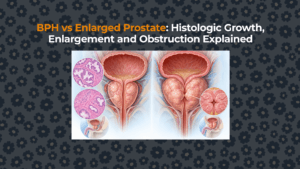
The prostate surrounds the first portion of the urethra immediately below the bladder. When benign prostate tissue enlarges, or smooth-muscle tone increases around the prostate and bladder neck, resistance to urinary outflow can rise.
The bladder normally empties when the detrusor muscle contracts while the bladder outlet and urethra provide sufficiently low resistance for urine to pass. If resistance increases, the detrusor must generate greater pressure to maintain urinary flow.
When this compensatory effort is insufficient, urination may stop before the bladder has completely emptied.
For the wider disease process, see Benign Prostatic Hyperplasia and Enlarged Prostate .
What prostate mechanism can produce incomplete bladder emptying?
BPH can affect bladder emptying through both a mechanical component and a dynamic component.
The mechanical component develops when enlarging prostate tissue changes the shape or available space within the prostatic urethra. BPH commonly develops within the transition zone and tissue close to the urethra, so enlargement can increase resistance along the urinary pathway.
The dynamic component involves smooth muscle within the prostate and bladder neck. Increased smooth-muscle tone can add further resistance even when prostate enlargement itself is not severe.
The bladder may compensate by generating greater pressure. If that pressure cannot sufficiently overcome the resistance, or if the bladder contraction is weak or poorly sustained, voiding may end while urine remains inside the bladder.
Which findings make BPH-related obstruction more likely?
Incomplete bladder emptying becomes more compatible with prostate-related obstruction when it occurs together with other signs of impaired urinary flow.
These findings may include a weak urinary stream, urinary hesitancy, intermittent flow, straining, prolonged voiding or a measured amount of urine remaining after urination.
Evidence of prostate enlargement can provide an anatomical explanation for increased resistance, but prostate size alone cannot determine whether the urinary outlet is functionally obstructed.
| Finding | What it may suggest | Important limitation |
|---|---|---|
| Enlarged prostate | Provides a possible anatomical basis for increased bladder-outlet resistance | Prostate enlargement does not prove functional obstruction |
| Weak or intermittent urinary stream | May occur when urine encounters increased outlet resistance | Reduced bladder contractility can produce similar changes |
| Urinary hesitancy | May reflect difficulty overcoming outlet resistance when urination begins | Hesitancy also occurs with bladder, urethral and neurological disorders |
| Elevated post-void residual | Demonstrates that urine remains after urination | Does not identify whether the cause is obstruction, weak detrusor function or both |
| Pressure-flow evidence | Can demonstrate increased bladder pressure together with reduced urinary flow | Urodynamic testing is generally used only in selected situations |
02. How Can Benign Prostatic Hyperplasia Cause Incomplete Bladder Emptying?
The bladder and urinary outlet function together as a coordinated pressure-and-resistance system.
During normal voiding, the detrusor muscle contracts and urine passes through the bladder neck, prostatic urethra and remainder of the urethra. When prostate-related resistance increases, greater bladder pressure may be needed to maintain urinary flow.
At first, the detrusor muscle may compensate effectively. This helps explain why some men can have prostate enlargement without developing a large post-void residual.
In other men, resistance may become substantial enough that urination ends while urine is still present in the bladder. Long-standing obstruction may also coexist with changes in bladder function, making emptying progressively less efficient.
An enlarged prostate can therefore affect bladder emptying through more than simple narrowing. The final result depends on both the amount of outlet resistance and the bladder’s ability to generate and sustain an effective contraction.
What other conditions can cause incomplete bladder emptying?
BPH is only one possible cause. Incomplete emptying can also develop when the bladder cannot generate an adequate contraction or when another part of the urinary tract obstructs urine flow.
One important alternative mechanism is detrusor underactivity. In this condition, the bladder contraction may be too weak or too brief to empty the bladder efficiently, even when prostate obstruction is not the primary problem.
Other possible causes or contributors include:
- urethral stricture or other urethral narrowing;
- bladder-neck obstruction or dysfunction;
- neurological disorders that affect bladder contraction;
- diabetes-related bladder dysfunction;
- medicines that reduce bladder contractility or alter urinary-outlet function;
- urinary or pelvic inflammation;
- previous pelvic or urinary procedures;
- and combinations of bladder weakness and outlet obstruction.
How is the feeling of incomplete emptying different from post-void residual?
These two findings are related but should not be treated as interchangeable.
This distinction matters in men with BPH because clinicians must determine whether the problem reflects actual impaired emptying, increased outlet resistance, altered bladder sensation, reduced bladder contractility or a combination of these factors.
03. Incomplete Bladder Emptying: Prostate-Related Mechanisms and Competing Causes
The presence of BPH together with residual urine suggests a possible relationship, but it does not automatically establish that the prostate is responsible.
An increased post-void residual can occur because of bladder-outlet obstruction, reduced detrusor function or a combination of both mechanisms.
This becomes particularly important in older men because prostate enlargement and reduced bladder contractility can coexist.
How do doctors separate prostate obstruction from bladder or urethral causes?
Evaluation begins with the urinary history. Clinicians consider the onset and progression of symptoms, urinary stream strength, hesitancy, straining, urinary frequency and urgency, medicines, previous procedures and neurological or metabolic conditions.
Physical examination and urinalysis can provide additional information. Depending on the clinical situation, prostate assessment, uroflowmetry, post-void residual measurement and urinary tract imaging may also be used.
A low urinary flow rate cannot by itself distinguish prostate obstruction from weak bladder contraction. Likewise, residual urine demonstrates incomplete emptying but does not identify why the bladder failed to empty completely.
When this distinction remains uncertain and would influence treatment, pressure-flow urodynamic testing can evaluate bladder pressure during voiding and help separate bladder-outlet obstruction from detrusor underactivity.
What does incomplete bladder emptying alone fail to prove about the prostate?
| Incomplete emptying does not prove… | Why |
|---|---|
| That BPH is present | Several bladder, urethral and neurological disorders can impair emptying |
| That the prostate is enlarged | Bladder contractility can be impaired without important prostate enlargement |
| That an enlarged prostate is obstructing urine flow | Anatomical prostate size and functional bladder-outlet obstruction are not equivalent |
| That residual urine is caused by the prostate | Poor detrusor contraction can produce an elevated PVR with or without obstruction |
| That complete urinary retention is present | A person may still pass urine while leaving a residual volume inside the bladder |
| That prostate cancer is present | Incomplete bladder emptying is nonspecific and cannot diagnose malignancy |
04. When Should Incomplete Bladder Emptying Be Evaluated Beyond the Prostate?
Persistent or worsening difficulty emptying the bladder deserves medical assessment because residual urine can arise from several mechanisms and may, in some circumstances, contribute to urinary complications.
Evaluation should not stop simply because an enlarged prostate has already been identified. A man with BPH can also develop bladder dysfunction, urethral disease, infection, neurological disease or another cause of impaired emptying.
When should incomplete bladder emptying trigger additional urinary evaluation?
Further assessment is particularly important when incomplete emptying occurs with:
- progressively weaker urinary flow;
- increasing difficulty starting urination;
- frequent straining to empty the bladder;
- repeated urinary tract infections;
- persistent or increasing post-void residual urine;
- blood in the urine;
- pain or burning during urination;
- lower abdominal fullness or discomfort;
- new neurological symptoms;
- kidney or upper urinary tract abnormalities;
- or episodes in which urination becomes extremely difficult or impossible.
How does incomplete bladder emptying fit with other BPH urinary symptoms?
Incomplete emptying can occur as part of a wider pattern of prostate-related voiding difficulty.
A man may first notice difficulty starting urination , followed by a weak or intermittent stream, straining or the feeling that urine remains after voiding.
If emptying becomes substantially impaired, the clinical picture can progress toward urinary retention.
For incomplete bladder emptying from causes beyond BPH, see Incomplete Bladder Emptying .
For the measurement itself, see What Is a Post-Void Residual (PVR) Test? Measuring Urine Left After Voiding .
The previous BPH symptom article explains How Can BPH Cause Urinary Hesitancy? Prostatic Obstruction and Delayed Flow .
The next article explains How Can BPH Cause Urinary Retention? Acute and Chronic Bladder Outlet Obstruction .
Summary
BPH can contribute to incomplete bladder emptying when prostate enlargement or increased smooth-muscle tone raises resistance at the bladder outlet. The bladder must then generate greater pressure to move urine through the prostatic urethra, and some urine may remain after voiding if the resistance cannot be fully overcome.
The amount of urine remaining after urination is called the post-void residual. However, an elevated PVR does not automatically prove prostate obstruction because reduced bladder contractility can produce the same finding. The feeling of incomplete emptying is also different from an objectively measured residual volume.
Persistent incomplete bladder emptying should therefore be interpreted using the complete urinary picture—including symptoms, prostate findings, urinary flow, residual urine and bladder function—rather than prostate size alone.
Educational information only. Persistent, worsening or severe urinary symptoms should be evaluated by a qualified healthcare professional.
Evidence sources
- International Continence Society — Feeling of Incomplete Bladder Emptying
- European Association of Urology — Diagnostic Evaluation of Male Lower Urinary Tract Symptoms
- European Association of Urology — Male LUTS Disease Management
- NIDDK — Enlarged Prostate (Benign Prostatic Hyperplasia)
- NIDDK — Symptoms and Causes of Urinary Retention