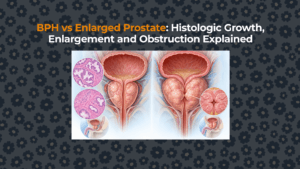
Simple prostatectomy is an operation used mainly for very large benign prostate enlargement when a substantial amount of obstructing adenoma must be removed. Despite its name, the operation does not remove the entire prostate. The surgeon removes the enlarged inner adenoma that is compressing the urinary channel while leaving the outer portion of the prostate in place.
01. Simple Prostatectomy: Indications, Technique and Treatment Role
What problem is Simple Prostatectomy intended to treat or evaluate?
Simple prostatectomy is used to relieve substantial bladder-outlet obstruction caused by a large volume of benign adenomatous prostate tissue.
The prostate lies below the bladder and surrounds the first part of the urethra. This section is the prostatic urethra.
Benign growth commonly develops within the transition zone of the prostate. As this inner tissue enlarges, it can compress and distort the urinary channel.
In very large glands, the amount of adenoma may become substantial enough that a more extensive tissue-removing procedure is considered.
Symptoms and complications that can lead to surgical evaluation include:
- severe or persistent lower urinary tract symptoms;
- markedly weak urinary flow;
- refractory urinary retention;
- recurrent urinary tract infection related to poor emptying;
- recurrent bladder stones;
- recurrent gross hematuria attributed to BPH;
- progressive bladder dysfunction associated with outlet obstruction;
- and renal consequences caused by severe chronic obstruction.
What happens before and during Simple Prostatectomy?
Before surgery, clinicians evaluate whether large-volume benign enlargement is actually responsible for the urinary obstruction and whether the patient’s anatomy favors simple prostatectomy rather than an endoscopic procedure.
Accurate gland sizing is therefore important. See How Is Prostate Volume Measured? for ultrasound, MRI and volume-calculation principles.
Evaluation may also include urinalysis, urinary-flow measurement, post-void residual testing, PSA when clinically appropriate, cystoscopy, kidney-function assessment and other testing when the cause or severity of obstruction is uncertain.
Large median-lobe growth can be particularly relevant. FBU explains this separately in Median Lobe Prostate Enlargement and Intravesical Prostatic Protrusion.
During simple prostatectomy, the surgeon creates access to the enlarged adenoma, identifies the plane separating it from surrounding prostate tissue and removes the obstructing inner tissue.
For the wider surgical pathway, see BPH Surgery and Minimally Invasive Procedures.
02. How Is Simple Prostatectomy Performed?
Which anatomy, prostate size or disease factors affect Simple Prostatectomy?
Simple prostatectomy is mainly used for large to very large prostate glands.
European guidance describes open prostatectomy as a treatment for substantially enlarged glands, commonly above approximately 80–100 mL. It strongly recommends open prostatectomy for prostates above 80 mL when endoscopic enucleation technology is not available.
The American Urological Association likewise considers open, laparoscopic and robot-assisted simple prostatectomy treatment options for large to very large glands, depending on clinician expertise.
The precise decision is not based on prostate volume alone. Factors include:
- total prostate volume;
- size of the adenoma;
- median-lobe enlargement;
- bladder stones;
- bladder diverticula requiring treatment;
- previous urinary retention;
- bladder contractility;
- previous pelvic or prostate surgery;
- bleeding risk;
- overall operative fitness;
- available surgical technology;
- and surgeon expertise.
| Feature | Open Simple Prostatectomy | Robot-Assisted Simple Prostatectomy |
|---|---|---|
| Surgical access | Larger lower abdominal incision. | Several small laparoscopic or robotic ports. |
| Adenoma removal | Direct enucleation of large benign adenoma. | Robot-assisted enucleation of the same obstructing adenoma. |
| Urinary effectiveness | Strong and durable improvement. | Functional improvement appears broadly comparable. |
| Blood loss | Generally greater. | Generally lower. |
| Transfusion risk | Higher than with robotic surgery in comparative evidence. | Lower in comparative studies. |
| Hospital stay | Usually longer. | Usually shorter. |
| Operating time | Often shorter. | Often longer. |
| Equipment | Does not require a robotic platform. | Requires robotic equipment and specialized expertise. |
What are the main expected outcomes after Simple Prostatectomy?
Simple prostatectomy can produce large improvements in urinary symptoms, urinary flow and bladder emptying because a substantial amount of obstructing adenoma is removed.
EAU evidence for open prostatectomy reports reductions in lower urinary tract symptoms of approximately 63–86%, large improvements in quality of life and increases in maximum urinary flow of approximately 16.5–20.2 mL/s.
Post-void residual urine also falls substantially in appropriately selected patients, and functional benefit can remain durable for years.
Robot-assisted and laparoscopic simple prostatectomy have shown similar improvements in symptom scores and urinary flow compared with open surgery.
These results should not be interpreted as a guarantee for every patient. If poor bladder contraction is also present, removing the obstruction may not completely normalize emptying.
03. Simple Prostatectomy: Outcomes, Recovery and Procedure-Specific Tradeoffs
What does recovery after Simple Prostatectomy usually involve?
Simple prostatectomy involves more extensive tissue removal than most minimally invasive BPH procedures, so recovery is correspondingly more substantial.
A urinary catheter is usually left in place after surgery to drain the bladder while the surgical site heals.
Depending on the operation and bleeding, continuous bladder irrigation may also be used temporarily to prevent clot accumulation.
Early recovery can include:
- blood in the urine;
- small blood clots;
- bladder spasms;
- catheter discomfort;
- pelvic or abdominal discomfort;
- urinary urgency after catheter removal;
- temporary urinary leakage;
- fatigue after major surgery;
- and temporary restrictions on heavy lifting and strenuous activity.
Open surgery generally requires a longer inpatient recovery than robot-assisted surgery.
Comparative evidence suggests robotic simple prostatectomy can reduce hospital stay, blood loss and transfusion risk relative to open simple prostatectomy, although operative time is generally longer.
Other potential complications include infection, blood clots in the bladder, wound problems after abdominal surgery, urinary retention, bladder-neck contracture, urethral stricture, urinary incontinence, thromboembolic complications and complications related to anesthesia.
Which urinary or sexual effects should be discussed before Simple Prostatectomy?
A major change in ejaculation is expected after conventional simple prostatectomy.
Removal of adenoma around the bladder neck and prostatic urethra commonly disrupts the normal pathway used by semen during ejaculation.
Men may continue to experience orgasm while producing little or no semen through the penis.
This should not be confused with erectile dysfunction.
Erection, orgasm, ejaculation and fertility are different outcomes. Erectile function may remain intact even when antegrade ejaculation is lost.
The extent of sexual effects depends on baseline function, surgical technique, anatomy and other medical factors.
04. Who Is Most Likely to Be Considered for Simple Prostatectomy?
How does Simple Prostatectomy compare with the closest alternative?
For a very large benign prostate, one of the closest alternatives is HoLEP, because both operations can remove a large volume of adenoma rather than treating only a small portion of the gland.
The previous treatment in the FBU procedure pathway, Prostate Artery Embolization, uses a completely different strategy: it reduces arterial blood flow so the prostate gradually shrinks rather than surgically removing the adenoma.
| Feature | Simple Prostatectomy | HoLEP | PAE |
|---|---|---|---|
| Primary mechanism | Surgical enucleation of large adenoma. | Endoscopic laser enucleation of adenoma. | Arterial embolization followed by gradual tissue shrinkage. |
| Surgical route | Open abdominal or minimally invasive robotic/laparoscopic route. | Through the urethra. | Through an artery in the wrist or groin. |
| Very large prostates | Established treatment role. | Effective across a broad range of gland sizes. | Can be considered in selected large glands. |
| Tissue removed | Large adenoma removed. | Large adenoma removed. | No tissue removed during procedure. |
| Urinary decompression | Strong. | Strong. | Generally less powerful than surgical enucleation. |
| Hospital recovery | Longest with open surgery; shorter with robotic approaches. | Generally shorter. | Often shortest. |
| Bleeding | Highest concern with traditional open surgery. | Generally favorable perioperative bleeding profile. | Low operative blood loss. |
| Histology specimen | Yes. | Yes. | No. |
| Ejaculation | Frequently altered. | Frequently altered after standard HoLEP. | Often preserved, although not guaranteed. |
Current European evidence indicates that open prostatectomy and HoLEP produce similar short- and mid-term improvements in men with large prostates, while open prostatectomy has a less favorable perioperative safety profile.
Robot-assisted simple prostatectomy also produces urinary outcomes comparable with HoLEP in available studies.
However, recent comparative meta-analysis suggests HoLEP generally provides shorter operating time, shorter hospitalization and shorter catheterization, with lower transfusion risk than robotic simple prostatectomy.
When is Simple Prostatectomy unsuitable or followed by additional evaluation?
Simple prostatectomy is usually excessive for a small or moderately enlarged gland when a less invasive procedure can adequately relieve the obstruction.
It may also be inappropriate when symptoms are primarily caused by weak bladder contraction, urethral disease, neurological dysfunction or another condition rather than prostate-related outlet resistance.
This is why prostate size alone should never determine the operation. FBU explains the relationship in Does Prostate Size Predict BPH Symptoms?
Further investigation may also be needed when PSA, examination, imaging or other findings raise concern for prostate cancer.
Simple prostatectomy is a treatment for benign adenomatous enlargement; it should not be substituted for appropriate cancer diagnosis or cancer-directed radical prostatectomy.
The broader assessment pathway is covered in How BPH Is Diagnosed, while the complete treatment framework is explained in BPH Surgery and Minimally Invasive Procedures.
Summary
- Simple prostatectomy is primarily used for large or very large benign prostate enlargement.
- The procedure removes the obstructing inner adenoma rather than removing the entire prostate gland.
- It is fundamentally different from radical prostatectomy for prostate cancer.
- Open surgery can be performed through the bladder or through the prostate capsule.
- Robot-assisted simple prostatectomy performs similar adenoma enucleation through minimally invasive abdominal access.
- Current European guidance identifies open prostatectomy as an effective and durable option for glands above about 80 mL when endoscopic enucleation is unavailable.
- Open simple prostatectomy produces large improvements in urinary symptoms, flow and residual urine but is the most invasive surgical BPH approach.
- Robot-assisted surgery generally reduces blood loss, transfusion risk and hospital stay compared with open surgery, although operative time may be longer.
- HoLEP can provide similar urinary effectiveness with a less invasive transurethral approach and often shorter hospitalization and catheterization.
- Temporary catheterization is expected after simple prostatectomy while the large surgical cavity heals.
- Bleeding, infection, bladder-neck narrowing, urethral stricture and urinary incontinence are among the complications that should be discussed.
- Ejaculation is commonly altered even when erectile function remains preserved.
- Prostate size alone does not prove obstruction or establish the need for surgery.
- No single procedure is universally best for every very large prostate.
Educational disclaimer: This article provides general medical education and does not recommend open, robotic or laparoscopic simple prostatectomy for an individual. Procedure selection requires evaluation of urinary symptoms, prostate anatomy, prostate volume, bladder function, medical risk and patient priorities by an appropriately qualified urologist.
Explore the Prostate and BPH Pathway
To understand the anatomy involved in simple prostatectomy, start with Prostate Health, Prostate Anatomy and Function, the Prostate Transition Zone, and the Prostatic Urethra.
For prostate sizing, see How Prostate Volume Is Measured.
For disease and treatment context, continue through BPH and Enlarged Prostate, How BPH Is Diagnosed, and BPH Surgery and Minimally Invasive Procedures.
The preceding treatment in this sequence is Prostate Artery Embolization for BPH.
Evidence Sources
- European Association of Urology. Management of Non-neurogenic Male LUTS — Open Simple Prostatectomy and Laparoscopic/Robot-Assisted Simple Prostatectomy.
- American Urological Association. Management of Lower Urinary Tract Symptoms Attributed to Benign Prostatic Hyperplasia — Simple Prostatectomy.
- Castellani D, et al. Robotic-Assisted Versus Open Simple Prostatectomy: Systematic Review and Meta-analysis of Comparative Studies.
- Benzouak T, et al. Comparative Analysis of Holmium Laser Enucleation of the Prostate and Robotic-Assisted Simple Prostatectomy in Benign Prostatic Hyperplasia Management. Journal of Urology. 2025.