Does Prostate Size Predict BPH Symptoms? Volume, Obstruction and LUTS
A prostate-volume number and a symptom score describe different dimensions. They can move together across populations while diverging sharply in one person.
01. Prostate Volume and Symptom Severity Measure Different Variables
Imaging estimates anatomy in millilitres. A symptom score records what a person experienced over a defined period. Neither measurement contains the other. NIDDK explicitly notes that urinary difficulty may not be directly related to prostate size: a large prostate may cause few symptoms, whereas slight enlargement may interfere substantially with urination.
The prostate-volume guide owns the measurement methods and ellipsoid equation. This page owns the relationship between that value and symptoms.
02. IPSS Quantifies Experience, Not Prostate Size or Cause
The International Prostate Symptom Score asks about incomplete emptying, frequency, intermittency, urgency, weak stream, straining and nocturia. The seven symptom items total 0–35: 0–7 mild, 8–19 moderate and 20–35 severe. A separate quality-of-life question records bother.
IPSS is reproducible for symptom severity and treatment follow-up, but it does not identify BPH, measure volume or prove benign prostatic obstruction. The same score may emerge from different mixtures of storage and voiding dysfunction.
03. Outlet Geometry Can Matter More Than Total Gland Volume
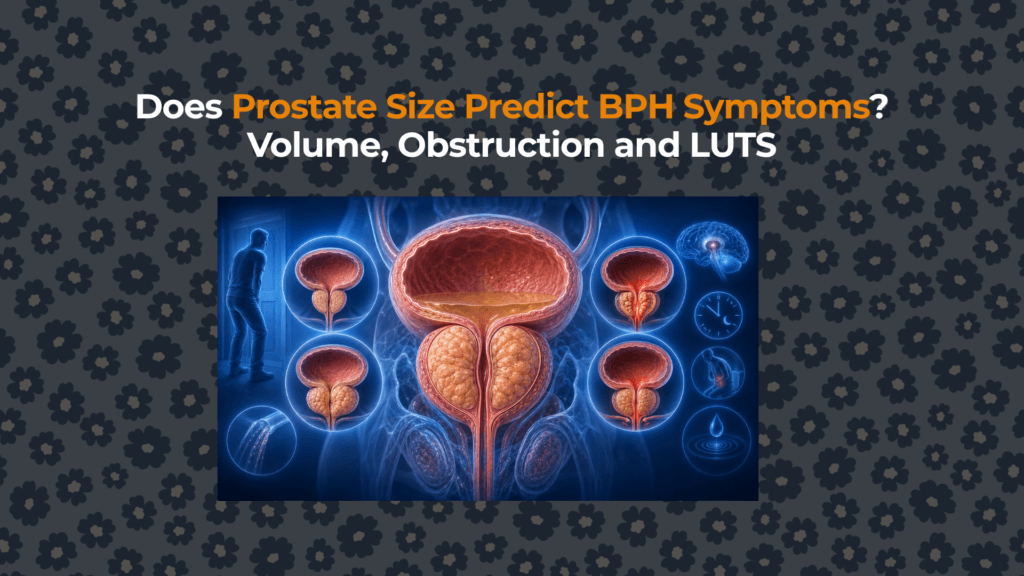
Total volume does not show where growth projects. Tissue expanding outward may increase the measured gland without substantially deforming the outlet. A median lobe or transition-zone nodule that protrudes into the bladder can create a valve-like distortion at a smaller total volume.
In the systematic review summarized by the EAU, intravesical prostatic protrusion greater than 10 mm had 0.71 sensitivity and 0.77 specificity for urodynamically determined bladder outlet obstruction. That is useful probability evidence—not a standalone diagnosis. The next article on median-lobe prostate enlargement owns this geometry in depth.
04. Dynamic Smooth-Muscle Tone Changes Resistance Without Changing Size
Prostate stroma and the bladder neck contain alpha-1 adrenergic receptors. Increased smooth-muscle tone can narrow the functional outlet without adding tissue volume; alpha-blockers may improve symptoms and flow relatively quickly without materially shrinking the gland. This dynamic component is one reason anatomy and current symptoms separate.
05. Bladder Adaptation Can Amplify or Mask the Same Outlet Load
The bladder initially may compensate for increased outlet resistance by generating more pressure. Over time, detrusor overactivity can produce urgency and frequency, while impaired contractility can cause slow flow and residual urine. Sensation and compliance also vary. Two men with similar prostate geometry can therefore report different symptoms and empty differently.
06. Storage Symptoms Often Extend Beyond the Prostate
Urgency, frequency and nocturia can reflect overactive bladder, high evening fluid intake, diuretics, sleep apnea, diabetes, edema-related nighttime diuresis or neurologic disease. Infection and bladder pathology may overlap. Voiding symptoms such as hesitancy or weak stream are also not prostate-specific.
07. Flow, Residual Urine and Pressure–Flow Testing Answer Different Questions
| Measure | What it observes | Why it may diverge from volume | Cannot prove alone |
|---|---|---|---|
| IPSS | Frequency and burden of seven LUTS | Bladder, sleep and perception contribute | BPH, enlargement or obstruction |
| Qmax | Maximum urinary flow | Depends on voided volume and detrusor strength | Cause of low flow |
| Post-void residual | Urine remaining after voiding | Obstruction and weak contraction can both raise it | BPO mechanism |
| Prostate volume | Estimated gland size | Does not encode geometry, tone or bladder response | Current symptom severity |
| Pressure–flow study | Detrusor pressure paired with flow | Directly tests functional relationship, not tissue volume | Benign prostate cause without clinical attribution |
The BPH-versus-BPO comparison explains when pressure–flow evidence changes the obstruction claim.
08. Volume Still Predicts Progression Risk and Changes Treatment Selection
Weak prediction of present symptoms does not make volume useless. The EAU states that prostate volume predicts symptom progression and complication risk and is important when choosing 5-alpha-reductase inhibitors or procedures. For example, it recommends 5-ARIs for men with moderate-to-severe LUTS and increased progression risk, using prostate volume above 40 mL as an example—not as a universal biological cutoff.
Volume is therefore better treated as a risk and treatment-modifier than as a direct meter of how bad someone should feel. The BPH clinical hub maps treatment mechanisms without turning one threshold into a prescription.
09. A Multi-Axis Clinical Profile Outperforms a Single Size Number
10. Four Size–Symptom Patterns Prevent Diagnostic Shortcuts
The prostatic-urethra anatomy shows where geometry acts. For the broader differential, continue to the urinary-health hub.