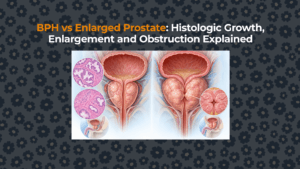
Aquablation is an image-guided surgical treatment for urinary obstruction associated with BPH and prostate enlargement. It uses a robotically controlled, high-velocity stream of sterile saline to remove selected prostate tissue through the urethra while real-time ultrasound helps the surgeon define the treatment area.
01. Aquablation: Indications, Technique and Treatment Role
What problem is Aquablation intended to treat?
Aquablation is intended to reduce urinary resistance caused by enlarged benign prostate tissue around the bladder outlet and prostatic urethra.
The prostate normally surrounds the first portion of the urethra. As tissue enlarges inward, the urinary lumen can become distorted or compressed.
This relationship is part of the broader prostate health and prostate anatomy pathway.
Prostate-related outlet obstruction can contribute to:
- a weak urine stream;
- difficulty starting urination;
- intermittent urinary flow;
- straining;
- a sensation of incomplete emptying;
- increasing residual urine;
- and episodes of urinary retention in some men.
Aquablation removes selected obstructing tissue rather than merely relaxing the prostate or temporarily retracting it.
What happens before and during Aquablation?
Before Aquablation, clinicians evaluate urinary symptoms, bladder emptying, prostate anatomy, prostate size and medical risk.
The prostate-volume assessment is important because the strongest randomized comparison with TURP is in glands between approximately 30 and 80 mL. FBU explains measurement methods in how prostate volume is measured.
Assessment may also include symptom scoring, urinalysis, urinary-flow testing, post-void residual measurement, PSA when appropriate, and cystoscopy or other testing when anatomy needs clarification.
Median-lobe configuration may also affect the shape of the planned treatment zone. The relevant anatomy is discussed in median lobe prostate enlargement and intravesical prostatic protrusion.
For the wider procedure pathway, see BPH surgery and minimally invasive procedures.
02. How Is Aquablation Performed?
Which anatomy, prostate size or disease factors affect Aquablation?
Aquablation is performed through the urethra while the prostate is visualized with transrectal ultrasound.
The surgeon maps the treatment area according to prostate shape, depth of tissue, location of the bladder neck, urethral lumen and structures that should be preserved.
A high-velocity jet of sterile saline then travels from a nozzle positioned inside the prostatic urethra and removes the mapped prostate tissue.
Current EAU guidance gives a strong recommendation for Aquablation as an alternative to TURP in men with moderate-to-severe LUTS or benign prostatic obstruction and prostate volumes of approximately 30–80 mL, particularly when preservation of ejaculation is an important goal.
Prospective WATER II data also support durable treatment of larger prostates from 80–150 mL, although the EAU notes that additional randomized trials are still needed in glands above 80 mL.
What are the main expected outcomes after Aquablation?
Aquablation can produce substantial and durable improvement in urinary symptoms, maximum urinary flow and quality of life.
In men with 30–80 mL prostates, randomized WATER trial data show long-term functional outcomes that are non-inferior to TURP.
The WATER II prospective study followed men with prostate volumes of 80–150 mL. At five years, mean International Prostate Symptom Score decreased from 22.6 before treatment to 6.8, while mean maximum urinary flow increased from 8.6 to 17.1 mL/s.
The same large-prostate study reported approximately 96.3% freedom from a secondary BPH procedure at five years.
| Evidence group | Prostate size | What the evidence shows |
|---|---|---|
| WATER randomized trial | 30–80 mL | Aquablation produced durable symptom and flow improvement comparable with TURP over long-term follow-up. |
| WATER II prospective study | 80–150 mL | Large prostates showed substantial five-year improvements in symptoms and flow with a low need for secondary BPH procedures. |
| EAU recommendation | 30–80 mL | Strong recommendation as an alternative to TURP, particularly when preservation of ejaculation is a priority. |
| Larger glands | >80 mL | Feasible and supported by prospective long-term data, but additional randomized comparative evidence is still needed. |
03. Aquablation: Outcomes, Recovery and Procedure-Specific Trade-Offs
What does recovery after Aquablation usually involve?
Aquablation is an operating-room procedure and generally requires anesthesia.
After the waterjet has removed the planned tissue, the surgical team assesses bleeding from the resection cavity.
A urinary catheter is commonly placed. Balloon pressure or light traction can help compress the prostate cavity, and electrocautery or low-powered laser treatment may be used for hemostasis when required.
EAU guidance notes that catheter removal within the first two postoperative days is commonly achievable, although actual timing depends on bleeding, urine clarity, prostate size, patient health and local practice.
During early recovery, temporary effects can include:
- blood or small clots in the urine;
- burning during urination;
- urinary urgency or frequency;
- temporary catheter dependence;
- bladder spasms;
- pelvic or urethral discomfort;
- and temporary difficulty controlling urine.
Which urinary or sexual effects should be discussed before Aquablation?
Possible complications include bleeding, blood transfusion in some cases, urinary tract infection, temporary urinary retention, urethral or bladder-neck narrowing, urinary incontinence and the need for additional BPH treatment.
One important advantage is the potential to preserve antegrade ejaculation.
Long-term evidence summarized by the EAU reports preservation of antegrade ejaculation in approximately 81–90% of men across WATER and WATER II follow-up.
This is substantially different from conventional TURP or standard HoLEP, where ejaculatory changes are common.
Preservation should not be described as guaranteed. The result depends on anatomy, treatment planning and individual response.
04. Who Is Most Likely to Be Considered for Aquablation?
How does Aquablation compare with the closest alternatives?
Aquablation is most directly compared with tissue-removing operations because it physically removes obstructing prostate tissue.
The preceding FBU treatment, Rezūm for BPH, works differently. Rezūm creates thermal injury and relies on gradual tissue resorption, whereas Aquablation removes tissue during the operation itself.
Aquablation has also been directly compared with TURP, and clinically it can also be considered alongside HoLEP when substantial outlet decompression is required.
| Feature | Aquablation | Rezūm | TURP / HoLEP |
|---|---|---|---|
| Main mechanism | Image-guided high-velocity saline removes mapped tissue. | Water-vapor thermal injury followed by gradual tissue resorption. | Electrosurgical resection or laser enucleation physically removes tissue. |
| Tissue removed immediately | Yes. | No. | Yes. |
| Imaging during treatment | Real-time transrectal ultrasound guides treatment planning. | Cystoscopic visual guidance. | Primarily direct endoscopic vision. |
| Speed of urinary improvement | Relatively rapid after postoperative swelling settles. | Gradual over weeks to months. | Relatively rapid after postoperative healing. |
| 30–80 mL evidence | Randomized comparison with TURP and strong EAU recommendation. | Strong prospective sham-controlled evidence. | Established evidence base. |
| Large prostates | Five-year prospective evidence in 80–150 mL glands. | Evidence is expanding into larger glands. | HoLEP is established across a broad range of sizes. |
| Ejaculation | Often preserved. | Generally favorable preservation profile. | Conventional TURP and standard HoLEP frequently alter ejaculation. |
| Bleeding | Requires deliberate postoperative hemostasis. | Less tissue disruption during treatment. | Depends on technique, prostate size and patient factors. |
When is Aquablation unsuitable or followed by additional evaluation?
Aquablation may not be appropriate when symptoms are not primarily caused by prostate-related obstruction, when anesthesia or operative risk is unacceptable, when urethral anatomy prevents safe transurethral access or when another procedure better matches the patient’s prostate size, anatomy and priorities.
A large prostate alone does not prove that surgery is required.
FBU explains the difference between size and clinical obstruction in prostate size, obstruction and BPH symptoms.
Poor bladder contraction is another important limitation. Aquablation can reduce resistance at the prostate outlet, but it cannot directly restore a weak detrusor muscle.
If symptoms, urinary flow and residual urine do not clearly establish the mechanism, further evaluation may be appropriate before surgery.
The complete disease and treatment pathway is covered in the BPH and enlarged prostate guide.
Summary
- Aquablation is an image-guided procedure that removes obstructing prostate tissue with a high-velocity sterile-saline waterjet.
- The instrument enters through the urethra while transrectal ultrasound allows the surgeon to map the treatment area.
- The waterjet tissue-removal phase does not generate thermal energy.
- The surgeon remains responsible for treatment planning; the robotic system executes the mapped resection rather than autonomously choosing what tissue to remove.
- Bleeding still requires active assessment and may be controlled using catheter traction, electrocautery or other hemostatic techniques.
- EAU guidance strongly recommends Aquablation as a TURP alternative for moderate-to-severe LUTS/BPO in prostates around 30–80 mL, particularly when preserving ejaculation matters.
- Prospective five-year evidence also supports durable outcomes in glands from 80–150 mL, although randomized evidence in larger prostates remains more limited.
- Five-year WATER II data showed substantial improvements in symptom scores and urinary flow, with more than 96% freedom from a secondary BPH procedure.
- Antegrade ejaculation is preserved in a high proportion of men, but preservation is not guaranteed.
- No single BPH procedure is universally best; anatomy, obstruction severity, prostate size, bleeding risk, recovery priorities and desired sexual outcomes all influence treatment selection.
Educational disclaimer: This article provides general medical education and does not recommend Aquablation or another procedure for an individual. Treatment selection requires assessment of urinary symptoms, prostate anatomy, prostate volume, bladder function, medical risk and patient priorities by an appropriately qualified clinician.
Explore the Prostate and BPH Pathway
To understand the anatomy treated during Aquablation, start with Prostate Health, Prostate Anatomy and Function, and the Prostatic Urethra.
Prostate size and procedure planning are explained further in How Prostate Volume Is Measured.
For disease and treatment context, continue through BPH and Enlarged Prostate and BPH Surgery and Minimally Invasive Procedures.
The preceding treatment in this procedure sequence is Rezūm for BPH.
Evidence Sources
- European Association of Urology. Management of Non-neurogenic Male LUTS: Aquablation.
- Bhojani N, et al. Aquablation Therapy in Large Prostates (80–150 mL): Final WATER II 5-Year Clinical Trial Results. Journal of Urology.
- Gilling P, et al. Five-Year Outcomes for Aquablation Therapy Compared With TURP: WATER Randomized Trial.
- U.S. Food and Drug Administration. AQUABEAM Robotic System — 510(k) K253211, 2026.