
Uncircumcised Penis: Anatomy, Sensitivity, and Care (A Functional Guide)
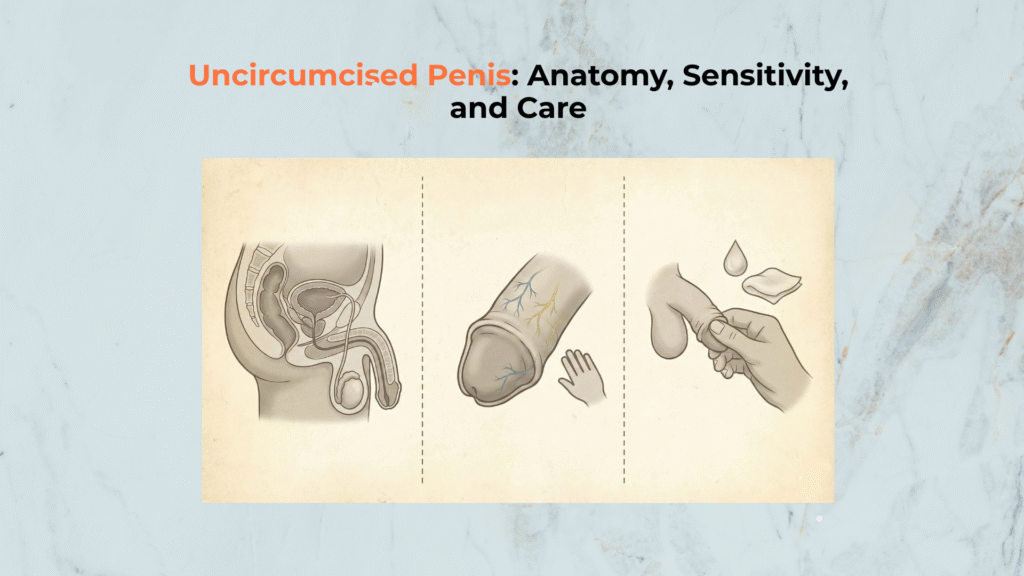
The uncircumcised penis represents the default human integumentary status, characterized by an intact prepuce (foreskin) that provides a movable mucosal sheath and specialized gliding mechanics.
An Integumentary Status refers to the condition of the skin and associated membranes. In the context of the uncircumcised penis, this implies a dual-layer system where the outer skin transitions into an internal mucosal epithelium. This guide details the gliding friction mechanism, explains the role of Meissner’s corpuscles in sensitivity, and provides safe sub-preputial maintenance protocols for adults and children.
Important Medical Disclaimer
This guide is for educational purposes only. If the foreskin becomes trapped behind the glans, swollen, or painful, seek emergency medical care immediately, as this may indicate paraphimosis [3,5].
Uncircumcised Anatomy: At a Glance
- 1 Is it the standard? Yes, it is the global anatomical standard (~63%).
- 2 Primary Benefit: Utilizes Gliding Friction and Autolubrication to reduce surface drag.
- 3 Care Rule: Requires daily Sub-Preputial Maintenance (retraction and cleaning).
- 4 Child Safety: Never force retraction in babies or young boys.
Why Is the Uncircumcised Penis Biomechanically Significant for Gliding Friction?
The uncircumcised penis is biomechanically significant for Gliding Friction because its intact Integumentary Status enables a unique movement mechanism that tends to reduce direct surface drag.
Global Prevalence and Anatomical Standard
The uncircumcised status remains the global anatomical standard, representing the default integumentary status for approximately 61% to 63% of the world’s male population [1,2].
| Status Category | Estimated Global Prevalence | Primary Functional Feature |
|---|---|---|
| Uncircumcised Penis | ~61% – 63% | Mucosal Gliding Surface (Autolubrication) |
| Circumcised Penis | ~37% – 39% | Glans Keratinization (External Lubrication emphasis) |
Circumcision comparison: To understand how gliding friction differs when the prepuce is removed, see the circumcised penis anatomy and friction model .
How the Prepuce Creates Functional Gliding Mechanics
The uncircumcised penis creates functional Gliding Friction through the dynamic movement of the prepuce, which provides a natural, low-friction mucosal sheath. The movable sheath can reduce surface drag by allowing skin layers to move independently during intromission.
Biomechanical models suggest this rolling action may amplify sensory input by stimulating internal mucosal nerves [12,13].
What Anatomical Structures Define the High Sensitivity?
The high sensitivity of the uncircumcised penis is defined by a concentration of specialized nerve endings, such as Meissner’s Corpuscles, and the protection of the mucosal epithelium.
Specialized Nerve Endings and Protected Tissues
Anatomical structures contributing to sensitivity include the highly innervated inner prepuce and the naturally protected glans surface. The Mucosal Epithelium is the delicate tissue lining the inner foreskin and glans, distinct from standard skin [12]. Histology confirms Meissner’s Corpuscles (light touch receptors) are abundant in prepuce tissue [13,15].
| Anatomical Zone | Tissue Composition | Primary Mechanical Feature |
|---|---|---|
| Inner Prepuce | Mucosal Epithelium | High concentration of Meissner’s Corpuscles. |
| Frenulum | High Vascular/Nerve bundle | Primary tactile focus for many individuals. |
| Glans Surface | Mucosal Epithelium | Protected from keratinization; maintains Tactile Acuity. |
Which Hygiene and Pathological Risks Dictate Maintenance Protocols?
Hygiene and pathological risks for the uncircumcised penis are managed through consistent sub-preputial maintenance to prevent microbial growth and mitigate the risk of Phimosis/Paraphimosis.
Pediatric vs. Adult Care Protocols
Hygiene protocols differ significantly by age; forcing retraction in infants can cause scarring, pain, and medical complications [6,7,8].
CRITICAL SAFETY INSTRUCTION (CHILDREN):
Do not force back the foreskin of a baby or young boy. Retraction often occurs naturally later in childhood. Forcing it can cause damage [6,8].
Tight foreskin risk: If the foreskin does not retract comfortably or causes pain, review the clinical criteria in tight foreskin (phimosis type) .
Adult Hygiene: Adults should perform daily gentle retraction and cleaning with warm water; if soap is used, it should be mild and non-perfumed [9,10,11].
Inflammation & hygiene: Recurrent redness or soreness may reflect inflammatory changes explained in balanitis (foreskin-related inflammation) .
When to See a Doctor (Emergency Triage)
Seek professional medical evaluation if you experience persistent pain, severe swelling, or if the foreskin becomes trapped in a retracted position.
Red Flags Requiring Urgent or Specialist Consultation
Inability to pull the foreskin forward over the glans after retraction is a sign of Paraphimosis, which requires urgent medical intervention [3,5]. Clinical guidelines also identify Balanitis (inflammation) and Phimosis (inability to retract) as conditions requiring professional evaluation [3,9,10].
MEDICAL EMERGENCY
Seek immediate medical care if the foreskin is stuck behind the glans and becomes painful or swollen; this is a medical emergency known as paraphimosis [3,5].
Emergency triage: A foreskin trapped behind the glans with swelling indicates an emergency—see paraphimosis impact and urgent management .
How to Optimize Functional Glide Mechanics
Functional Glide Mechanics of the uncircumcised penis are optimized by employing slow, full-excursion movements that maximize the rolling motion of the mucosal sheath.
Positional strategies like the Coital Alignment Technique (CAT) may maximize sheath movement and natural autolubrication [12]. Prioritize slow, deep thrusts rather than rapid, shallow pulsing to allow the skin to complete its full gliding excursion.
| Strategy | Effectiveness | Mechanical Rationale |
|---|---|---|
| Full Piston Stroke | Optimal | Maximizes the full rolling movement of the sheath. |
| Shallow Pulsing | Medium/Low | Reduces the time needed for the skin to complete the glide. |
| CAT Position | Very High | Maximizes Gliding Friction and sensory amplification. |
Frequently Asked Questions
Is the uncircumcised penis more sensitive than a circumcised one?
While individual sensitivity varies, the uncircumcised penis retains the prepuce, which contains a high concentration of fine-touch receptors (Meissner’s corpuscles) and keeps the glans moist and non-keratinized. This anatomical difference suggests a distinct sensory profile, though subjective experience is personal.
What is the white substance that collects under the foreskin?
This is called smegma. It is a natural substance produced by the body to lubricate the glans and facilitate the gliding mechanism. It is not a sign of infection or “dirtiness,” but it should be rinsed away gently during daily hygiene to prevent build-up.
At what age should a child’s foreskin retract?
There is no fixed age. For many boys, the foreskin remains non-retractable (adhered to the glans) for several years after birth. This is normal. It may separate naturally anywhere from age 3 to puberty. Never force retraction in a young child.
Do I need special soap for hygiene?
No. In fact, strong soaps or shower gels can irritate the delicate mucosal epithelium of the glans and inner foreskin. Warm water is often sufficient. If soap is used, it should be mild, unscented, and specifically designed for sensitive skin.
Conclusion: Sustaining Integrated Care and Function
The final protocol for the uncircumcised penis synthesizes anatomical awareness, the principle of Gliding Friction, and the necessity of age-appropriate sub-preputial maintenance. Respecting the intact integumentary status is the key to mastering default human mechanics.
Talking to Your Partner: Key Sentences
- “Because my shape uses a gliding motion, let’s try starting slow so we can find the best rhythm.”
- “I’m focusing on comfort first; let me know if you’d like to try more lubrication.”
Final Care Checklist
References
- Elsayed B, et al. Global prevalence of male circumcision. PLOS ONE 2024.
- UNAIDS. Male circumcision: global trends and determinants.
- MSD Manual (Professional). Phimosis and Paraphimosis overview.
- StatPearls (NCBI). Paraphimosis management update.
- Cleveland Clinic. Paraphimosis symptoms and urgent care.
- NHS. Tight foreskin (phimosis) and child care.
- nidirect. Tight foreskin (phimosis/paraphimosis) parent guide.
- Royal Children’s Hospital Melbourne. The penis and foreskin.
- NHS. Balanitis causes and cleaning guidance.
- StatPearls (NCBI). Balanitis 2024 update.
- Cleveland Clinic. Smegma definition and prevention.
- Taylor JR, et al. The prepuce: specialized mucosa. Br J Urol 1996.
- Cox G, Morris BJ. Histological correlates of penile sensation. PMC.
- Dinh MH, et al. The role of the foreskin and keratinization. PMC.
- Dinh MH, et al. Keratin thickness in foreskin. PLOS ONE.


2 Responses