
Downward-Angled Erection Penis: Causes, Concerns, and Sexual Implications (Anatomical Guide)
The Downward-Angled Erection is an anatomical variation defined by a shaft that points downwards (ventral curvature), resulting from relative laxity in the Suspensory Ligament, which provides a mechanical advantage for posterior wall stimulation.
The defining downward trajectory of this erection type originates from the behavior of the penile ligament system, particularly when suspensory fibers exert reduced upward tension against the pubic symphysis. Specifically, the Suspensory Ligament Complex (SLC) functions as a tether; when this ligament is longer or more elastic ("laxity"), it exerts less upward tension on the Corpora Cavernosa, allowing gravity and ventral tissue weight to dictate the angle. This is not a defect but a structural variation.
In comparative context, this ventral orientation contrasts with the anterior targeting seen in a pronounced upward-angled erection, highlighting how erection angle redistributes stimulation zones rather than determining performance quality. While upward angles target the anterior wall (G-Spot), the downward angle naturally aligns with the Rectovaginal Septum, optimizing depth without requiring extreme pelvic tilt.
Action: Identify if your angle creates a "Posterior Targeting" effect to leverage the correct positions (Prone/Rear-Entry).
Why Is the Downward-Angled Erection Biomechanically Significant?
The Downward-Angled Erection is biomechanically significant because its descending trajectory dictates the natural stimulation vector, optimizing contact with the Posterior Fornix.
How to Interpret the Prevalence of the Downward-Angled Erection
Interpreting the prevalence of the Downward-Angled Erection confirms it is a common variation, representing a significant segment of the general population. This angulation is a result of ligamentous equilibrium where the Suspensory Ligament Complex (SLC) permits the shaft to separate further from the abdominal wall.
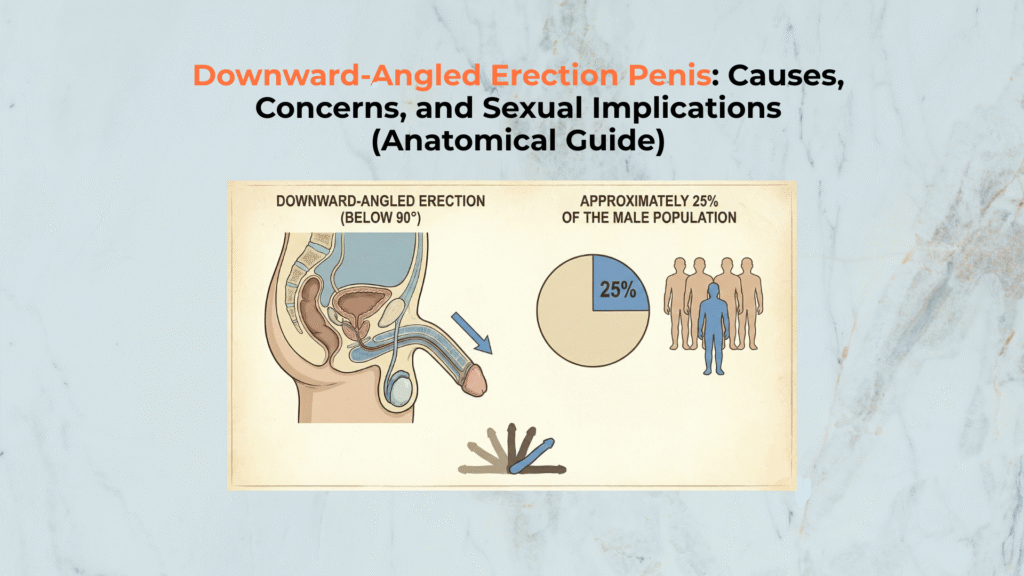
Modern photogrammetric studies confirm that the Downward-Angled Erection (below 90°) appears in approximately 25% of the male population. This frequency establishes the angle as a natural, non-pathological phenotype. Importantly, a stable downward angle caused by ligamentous anatomy must be distinguished from acquired deformity; when curvature becomes progressive, painful, or asymmetric, clinicians evaluate for fibrotic conditions such as Peyronie’s disease rather than normal morphological variation.
| Erection Angle Category | Estimated Prevalence | Anatomical Cause |
|---|---|---|
| Horizontal (90°) | ≈ 15% | Ligamentous Equilibrium (Balanced tension). |
| Upward-Angled (>90°) | ≈ 50% | High tension (Short Ligament). |
| Downward-Angled (<90°) | ≈ 25% | Low tension (Long Suspensory Ligament). |
| Lateral/Curved | ≈ 10% | Asymmetrical Corpora Cavernosa or Peyronie's. |
How Does the Downward-Angled Erection Optimize Sexual Compatibility?
The Downward-Angled Erection optimizes sexual compatibility by offering a mechanically advantageous vector for deep entry in prone positions. The descending trajectory dictates the natural stimulation vector, concentrating force along the Rectovaginal Septum.
Kinematic analysis confirms that the descending trajectory naturally targets the Posterior Vaginal Wall, avoiding direct friction on the sensitive urethral tissues. This makes the anatomy a natural Posterior Targeting Tool.
- Posterior Targeting: Naturally hits the deeper, less sensitive posterior zones.
- Cervical Avoidance: Often slides under the cervix in missionary, preventing collision pain.
- Rear-Entry Geometry: Perfect vector alignment for Prone Positioning.
What Anatomical Factors Create the Downward-Angled Erection?
Anatomical factors creating the Downward-Angled Erection are a combination of ligamentous laxity in the SLC and the natural weight of engorged tissue. Once rigidity is achieved, this angle is mechanically expressed through the way arterial inflow and venous restriction interact during tumescence, a process governed by normal flaccid-to-erect blood-flow dynamics rather than muscular control.
How Ligament Tension Defines the Downward-Angled Erection
Ligament tension defines the Downward-Angled Erection by allowing the penile shaft to hang lower due to a longer insertion point from the pubis. The angle is determined by the length-tension relationship of the deep Suspensory Ligament Proper anchoring the corpora to the Pubic Symphysis.
Anatomical findings confirm that a relaxed Suspensory Ligament allows the penile shaft to hang lower, creating a ventral angle relative to the Pubic Symphysis. Stable downward alignment depends on symmetrical expansion of the paired erectile chambers, meaning the corpora cavernosa must inflate evenly to preserve a predictable ventral vector instead of drifting laterally. Internally, shape stability is reinforced by connective scaffolding elements such as intracavernosal struts, which limit ballooning and help maintain a consistent downward orientation under axial load.
| Anatomical Structure | Role in Erection | Contribution to Downward Angle |
|---|---|---|
| Suspensory Ligament | Anchors penis to Pubic Symphysis. | Laxity: Longer fibers allow a lower resting angle. |
| Corpora Cavernosa | Fill with blood for rigidity. | Ventral Weight: Heavy engorgement can increase the downward droop. |
| Skin Elasticity | Surface tension. | Dorsal Laxity: Loose skin on top permits the downward slope. |
How to Measure the Severity of the Downward-Angled Erection
Measuring the severity of the Downward-Angled Erection involves establishing the angle of deviation from the horizontal plane (90°). The measurement requires establishing the vertical body axis and the angle formed by the dorsal surface of the rigid penis.
Clinical measurement standards define a Downward-Angled Erection as any angle greater than 95° from the abdominal wall (where 0° is the stomach).
- Stand upright to establish the Vertical Body Axis.
- Achieve full tumescence.
- Determine if the angle falls below the horizontal plane (pointing towards the feet).
How Does the Friction Profile Compare to Upward Types?
The Downward-Angled Erection friction profile compares to upward types by concentrating pressure on the Rectovaginal Septum rather than the G-Spot region. The descending vector ensures that the mechanical load focuses on the floor of the canal, avoiding the roof.
This expansion is mechanically contained by the surrounding fibrous envelope, where the tensile properties of the tunica albuginea distribute intracavernosal pressure and prevent unwanted bending during full rigidity. Unlike the Upward-Angled Erection which targets the G-Spot, the Downward-Angled Erection focuses friction on the Rectovaginal Septum providing deep pressure sensation. This distinction is vital for optimizing partner satisfaction based on anatomical preference.
Which Sexual Scenarios Best Leverage the Downward-Angled Erection?
Sexual scenarios that best leverage the Downward-Angled Erection are those that utilize prone positioning for optimal vector congruence.
Why Does the Downward-Angled Erection Excel in Rear-Entry Positions?
The Downward-Angled Erection excels in rear-entry positions because the geometry naturally matches the pelvic alignment of the receiving partner in the prone position. The Downward-Angled Erection's geometry aligns perfectly with the horizontal axis of the vaginal canal in prone positions.
The geometry of the Downward-Angled Erection matches the pelvic tilt of Doggy Style, creating a perfectly aligned insertion vector. This Vector Congruence drastically reduces the risk of buckling or lateral strain.
- Vector Congruence: The penis points exactly where the vaginal/anal canal opens in prone positions.
- Deep Access: Allows for maximum depth without bending the shaft.
How Does the Downward-Angled Erection Dictate Depth Strategy?
The Downward-Angled Erection dictates depth strategy by naturally guiding the shaft toward the deep Posterior Fornix. This angle allows the shaft to bypass the cervix to achieve 'Deep Spot' stimulation, concentrating pressure on the Rectovaginal Septum.
The downward vector of the Downward-Angled Erection allows it to slide into the Posterior Fornix, bypassing the cervix to achieve 'Deep Spot' stimulation. The deepest strokes should be executed in prone positions to maximize this functional advantage.
How Do Advanced Techniques Optimize the Downward-Angled Erection?
Advanced techniques optimize the Downward-Angled Erection by solving the positional incompatibility risk posed in supine scenarios.
How to Modify Missionary Position
Modifying the missionary position for the Downward-Angled Erection requires tilting the partner's pelvis to realign the entry vector. The primary goal is to use physical aids to overcome the anatomical opposition that causes the slipping or "pop-out" problem.
Placing a pillow under the partner's hips tilts the pelvic inlet upward, aligning it with the Downward-Angled Erection vector. Leaning forward during entry also helps to simulate a more horizontal entry angle.
Alignment Checklist:
How to Execute "The Deep Glide"
Executing "The Deep Glide" with a Downward-Angled Erection utilizes the natural vector for sustained, deep stimulation. This technique leverages the angle's natural tendency to glide deep along the Rectovaginal Septum floor.
Sexological advice suggests the use of long, slow strokes (the "Deep Glide") is superior to short, rapid strokes for this morphology. The motion should maximize pressure against the Posterior Fornix. During thrusting and positional changes, sensory feedback transmitted through the dorsal nerve of the penis refines motor control, allowing the shaft to maintain alignment despite movement and resistance.
- Enter from a rear position (Doggy/Prone).
- Use long, slow strokes to utilize the full length.
- Angle slightly downward to press against the floor of the canal.
How Can the Downward-Angled Erection Checklist Ensure Mechanical Advantage?
The Downward-Angled Erection checklist ensures mechanical advantage by systematizing the positional adjustments required for this anatomy.
What Are the Mechanical Advantages?
The mechanical advantages of the Downward-Angled Erection include superior access to the posterior wall and the deepest parts of the canal. The angle offers Vector Congruence in prone positions and reduces risk of cervical collision in supine positions.
Clinical literature affirms that the downward angle is considered the "Doggy Style Specialist" due to its near-perfect alignment with the axis of the vaginal canal in that position. Understanding these advantages reframes the morphology as an asset.
- Posterior Targeting
- High Comfort in Doggy Style
- Deep Access
Optimization Checklist
Completing the optimization checklist for the Downward-Angled Erection ensures the user masters its functional potential. The checklist serves as the final T-Layer Execution tool, consolidating all positional and functional knowledge.
Mastery Protocol:
Conclusion
In conclusion, the Downward-Angled Erection is a powerful anatomical variation dictated by ligament laxity that provides a clear biomechanical advantage for posterior wall stimulation and deep prone positioning.
Success is achieved by understanding Vector Congruence and utilizing the correct Positional Strategies, overriding any cultural myth that upward angulation is superior. At FactBasedUrology, we teach that every anatomy possesses its own unique biomechanical advantage.
Your Downward-Angled Erection is a Biomechanical Specialist for deep, targeted connection.



One Response