
What Is the Anatomical Relationship Between the Corpus Spongiosum and the Urethra?
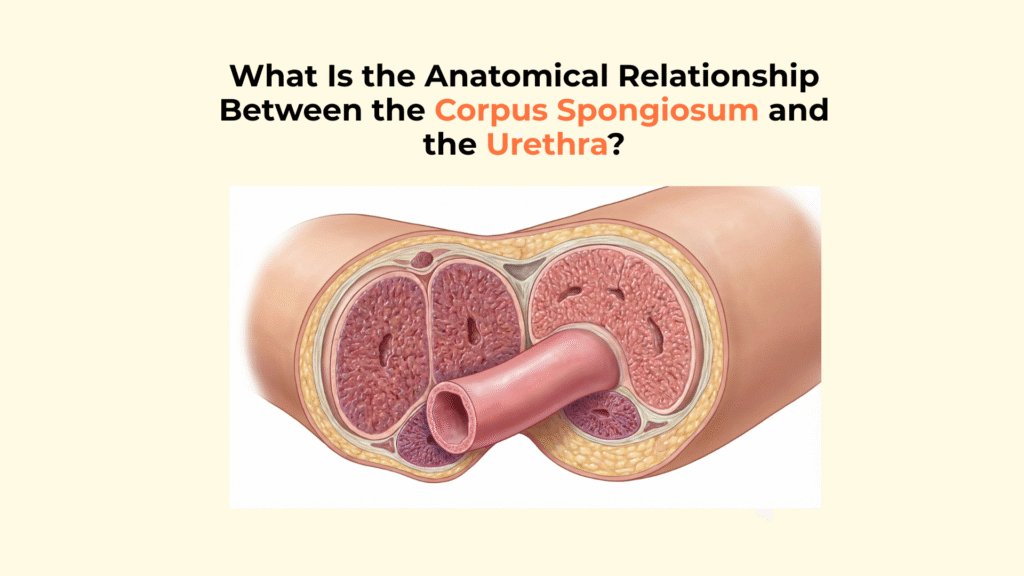
The anatomical relationship between the corpus spongiosum and the urethra is one of complete encapsulation, where the spongy vascular tissue forms a protective, low-pressure sleeve around the penile urethra to maintain its open state (patency) during erection and ejaculation.
Without this specific “tube-within-a-tube” structural design, the high internal pressures required for a rigid erection would compress the urethra against the tunica albuginea, effectively crushing it and making ejaculation impossible.
This guide details the structural architecture of this relationship, explaining how the corpus spongiosum acts as a vascular cushion, a hydraulic aid for ejaculation, and a protective barrier for the urethra.
Important Medical Disclaimer: This information is for educational purposes only and is not a substitute for professional medical advice, diagnosis, or treatment. Consult with a qualified healthcare provider regarding any medical condition or concerns about your health.
Key Anatomical Facts: Spongiosum & Urethra
- The Architecture: The corpus spongiosum completely encircles the penile urethra, forming a “concentric cylinder.”
- The Purpose: Its primary role is to cushion the urethra against the high pressure of the adjacent corpora cavernosa.
- The Glans: The glans penis is the distal expansion of the spongiosum, capping the end of the penis to protect the urethral meatus.
- Ejaculation: Rhythmic contractions compress the spongiosum, helping to “milk” semen through the urethra.
- Pathology: Scarring of the spongiosum (spongiofibrosis) directly constricts the urethra, causing a stricture.
How Does the Corpus Spongiosum Anatomically Encase the Urethra?
The corpus spongiosum anatomically encases the urethra by forming a concentric vascular cylinder around the tube, extending from the bulb at the base to the glans at the tip.
The “Concentric Cylinder” Architecture
Geometrically, the corpus spongiosum does not merely sit adjacent to the urethra; it fully encircles the spongy urethra (penile urethra), acting as a vascular sleeve. It surrounds the urethral tube roughly centrally—though often slightly eccentric ventrally—throughout the entire length of the penile shaft.
You can visualize this anatomical relationship like the insulation around an electrical wire. The urethra is the central wire, and the corpus spongiosum is the thick layer of protective material wrapping around it.
This architecture separates the urethral mucosa from the denser, more rigid tissues of the penile shaft, providing a compliant buffer zone essential for biological function.
3D Scientific Education: The Concentric Cylinder Model
To truly understand the protective function of the corpus spongiosum, we must visualize it in three dimensions. It is not merely a “strip” of tissue running along the bottom of the penis; it is a complete, 360-degree vascular cylinder.
The Distal Expansion (The Glans Penis)
As this anatomical relationship reaches the distal end of the penis, the corpus spongiosum expands outward in a mushroom-like shape to form the glans penis, which caps the ends of the corpora cavernosa.
Within this expansion, the urethra widens to form the fossa navicularis before exiting at the external urethral meatus. This structure serves a vital protective role: the distal expansion of the spongiosum creates a soft, vascular buffer that cushions the exit point of the urethra, protecting the meatus during penetrative impact.
Why Is This Anatomical Relationship Critical for Urethral Patency?
This anatomical relationship is critical for urethral patency (staying open) because the corpus spongiosum acts as a low-pressure cushion that prevents the rigid, high-pressure corpora cavernosa from crushing the urethra during an erection.
The “Cushioning Effect” During Erection
During an erection, the adjacent corpora cavernosa become rigid, high-pressure cylinders (>100 mmHg), creating a compressive force that would occlude the urethra without protection. However, the corpus spongiosum functions differently. While it engorges with blood, it remains at a significantly lower pressure—typically one-third to one-half of the cavernosa pressure—due to its distinct venous drainage and thinner tunica albuginea. This pressure differential is the key to function: the spongy tissue surrounding the urethra absorbs the compressive forces from the rigid cavernosa, keeping the urethral lumen open (patent) for ejaculation. (Source: NCBI – Penile Hemodynamics)
The “Hydraulic Sleeve” Mechanism
During ejaculation, the corpus spongiosum functions as a “hydraulic sleeve,” transmitting the rhythmic contractions of the bulbospongiosus muscle directly to the urethra. Because the tissue is fluid-filled and encases the tube, external muscle contractions at the base of the penis create a wave of pressure. This pressure is transmitted through the spongy tissue to the urethral wall, helping to expel semen in a “milking” action. This ensures efficient expulsion despite the length of the male urethra.
Comparison: Urethral Segments and Spongiosum Coverage
| Urethral Segment | Spongiosum Relationship | Vulnerability |
|---|---|---|
| Prostatic Urethra | Absent (Surrounded by Prostate) | Protected by Prostate |
| Membranous Urethra | Absent (Passes through Pelvic Floor) | Vulnerable to trauma/shearing |
| Spongy (Penile) Urethra | Fully Encased | Protected by Spongiosum; Prone to stricture |
The Bulb of the Penis (The Entry Point)
The urethra enters the corpus spongiosum at the bulb of the penis, the proximal, widened base of the tissue anchored to the perineum.
The urethra pierces the superior surface of the bulb to begin its journey through the spongy tissue. This is a common site for traumatic injury (straddle injury) because the urethra transitions from being fixed to being mobile at this point. Impact here can crush the corpus spongiosum against the pubic bone, damaging the relationship between the vascular tissue and the urethral lining.
How Do Defects in This Anatomical Relationship Affect Function?
Defects in the relationship between the spongiosum and urethra, such as developmental failures (hypospadias) or scarring (strictures), directly compromise urinary and sexual function.
Hypospadias (Developmental Failure)
Hypospadias is a congenital defect caused by a failure of the urethral folds to close completely, leaving the urethra to exit ventrally (underneath) the shaft rather than at the tip. This condition disrupts the standard encapsulation. It is often accompanied by a malformed or absent corpus spongiosum distal to the opening, which can cause curvature (chordee) and leave the urethra unprotected. (Source: CDC – Hypospadias)
Urethral Strictures (Scarring of the Relationship)
Urethral strictures occur when trauma or infection causes spongiofibrosis, a process where the spongy tissue of the corpus spongiosum becomes scarred and inelastic. In healthy anatomy, the spongiosum is elastic and compliant. When spongiofibrosis occurs, the scar tissue contracts, constricting the concentric relationship, narrowing the urethral lumen and blocking flow. This turns the protective sleeve into a restrictive tourniquet. Learn more about how this scarring affects flow at our Urethral Stricture Knowledge Hub.
Summary and Resources
[Checklist] Verifying the Spongiosum-Urethra Relationship
- Encapsulation: Is the urethra fully surrounded by spongy tissue in the shaft?
- Pressure Gradient: Is the spongiosum recognized as lower pressure to maintain the urethral opening?
- Distal Protection: Is the Glans identified as the spongiosum’s protection for the urethral exit?
- Proximal Entry: Is the Bulb identified as the entry point of the urethra into the spongiosum?
- Vascular Support: Does the spongiosum provide the blood supply to the urethral epithelium?
Glossary of Anatomical Terms
| Term | Definition |
|---|---|
| Corpus Spongiosum | The cylinder of erectile tissue that surrounds the urethra and expands to form the glans penis. |
| Urethra | The tube that carries urine and semen out of the body. |
| Urethral Patency | The state of the urethra being open and unobstructed. |
| Spongiofibrosis | Scarring of the corpus spongiosum tissue, often leading to urethral stricture. |
| Fossa Navicularis | The widened section of the urethra located within the glans penis. |
| Bulbospongiosus Muscle | The muscle surrounding the bulb of the penis that contracts to expel fluid from the urethra. |
Conclusion
In conclusion, the anatomical relationship between the corpus spongiosum and the urethra is a specialized “tube-within-a-tube” design that ensures the urinary and reproductive channel remains protected, vascularized, and open, even under the extreme pressures of an erection.
By maintaining a lower pressure than the neighboring corpora cavernosa, the spongiosum guarantees that the urethra is not crushed during sexual activity.
At Factbasedurology, we believe that precise anatomical knowledge is the foundation for understanding male health. This elegant biological engineering ensures that function follows form.

2 Responses