
What Is the Penile Corona and Frenulum? An Anatomical Guide
The penile corona is the rounded ridge at the base of the glans penis, while the penile frenulum is the sensitive band of tissue connecting the glans to the foreskin on its underside; both are key anatomical landmarks for sensation and function.
Understanding the specific anatomy of the penile corona and penile frenulum is key for understanding sexual health, sources of pleasure, and distinguishing normal physical variations from conditions that might require attention.
This guide provides a detailed, medically accurate explanation of the ‘penile corona’ and ‘penile frenulum,’ detailing their structure, function, common conditions, and best practices for health.
This guide offers a focused look at the visible external anatomy of the penis—including the shaft, glans, meatus, and foreskin. For a broader anatomical overview, refer to our complete penile anatomy breakdown.
Key Takeaways on the Corona and Frenulum
- Penile Corona: This is the rounded ridge or “crown” that separates the glans (head) from the shaft of the penis.
- Penile Frenulum: This is the highly sensitive, elastic band of tissue on the underside of the penis that connects the glans to the foreskin.
- Common Concerns: A common condition on the corona is Pearly Penile Papules (PPPs), which are harmless. A common condition of the frenulum is Frenulum Breve (a short frenulum), which can cause pain or tearing.
- Primary Function: Both structures are densely packed with nerve endings and are critical for sexual sensation.
What Is the Penile Corona and What Is Its Function?
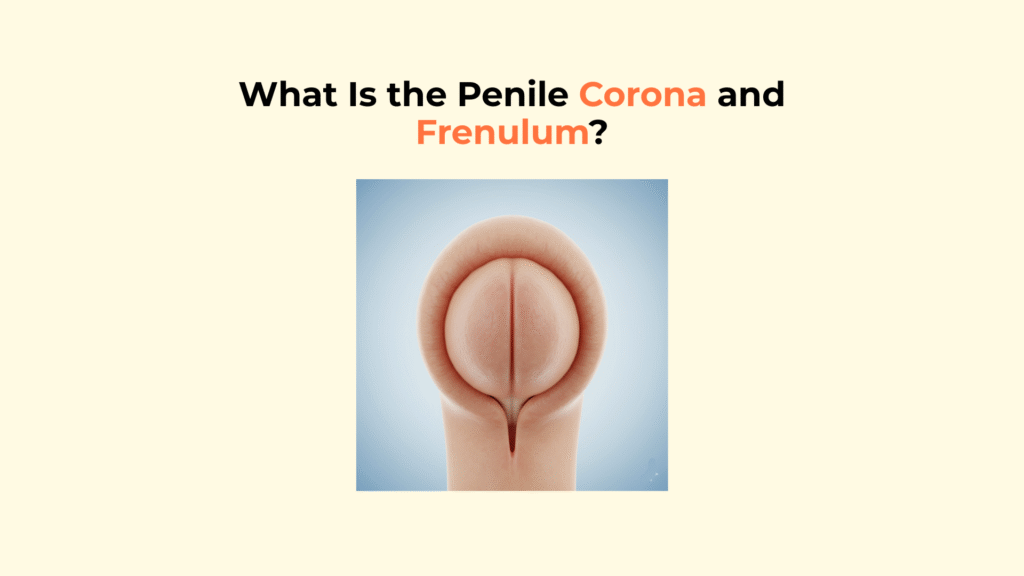
The penile corona, or corona glandis, is the rounded ridge or “crown” located at the base of the glans penis, serving as a distinct anatomical boundary and a key site of sexual sensation. It forms a visible border that separates the sensitive, bulbous head of the penis (the glans) from the longer shaft.
The corona forms the base of the glans penis (head of the penis), creating a natural ridge that enhances sensation.
The function of the penile corona is twofold and centered on sensation:
- Heightened Sensation: It is one of the most nerve-rich areas of the penis. The corona is densely populated with specialized sensory receptors that make it exceptionally sensitive to touch and stimulation.
- Physical Stimulation: The raised edge of the penile corona can create friction during intercourse, contributing to pleasurable sensations for both partners.
What Is the Penile Frenulum and What Is Its Function?
The penile frenulum is the small, elastic band of tissue located on the underside (ventral aspect) of the penis, connecting the foreskin to the glans, and functions as a highly sensitive erogenous zone. It originates just below the opening of the urethra and runs down to attach to the inner layer of the foreskin.
Just above the frenulum lies the urethral meatus (penile opening), which serves as the exit for urine and semen.
This structure is often referred to by its common nickname, the “banjo string.” It is given this name due to its taught, string-like nature when the foreskin is retracted, similar to the string on a musical instrument.
The penile frenulum serves critical functions in both sensation and mechanics:
- Intense Sensitivity: It is a powerful erogenous zone with an exceptionally high concentration of nerve endings. For many individuals, the frenulum is considered one of the most sensitive parts of the penis.
- Foreskin Mechanics: In uncircumcised individuals, the penile frenulum helps guide the movement of the foreskin, allowing it to retract correctly and comfortably over the glans penis.
The frenulum assists the foreskin (prepuce) in retracting smoothly over the glans, maintaining comfort and sensitivity.
What Are Common Conditions That Affect the Corona and Frenulum?
Common conditions affecting these structures are specific to each part: the penile corona is the site of Pearly Penile Papules (PPPs), a harmless variation, while the frenulum can be affected by Frenulum Breve, a condition of tightness.
What Are Pearly Penile Papules on the Penile Corona?
Pearly Penile Papules (PPPs) are a common and completely harmless anatomical variation characterized by small, dome-shaped, skin-colored bumps, often appearing in one or more rows around the corona of the glans.
It is critical to understand that PPPs are not a Sexually Transmitted Infection (STI). They are not contagious, are not caused by sexual activity, and are not related to hygiene. They require no medical treatment.
Pearly Penile Papules are very common, affecting an estimated 8% to 48% of men, typically appearing after puberty. (Source: DermNet NZ)
What Is a Frenulum Breve (Short Frenulum)?
Frenulum breve is an anatomical condition where the penile frenulum is shorter or tighter than typical, which can restrict the normal retraction of the foreskin, leading to pain or tearing during an erection.
This tightness can result in a “short frenulum pain,” a pulling sensation during intercourse, or discomfort. In some cases, the tension can be high enough to cause a frenulum tear, which can be painful and may bleed.
For mild cases, stretching exercises may be suggested. For symptomatic cases, common solutions include a minor surgical procedure called a “frenuloplasty,” which lengthens the frenulum to relieve tension and resolve the issue. (Source: NCBI)
In cases where the frenulum is unusually short or tight, the condition is known as frenulum breve (short frenulum condition).
What Are Best Practices for Corona and Frenulum Health?
Best practices for penile corona and frenulum health primarily involve gentle, regular hygiene and seeking prompt medical attention if specific symptoms like tearing or persistent pain arise.
How Should You Clean the Corona and Frenulum?
Proper cleaning of the corona and frenulum involves gentle washing with warm water, which is particularly important for uncircumcised individuals who must retract the foreskin daily.
This allows for cleaning underneath the foreskin, removing any potential buildup of smegma (a natural secretion of oils and dead skin cells).
It is best to use only warm water or, if necessary, a very mild, unscented soap. Harsh soaps or vigorous scrubbing should be avoided, as they can strip natural lubrication and cause irritation to these sensitive areas.
When Should You See a Doctor About the Corona or Frenulum?
You should see a doctor if you experience specific symptoms related to the corona or frenulum, such as tearing, persistent pain, unusual growths, or signs of infection.
Consult a healthcare provider for any of the following:
- Tearing of the frenulum that bleeds significantly or causes intense pain.
- Persistent pain or a restrictive pulling sensation during erection (potential Frenulum Breve).
- Any unusual discharge, sores, blisters, or persistent redness/inflammation on or around the corona or frenulum.
- Any new growths or bumps on the corona that change in size/appearance (to confirm they are harmless PPPs and not an STI).
Persistent redness or inflammation around the corona may indicate balanitis (inflammation of the glans and corona), which requires medical evaluation.
What Are the Key Differences Between the Corona and Frenulum?
The key differences between the penile corona and frenulum lie in their specific location, primary anatomical role, and the common concerns associated with each.
| Feature | Penile Corona | Penile Frenulum |
|---|---|---|
| Location | The ridge/crown at the base of the glans | Underside of the penis, connecting foreskin to glans |
| Primary Role | High sensation, physical border | Intense pleasure, assists in foreskin retraction |
| Common Concern | Pearly Penile Papules (Harmless variation) | Frenulum Breve (Shortness, potential for tearing) |
| Sensitivity | Very High | Extremely High |
Conclusion: Key Sensory Components of Penile Anatomy
In conclusion, the penile corona and frenulum are distinct but equally important anatomical structures, both characterized by high nerve density and playing critical roles in sexual sensation and function.
They are normal, highly sensitive parts essential for sexual function. Understanding their specific roles helps distinguish normal variations (like PPPs) from conditions that might require a doctor’s attention (like symptomatic Frenulum Breve or frenulum tears).
Familiarity with your anatomy is the best tool for identifying what is normal for you and knowing when to seek care. At Factbasedurology, we believe that precise anatomical knowledge is the foundation of body confidence and health.
For a visual breakdown of structures beneath the glans, see our corpora cavernosa anatomy page, which explains erectile function at a structural level.
Glossary of Clinical Terms
To ensure full clarity, this glossary defines the key anatomical terms used throughout this guide.
| Term | Definition |
|---|---|
| Penile Corona | The rounded ridge or “crown” at the base of the glans (head) that separates it from the shaft. |
| Penile Frenulum | The small, elastic band of tissue on the underside of the penis that connects the glans to the foreskin. |
| Pearly Penile Papules (PPPs) | Harmless, small, skin-colored bumps that commonly appear in rows around the corona. Not an STI. |
| Frenulum Breve | A condition where the frenulum is unusually short or tight, which can cause pain or tearing during an erection. |
| Glans Penis | The sensitive, cone-shaped head or tip of the penis. |
| Foreskin (Prepuce) | The dual-layered, retractable fold of skin that covers the glans in uncircumcised males. |
4 Responses